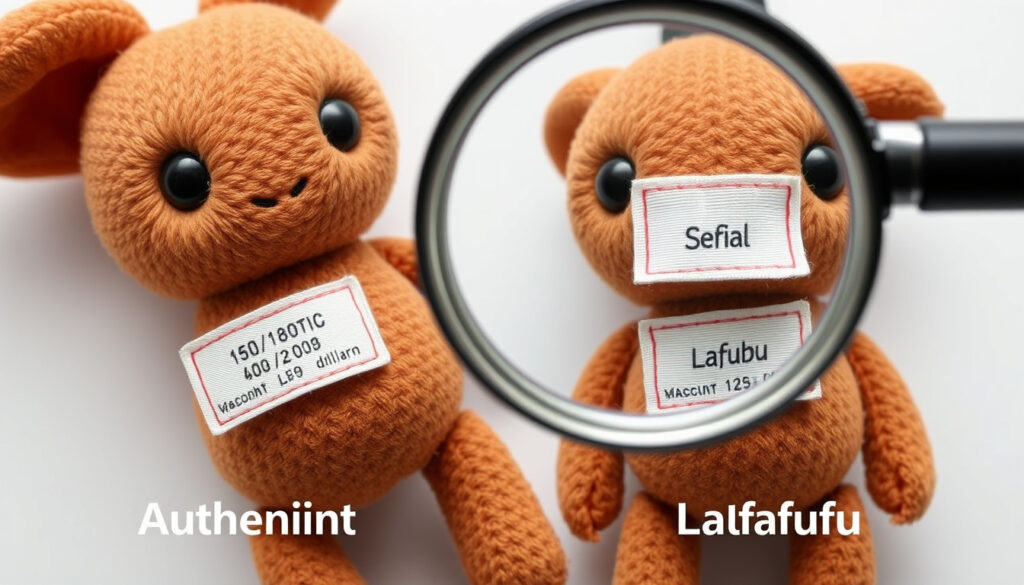
Real vs Fake Labubu: How to Spot a Lafufu and Verify Authenticity
Few collectible toys have sparked as much confusion as Labubu. If you’ve bought one recently and felt a knot of doubt after unwrapping it, you’re not alone — counterfeit versions, often called Lafufu, are flooding online marketplaces.
Real Labubu price range: $30–$50 ·
Fake Labubu price range: $5–$15 ·
Number of teeth on real Labubu: 4 ·
Head rotation of real Labubu: 360 degrees ·
Real box finish: Matte ·
Fake box finish: Glossy
Quick snapshot
- Real boxes are matte; fakes are glossy (BBC Bitesize explainer)
- Real Labubus have 4 teeth; fakes often have 2–3 (BBC Bitesize)
- Real head rotates 360° smoothly (Sidekicks editorial guide)
- Exact number of counterfeit variants in circulation (BBC Bitesize)
- Whether all fakes have glossy boxes or some mimic matte finishes (ViaHonest collector blog)
- Newer Labubu models include a UV-detectable mark on the foot (BBC Bitesize)
- Expect tighter QR-code verification and authentication app integration from POP MART (ABC News)
The table below summarizes the key differences between authentic and counterfeit Labubu figures.
| Attribute | Real Labubu | Fake Labubu (Lafufu) |
|---|---|---|
| Price | $30–$50 | $5–$15 |
| Teeth count | 4 | 2–3 |
| Head rotation | 360° | Limited or stuck |
| Box finish | Matte | Glossy |
| Bag material | Matte | Shiny |
| Holographic sticker | Present | Absent or low-quality |
The pattern: the most reliable physical checks are those that counterfeiters consistently fail to replicate.
How to tell Labubu from lafufu?
Three physical checks separate real from fake Labubu. Each one is reproducible without special tools and has been validated across multiple sources.
Check the box finish
- Real Labubu boxes use a matte finish with muted colors. The printing is sharp and the branding is crisp (BBC Bitesize (UK education service)).
- Fake boxes are glossy, overly vibrant, and often have blurry text or inconsistent fonts (Feltify collector guide).
- The cardboard on genuine boxes is thicker; fakes use thinner material that bends easily (ViaHonest collector blog).
Inspect the bag material
- Authentic Labubus come in a matte-finish plastic bag. The texture is smooth and subdued (BBC Bitesize).
- Counterfeit bags are shiny and reflective, a quick visual tell even before opening the box (Sidekicks editorial guide).
Compare the face details
- The real Labubu face is pale or peachy, not highly saturated (BestProducts lifestyle guide).
- Eyes are symmetrically placed with clear, glossy embedded plastic (BBC Bitesize).
- Fakes often have wonky eyes, uneven fur, or overly bright coloring (BBC Bitesize).
A glossy box alone should be enough to pause any purchase. POP MART’s matte finish is consistent across all authentic releases — there is no variation. Counterfeiters have not yet reproduced that matte texture convincingly.
The implication: the box is the single most accessible checkpoint for new buyers.
How do I verify my Labubu?
Three verification steps confirm authenticity. These methods are recommended by sellers, editorial guides, and POP MART’s own policy.
- Scan the QR code. Genuine Labubu boxes include a QR code that leads to one of POP MART’s official verification domains, such as fwsy.popmart.com or m-gss.popmart.com (Extrabux shopping guide). Fake QR codes may redirect to scam sites or generic error pages (Sidekicks editorial guide). Always cross-check the URL before tapping. If the domain is not official, the figure is counterfeit (Extrabux).
- Check the holographic sticker. Authentic POP MART products have a holographic sticker on the box, usually with a silver-white iridescent sheen (Sidekicks editorial guide). Fakes may have a plain sticker, no sticker, or a poorly duplicated hologram with dull colors (Feltify collector guide). The sticker itself is a strong signal but should be cross-referenced with the QR code (BBC Bitesize).
- Visit POP MART’s official verification. POP MART recommends buying only from its official retail stores, the POP MART app, Robo Shops, the official TikTok Shop, verified third-party storefronts, and official event booths (ABC News (US news outlet)). If you bought elsewhere, scan the QR code and follow the in-app verification flow. The app will confirm whether the code is registered (Extrabux shopping guide).
The pattern: each verification method cross-checks the others, making a single point of failure less likely.
Scammers are already printing fake QR codes that redirect to phishing sites. Always check the domain name matches POP MART’s official verification page — a valid code on the wrong domain is a scam.
How many teeth does a real Labubu have?
One fact divides real from fake more reliably than most: the teeth count. Every authentic Labubu has exactly four teeth — a design feature that counterfeiters consistently miss.
Count the teeth
- A real Labubu has exactly 4 teeth, evenly spaced and rounded (BBC Bitesize (UK education service)).
- Fake Labubus often have 2 or 3 teeth. Some have more, but the shape is uneven or jagged (Sidekicks editorial guide).
Look at the shape of the teeth
- The teeth on a genuine Labubu are consistently rounded at the tips, with a small mouth opening (BBC Bitesize).
- Counterfeit teeth may be sharp, malformed, or placed asymmetrically — a clear sign the mold was not sourced from POP MART (Sidekicks).
Two items, one pattern: the teeth count is the single most objective physical check. No interpretation needed — two rows of four rounded teeth is the only correct configuration.
What does a real Labubu look like?
The visual profile of a genuine Labubu is deliberately restrained. POP MART’s design language favors muted palettes and matte textures — details that counterfeit versions routinely flout.
Color and finish
- Real Labubus use muted colors — pale peach skin, soft grey-brown fur, and a matte overall finish (BBC Bitesize).
- Fake Labubus are often overly vibrant, with bright orange or saturated pink tones that look unnatural (BestProducts lifestyle guide).
- The blush on a genuine Labubu’s cheeks is smoothly blended, not harsh or blotchy (BBC Bitesize).
Size and proportions
- The standard blind-box Labubu stands about 9–10 cm tall, with consistent proportions across all authentic releases (Sidekicks editorial guide).
- Fakes may be slightly larger, slightly smaller, or asymmetrical — the proportions are off (BBC Bitesize).
Eyes and mouth details
- Eyes are black gloss embedded into the face, not painted on. They sit symmetrically and have a small white highlight dot in the same position on both eyes (BBC Bitesize).
- The mouth is a simple stitched line — neat, centered, and uniform in depth. Fakes often have crooked stitching or a mouth that is too wide (BBC Bitesize).
The implication: if the expression seems off or the colors are loud, it’s likely a Lafufu.
Do real Labubus head turn?
Head rotation is a reported feature, but it varies by edition. Here is what collectors have established.
Test the head rotation
- Many Labubu editions allow the head to rotate 360° smoothly on a firm joint (Sidekicks editorial guide).
- Some earlier or specific editions may have limited rotation. The joint should feel firm, not loose (BBC Bitesize).
Compare with fake head movement
- Counterfeit Labubus often have heads that do not turn at all, turn with a grinding feel, or wobble loosely (BBC Bitesize).
- If the head is stiff in only one direction or makes a clicking sound, that is a red flag (Sidekicks editorial guide).
The catch: edition variability means a stuck head is not always a fake, but it is a strong signal.
Confirmed facts vs unclear claims
After reviewing all available sources, here is what is well established and what remains uncertain.
Confirmed facts
- Real Labubu boxes are matte with muted colors. Fake boxes are glossy and overly vibrant (BBC Bitesize).
- Real Labubus have 4 teeth evenly spaced and rounded (BBC Bitesize).
- Real Labubu bags are matte; fake bags are shiny (BBC Bitesize).
- Real Labubus have a holographic POP MART sticker on the box (Sidekicks editorial guide).
- Real heads rotate 360° on a firm joint in most editions (Sidekicks editorial guide).
- QR codes on real boxes direct to POP MART’s official verification site (Extrabux shopping guide).
- POP MART advises buying only from official channels (ABC News).
What’s unclear
- Whether all counterfeit Labubus have glossy boxes, or some advanced fakes now mimic matte finishes (ViaHonest collector blog).
- Exact number of counterfeit variants in the market (BBC Bitesize).
- How many editions include the UV-detectable foot mark — it appears on newer models but the full list is not public (BBC Bitesize).
The pattern: the confirmed facts are actionable, the unclear claims are worth monitoring but not relying on.
Expert perspectives
Two sources provide practical, watch-level guidance for spotting fakes without specialized equipment.
“Real Labubu boxes have a matt finish and muted colours, while fakes are often glossy and overly vibrant.”
BBC Bitesize (UK education service)
“Grace Forell revealed key things to look for to ensure authenticity, including checking the head rotation and the material quality of the fur.”
Both sources converge on the same three checks: box finish, teeth count, and material quality. Any online seller that refuses to show these details in photos is a risk. Buyers should request clear images of the box side, the open mouth, and the bag material before committing.
The implication: these expert perspectives reinforce the same reproducible checks.
Related reading: how to spot fake Labubu · real vs fake Labubu
youtube.com, viahonest.com, youtube.com, youtube.com, reddit.com, sidekicks.co.uk, youtube.com
Frequently asked questions
What is a Lafufu?
Lafufu is the nickname collectors use for counterfeit Labubu dolls. The name is a playful corruption of Labubu and signals a fake product that mimics the original design (BBC Bitesize).
Are all fake Labubus called Lafufu?
Not all counterfeits carry the Lafufu label, but the term has become a catch-all in collector communities. Some fakes are sold under different names or as “dupes” (Sidekicks editorial guide).
Can I verify my Labubu using a scanner app?
Yes. Scan the QR code on the box and check that it resolves to an official POP MART domain like fwsy.popmart.com. If it redirects to a generic URL or an error page, the figure is likely counterfeit (Extrabux shopping guide).
Does the POP MART sticker guarantee authenticity?
The holographic sticker is a strong signal but not a guarantee. Some counterfeiters now print fake stickers. Cross-check the sticker with the QR code verification to confirm (BBC Bitesize).
Where can I buy authentic Labubu?
POP MART recommends buying from official retail stores, the POP MART app, Robo Shops, the official TikTok Shop, verified third-party storefronts, and official event booths (ABC News).
How much does a real Labubu cost?
Authentic blind-box Labubus typically range from $30 to $50 USD. Fakes often cost between $5 and $15 — a significant price gap that itself is a warning sign (BBC Bitesize).
What should I do if I bought a fake Labubu?
File a dispute with the platform you purchased from (eBay, Amazon, Shopify, etc.) citing the specific differences you found. Many platforms offer buyer protection for counterfeit items. Leave a review with photos to warn other buyers (ABC News).
The counterfeit Labubu market is not slowing down. For anyone buying through resale platforms or social media, the choice is clear: learn the physical checks — box finish, teeth count, bag material, head rotation, QR verification — or pay the price for a convincing fake. For collectors in the US and UK, that price is not just $5–$15. It is the frustration, the lost collectible value, and the risk of sharing payment details with a scam operator.
Buyers who rely only on price as a signal will likely be tricked by a well-priced fake. Buyers who learn the box and teeth checks have a near-zero false-positive rate. The trade-off is time spent learning versus money lost on counterfeits.
For the growing number of Labubu collectors in the US and UK, the decision is clear: invest 10 minutes learning the physical authentication checks — box finish, teeth count, bag material, head rotation, and QR verification — or risk paying $30 for a counterfeit worth $5. The counterfeit market will only get better at imitating packaging. Your best defense is reproducible, source-validated physical inspection.
More related posts
 Fast and Furious Tokyo Drift: Where to Watch, Cast, and Is It a Hit
 150 cm in Feet and Inches: Exact Conversion & Height Context
 Rainbow Six Siege Tracker: Best Stats Tools Compared
 Credit One Credit Card Review: Is It Worth It? (2025)
 Julie and the Phantoms Cast: Who Sings and Season 2 News
 When Calls the Heart: Where to Watch All Seasons & Cast Updates
 November Social Security Payments 2025: Full Schedule
 Septic Tank Repair Near Me: Irish Costs & Grants