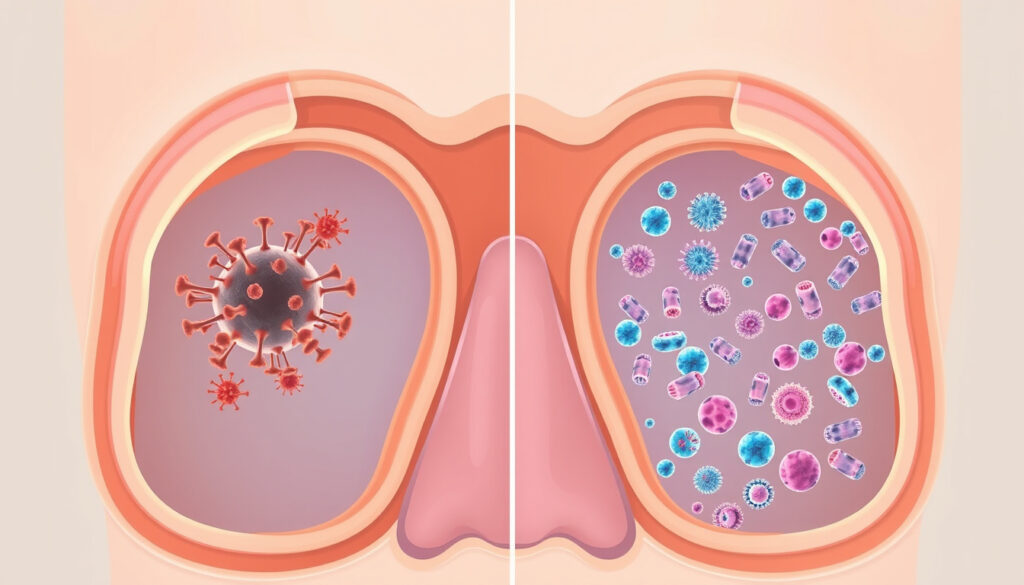
Is a Sinus Infection Contagious? Viral vs. Bacterial
Sitting across from a friend who’s sniffling and coughing, it’s hard not to wonder: is a sinus infection contagious? The answer isn’t a simple yes or no – the CDC notes that sinus infections themselves are generally not contagious, but the viruses that trigger them certainly can be. This article breaks down when you’re contagious, how to tell viral from bacterial, and what you can do to protect yourself and others.
Sinus infections per year in the US: 28.9 million adults · Percentage caused by viruses: Over 90% · Average duration of acute sinusitis: 7–10 days · Contagious period for viral sinusitis: First 3–5 days of symptoms · Bacterial sinusitis cases: 0.5–2% of viral cases
Quick snapshot
- Sinus infections themselves are not contagious (CDC, U.S. public health agency)
- Over 90% of acute sinusitis cases are viral (CDC)
- Most cold viruses are contagious for the first 3–5 days (Harvard Health, Harvard Medical School)
- The exact contagious window for each specific cold virus is not precisely defined (CDC)
- Whether kissing transmits the virus is not well-studied for all common cold viruses (Harvard Health)
- Days 1–3: Viral symptoms peak; highest contagion (NHS, UK health service)
- Days 4–7: Contagiousness declines but still possible (CDC)
- Day 10+: Symptoms persisting may indicate bacterial infection; contagiousness low (CDC)
- Monitor symptoms; if they last beyond 10 days or worsen, see a healthcare provider (CDC)
- Practice hand hygiene and respiratory etiquette to prevent spread (CDC)
Seven key facts about sinus infections, one pattern: the distinction between viral and bacterial causes determines nearly everything about contagiousness and treatment.
| Fact | Detail |
|---|---|
| Sinus infection definition | Inflammation or swelling of the tissue lining the sinuses (CDC) |
| Primary cause | Viral infection (over 90% of cases) (CDC) |
| Contagious mechanism | Spread via respiratory droplets, not sinus inflammation itself (CDC) |
| Typical duration acute viral sinusitis | 7–10 days (NHS) |
| Contagious period | First 3–5 days of symptoms (Harvard Health) |
| Treatment for viral | Rest, fluids, OTC pain relief (NHS) |
| Treatment for bacterial | Antibiotics if prescribed (CDC) |
| Prevention | Handwashing, covering coughs, avoiding close contact when symptomatic (CDC) |
Can you catch a sinus infection from someone?
Viral vs. bacterial origins
- Sinus infections themselves are not directly contagious – the viruses or bacteria that cause them can be (CDC).
- Most sinus infections start from a viral cold, which is contagious for the first few days (Harvard Health).
- Bacterial sinusitis is generally not spread from person to person (UCHealth, Colorado hospital system).
When the underlying cause is contagious
- If you have a runny nose, sneezing, or coughing from a cold, you can spread the virus (NHS).
- The inflammation in your sinuses is not what travels – it’s the respiratory droplets from sneezes and coughs (CDC).
The sinus infection itself isn’t contagious, but the cold virus that started it is – so treat the person as infectious, not the sinuses. Your risk comes from the virus, not the inflammation.
The implication: If you’re only dealing with sinus pressure and no cold symptoms, you’re likely not spreading anything. But if you’re also sniffling and coughing, you could be passing the virus to others.
How do I tell if my sinus infection is viral or bacterial?
Key symptom differences
- Viral sinusitis often improves within 7–10 days; bacterial sinusitis may persist or worsen after 10 days (CDC).
- Green or yellow mucus alone does not confirm bacterial infection (NHS).
- Fever, facial pain, and double sickening (feeling better then worse) are more suggestive of bacterial (UCHealth).
Duration and color of mucus
- If symptoms last less than 10 days and are mild, it’s likely viral (CDC).
- Bacterial sinusitis is more common when symptoms start to improve then worsen again (Harvard Health).
Relying on mucus color alone leads to overuse of antibiotics. The timeline – not the color – is a better predictor. Viral cases improve with time; bacterial cases don’t.
What this means: Wait 10 days before assuming bacterial. Most people with acute sinusitis will never need antibiotics – only about 0.5–2% of viral cases turn bacterial, per CDC estimates.
How long is a sinus infection contagious?
Contagious period for viral sinusitis
- Typical contagious window is 3–5 days from symptom onset (Harvard Health).
- You are most contagious when symptoms like runny nose and sneezing peak (NHS).
- After day 5, contagiousness drops sharply but may persist as long as symptoms last (CDC).
Contagiousness after starting antibiotics
- Antibiotics for bacterial sinusitis do not affect viral contagiousness (CDC).
- If the cause is bacterial, starting antibiotics does not mean you were contagious in the first place (UCHealth).
- For viral cases, antibiotics are useless, so taking them doesn’t change the contagious window (Harvard Health).
Starting antibiotics doesn’t make you non-contagious if the cause is viral – the virus still spreads for the first few days. You remain contagious until cold symptoms subside.
The pattern: Contagiousness is tied to cold symptoms, not sinus pressure. Once the runny nose and sneezing stop, you’re likely safe to be around others.
Should you stay away from people if you have a sinus infection?
Prevention tips
- Avoid close contact if you have fever, sneezing, or coughing (CDC).
- Hand hygiene and covering coughs reduce spread (CDC).
- Staying home during the first 3–5 days protects coworkers and friends (Harvard Health).
When it is safe to resume normal contact
- Once cold symptoms (runny nose, sneezing, cough) have resolved, you are no longer contagious (NHS).
- If only sinus pressure or headache remains, there is no risk of spreading the infection (CDC).
For someone with a sinus infection, the choice to stay home during the first few days is straightforward: you reduce the chance of spreading the virus to coworkers and give your body the best shot at recovery. The alternative? Prolonged illness and potentially passing the bug to others.
The takeaway: If you feel well enough to work but still have cold symptoms, wear a mask and keep distance. If only sinus pressure remains, you’re in the clear.
What kills a sinus infection naturally?
Home remedies: steam, saline rinses, hydration
- Saline nasal irrigation can relieve symptoms but does not cure the infection (CDC).
- Rest and fluids support the immune system (NHS).
- Inhaling steam from a bowl of hot water or a warm shower can loosen mucus and ease pressure (NHS).
- Using a humidifier keeps nasal passages moist and helps drainage (UCHealth).
When to seek medical treatment
- If symptoms persist beyond 10 days or worsen, see a doctor (CDC).
- Severe facial pain, high fever, or swelling around the eyes requires prompt medical attention (NHS).
- Natural remedies can help symptoms but do not replace antibiotics if bacterial infection is confirmed (Harvard Health).
Natural remedies relieve symptoms but don’t cure infections. If symptoms persist beyond 10 days or worsen, see a doctor. Delaying treatment for a bacterial case can lead to complications.
The trade-off: Home care is safe and often enough for viral sinusitis, but it carries a risk of under-treating a bacterial infection that needs antibiotics. Know the timeline.
Timeline of contagiousness
Three phases of a sinus infection, one pattern: the virus dictates spread.
| Period | What happens |
|---|---|
| Days 1–3 | Viral symptoms peak; highest contagion (NHS) |
| Days 4–7 | Contagiousness declines but still possible (CDC) |
| Day 10+ | Symptoms persisting may indicate bacterial infection; contagiousness low (CDC) |
Clarity: what we know and what remains uncertain
Confirmed facts
- Sinus infections themselves are not contagious (CDC)
- The viruses that cause most sinus infections are contagious (CDC)
- Antibiotics are only effective for bacterial sinusitis (CDC)
What’s unclear
- Exact duration of contagiousness for each specific virus is not precisely defined (Harvard Health)
- Whether kissing transmits the virus is not well-studied for all common cold viruses (CDC)
“Sinusitis itself is not contagious, but the viruses and bacteria that cause it can be.”
Cleveland Clinic (Cleveland Clinic, U.S. medical center)
“The answer is both yes and no. Sinus infections themselves are not contagious, but the underlying causes can be.”
Harvard Health Publishing (Harvard Health, Harvard Medical School)
For someone dealing with a sinus infection, the decision to stay home during the first few days is straightforward: you reduce the chance of spreading the virus to coworkers and give your body the best shot at recovery. The alternative is a week of missed work for the person who catches your cold – and a longer recovery for you if complications arise.
Related reading: How Long Do COVID Symptoms Last? Timeline & Recovery · How Do You Get Ringworm? Causes, Transmission, Treatment
afcurgentcare.com, bcbsm.mibluedaily.com, ascentent.com, dmvallergy.com, healthcareassociates.com, carolinaearnosethroat.com, drlapco.com, newingtonpharmacy.org.uk
Frequently asked questions
Are sinus infections contagious through kissing?
The virus that caused the sinus infection can be transmitted through close contact, including kissing, especially if the infected person has active cold symptoms. However, direct studies on kissing transmission for sinusitis are limited.
Do I need antibiotics for a sinus infection?
Only if a healthcare provider confirms a bacterial infection. Most sinus infections are viral and antibiotics will not help. Overuse of antibiotics contributes to resistance (CDC).
Can a sinus infection spread to the lungs?
In rare cases, the infection can spread to the lower respiratory tract, especially in people with weakened immune systems. Seek medical attention if you develop a productive cough or shortness of breath.
When should I see a doctor for a sinus infection?
If symptoms last more than 10 days, worsen after initial improvement, or include high fever, severe facial pain, or swelling around the eyes (NHS).
Can I go to work with a sinus infection?
If you have cold symptoms (runny nose, sneezing, cough), stay home for the first 3–5 days to avoid spreading the virus. If only sinus pressure remains, you can go back safely.
How can I prevent a sinus infection?
Wash hands regularly, avoid close contact with people who have colds, use a humidifier, and treat allergies promptly (CDC).
What is the difference between sinusitis and a cold?
A cold is a viral infection of the upper respiratory tract that often precedes sinusitis. Sinusitis is inflammation of the sinuses that can be triggered by a cold, allergies, or bacterial infection.
More related posts
 Go Karts Near Me: Ireland’s Top Venues & Costs
 What Does APR Mean? Understanding Annual Percentage Rate
 Matthew 17:21 Meaning, Why It’s Missing, and Fasting Rules
 Cast of Marvel Zombies: Voice Actors, Characters & Episode Guide
 Star Wars Battlefront 2 – Still Worth Playing in 2024
 Frontier Airlines Customer Service: Phone, Hours, Real Person
 What Causes Low Blood Sugar? Causes, Symptoms, and Treatment
 Graham Greene Actor Death: Cause, Ethnicity, Costner Reaction