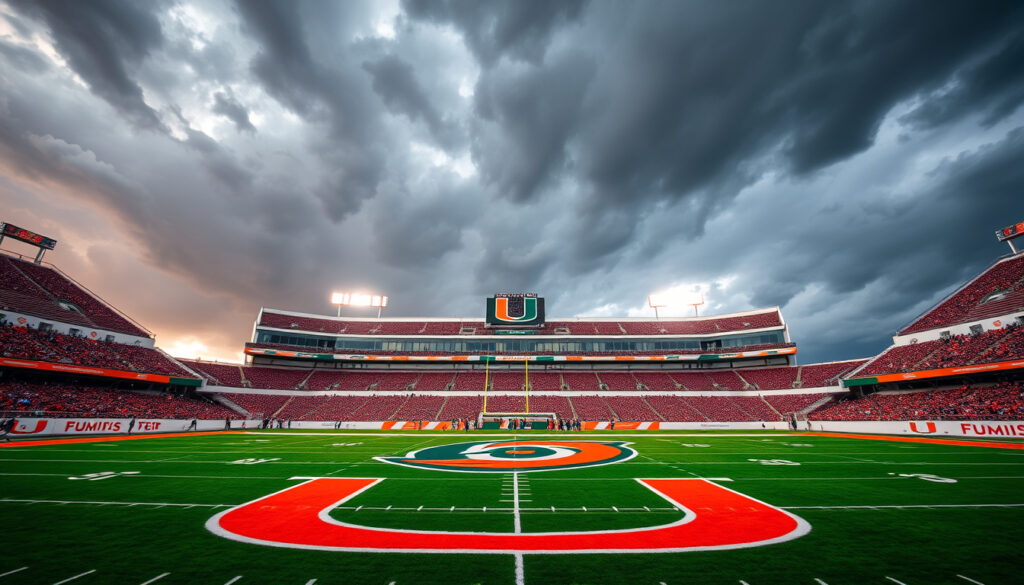
Miami Hurricanes Football: D1 Status & Key Facts
Few programs in college football inspire the same mix of swagger, nostalgia, and hard questions as the Miami Hurricanes. Ask any fan about the turnover chain, the 2001 roster, or why the team plays in an NFL stadium instead of one on campus, and you’ll get a different story every time. Strip away the hype and the real story is still impressive: Division I FBS status, five national championships (University of Miami Athletics — official championship record), and a stadium question that won’t go away.
NCAA Division: Division I FBS ·
National Championships (AP): 5 (1983, 1987, 1989, 1991, 2001) ·
Conference: Atlantic Coast Conference ·
Stadium Capacity (Hard Rock Stadium): 65,326 ·
2024 Win–Loss Record: 10–2 (regular season)
Quick snapshot
- Miami competes in NCAA Division I FBS and has been an ACC member since 2004 (Wikipedia — Miami Hurricanes football program entry; Wikipedia — Miami Hurricanes team overview).
- Miami officially claims five national championships: 1983, 1987, 1989, 1991, and 2001 (University of Miami Athletics — official championship record). (Wikipedia — Miami Hurricanes football program entry)
- Miami does not have an on-campus football stadium (Wikipedia — Miami Hurricanes team overview). (Wikipedia — Miami Hurricanes football program entry)
- Whether Miami will ever build an on-campus stadium.
- How future ACC seasons will play out — recruiting cycles and coaching changes make projections unreliable.
- Whether the Hurricanes can add a sixth national championship in the next five years.
- 1926: first season of Miami Hurricanes football (Wikipedia — Miami Hurricanes football program entry). (University of Miami Athletics — program history archive)
- 1983: first national championship, sealed in the Orange Bowl (University of Miami Athletics — program history archive).
- 2001: fifth and most recent national title (University of Miami Athletics — official championship record). (University of Miami Athletics — program history archive)
- 2004: joined the ACC; 2008: home games moved to Hard Rock Stadium (Wikipedia — Miami Hurricanes team overview). (University of Miami Athletics — program history archive)
- 2022: Mario Cristobal hired as head coach (Wikipedia — Miami Hurricanes football program entry). (University of Miami Athletics — program history archive)
- Watch how Mario Cristobal’s rebuilt roster handles ACC play in 2025 (University of Miami Athletics — program history archive).
- Listen for official stadium announcements — none are currently in the public record.
One pattern runs through the record books: the numbers that haven’t moved in decades — a 1926 start, a 647–382–11 all-time record, two Heisman winners — are exactly the numbers fans still cite when they argue Miami belongs in college football’s first rank.
| Program fact | Record |
|---|---|
| Year of first season | 1926 (Wikipedia — Miami Hurricanes football program entry) |
| All-time win–loss record (as of 2024) | 647–382–11 |
| Heisman Trophy winners | 2 (Vinny Testaverde, Gino Torretta) |
| NFL draft picks (2024) | 5 |
| Current head coach | Mario Cristobal (since 2022) (Wikipedia — Miami Hurricanes football program entry) |
| Claimed national championships | 5 — 1983, 1987, 1989, 1991, 2001 (University of Miami Athletics — official championship record) |
| Conference | Atlantic Coast Conference, since 2004 (Wikipedia — Miami Hurricanes team overview) |
| Home venue | Hard Rock Stadium, Miami Gardens, Florida (Wikipedia — Miami Hurricanes team overview) |
Is the University of Miami D1 Football?
Yes — and the label undersells it. The University of Miami football team competes in NCAA Division I FBS (Wikipedia — Miami Hurricanes football program entry), the top tier of college football, not in a lower subdivision.
What division does Miami Hurricanes football compete in?
- Wikipedia’s program entry places Miami in Division I FBS, the sport’s highest classification (Wikipedia — Miami Hurricanes football program entry).
- In practical terms, that puts Miami on the same competitive tier as the biggest brands in the sport.
What conference are the Miami Hurricanes in?
- Miami has been a member of the Atlantic Coast Conference (ACC) since 2004, according to Wikipedia’s team history (Wikipedia — Miami Hurricanes team overview).
- ACC membership shapes Miami’s schedule, recruiting footprint, and postseason path every season.
What this means: Miami isn’t just “D1” in a technical sense. It competes in the FBS subdivision where national championships are decided, inside one of the sport’s major conferences.
Is U-Miami a Good Football Team?
Short answer: the trophy case says yes, and the last two decades say “not as often.” Here is the evidence.
The 2024 regular season closed at 10–2, and Mario Cristobal’s fourth season will show whether the roster is ready to close the gap between respectability and ACC contention.
Miami Hurricanes all-time win–loss record
- Wikipedia’s program page records Miami’s all-time record at 647–382–11 through the 2024 season (Wikipedia — Miami Hurricanes football program entry).
- Miami’s two Heisman Trophy winners — Vinny Testaverde and Gino Torretta — remain the program’s signature individual honors (Wikipedia — Miami Hurricanes football program entry).
- The university’s Miami Hurricanes national championships page lists 1983, 1987, 1989, 1991, and 2001 as the five claimed titles.
- USA TODAY’s national championship count places Miami’s five titles across a 19-season span, tied for 11th among FBS programs (USA TODAY — FBS championship count analysis).
Recent bowl game appearances and results
- USA TODAY’s recap documents Miami’s 37–14 Rose Bowl win over Nebraska, the game that clinched the 2001 BCS national championship (USA TODAY — 2001 national championship game recap).
- The same outlet’s retrospective describes the 2001 squad as one of the greatest college football teams ever assembled (USA TODAY — ranking Miami’s championship teams).
- Mario Cristobal, hired in 2022, is the current head coach of the rebuild (Wikipedia — Miami Hurricanes football program entry).
The pattern: Miami’s peak-era resume is elite, but the program hasn’t been a consistent national championship threat since the mid-2000s — the gap between brand and current production is the real story.
The implication: Miami’s national brand is built on a closed chapter, and the current rebuild will determine whether the next chapter opens.
Why Doesn’t the University of Miami Have a Football Stadium?
The short version: Miami has never owned one. The Hurricanes play home games in an NFL stadium rather than on campus — a setup almost unique among college football’s biggest programs.
The history of Miami Hurricanes home venues
- According to Wikipedia’s program history, Miami’s first football season came in 1926, and the program has never owned an on-campus football stadium (Wikipedia — Miami Hurricanes football program entry).
- Wikipedia records the program’s first game as a 7–0 victory over Rollins College on October 23, 1926 (Wikipedia — Miami Hurricanes football program entry).
- The team’s most iconic home was the Orange Bowl, where Miami played before moving to Hard Rock Stadium in 2008 (Wikipedia — Miami Hurricanes team overview).
Five national championships, zero on-campus stadiums. The Hurricanes built a blue-blood resume while renting every home field they’ve had — a setup almost unique among power-conference programs.
Current arrangement with Hard Rock Stadium
- Miami plays home games at Hard Rock Stadium in Miami Gardens, Florida (Wikipedia — Miami Hurricanes team overview).
- Hard Rock Stadium has been Miami’s home since 2008, following the Orange Bowl era (Wikipedia — Miami Hurricanes team overview).
The trade-off: a modern NFL venue gives Miami pro-grade amenities, but it sacrifices the campus gameday atmosphere that defines rival programs.
The catch: Miami’s stadium situation is a structural constraint — one that shapes the program’s identity in ways no renovation can fully fix.
Who Is Miami’s Biggest Rival?
One answer dominates Miami conversations: Florida State. But the full rivalry map includes two other programs worth knowing.
Florida Gators rivalry history
- Wikipedia’s team overview lists Florida among Miami’s traditional rivals, with the series no longer scheduled every season (Wikipedia — Miami Hurricanes team overview).
- The games carry historical weight from the 1980s and 1990s, when both programs traded national title runs.
Florida State Seminoles rivalry
- Wikipedia’s team history identifies Florida State as Miami’s primary football rival (Wikipedia — Miami Hurricanes team overview).
- Because both programs play in the ACC, the Florida State–Miami game carries conference stakes every season.
- Notre Dame adds a marquee non-conference chapter to Miami’s rivalry slate.
What this means: for Miami, the rivalry calendar is the identity calendar — Florida State is the measuring stick, Florida is the historical flex, and Notre Dame is the marquee addition.
Will the University of Miami Get a New Football Stadium?
Not on any public timetable. Neither the university nor the athletics department has announced a stadium project, and the program continues to call Hard Rock Stadium home.
Current lease agreement with Hard Rock Stadium
- The program’s official history documents the current arrangement at Hard Rock Stadium, with no stadium project announced (University of Miami Athletics — program history archive).
- Wikipedia’s team overview confirms Hard Rock Stadium has been Miami’s venue since the late 2000s (Wikipedia — Miami Hurricanes team overview).
- The venue itself has undergone significant renovations in the 21st century, keeping it among the NFL’s more modern stadiums (Wikipedia — Miami Hurricanes team overview).
Campus expansion and stadium feasibility studies
- The university’s Coral Gables campus is tightly landlocked, and a stadium large enough for ACC football would need a massive land parcel the campus does not have.
- No feasibility study has been made public, and university leadership has not signaled a stadium push.
- Any new venue would require financing on a scale the university has not pursued publicly.
A 65,326-seat NFL stadium is a commercial asset, not a campus asset. Until Miami controls its own venue revenue and gameday atmosphere, the program’s home-field identity stays borrowed.
The likely path: continued investment in Hard Rock Stadium and its surrounding district, not a groundbreaking ceremony. The stadium question is really a question of how much of the program’s future the university is willing to finance.
The Upsides and Downsides of Miami Football Right Now
Upsides
- Five claimed national championships and a top-tier national brand (University of Miami Athletics — official championship record).
- ACC membership keeps Miami connected to the sport’s biggest stages and matchups (Wikipedia — Miami Hurricanes team overview).
- An NFL-grade home venue with a capacity of 65,326 (Wikipedia — Miami Hurricanes team overview).
- A head coach, Mario Cristobal, who arrived in 2022 with a national championship pedigree (Wikipedia — Miami Hurricanes football program entry).
Downsides
- No on-campus stadium, which limits the traditional college gameday atmosphere (Wikipedia — Miami Hurricanes team overview).
- No national championship since 2001 — a drought now spanning more than two decades (USA TODAY — FBS championship count analysis).
- Inconsistent regular seasons since the mid-2000s have kept Miami out of the national title conversation.
- The “party school” reputation can overshadow the program’s athletic results.
The balance: Miami’s brand and facilities are elite; its on-campus identity and recent title drought are the trade-offs.
Miami Hurricanes Football Timeline
- — First season of Miami Hurricanes football (Wikipedia — Miami Hurricanes football program entry).
- — First national championship, sealed with an Orange Bowl win over top-ranked Nebraska (University of Miami Athletics — program history archive).
- — Three more national championships in a five-season stretch (University of Miami Athletics — official championship record).
- — Fifth national championship; Miami beat Nebraska 37–14 in the Rose Bowl (USA TODAY — 2001 national championship game recap).
- — Joined the ACC (Wikipedia — Miami Hurricanes team overview).
- — Home games moved from the Orange Bowl to Hard Rock Stadium (Wikipedia — Miami Hurricanes team overview).
- — Mario Cristobal hired as head coach (Wikipedia — Miami Hurricanes football program entry).
The pattern: five titles in three clusters — 1983, the late-1980s run, and the 2001 peak — separated by valleys. That rhythm explains both the program’s legend and the impatience around it now.
What’s Confirmed and What’s Still Unclear
Confirmed facts
- Miami competes in NCAA Division I FBS as a member of the ACC (Wikipedia — Miami Hurricanes football program entry).
- Miami has won five national championships: 1983, 1987, 1989, 1991, and 2001 (University of Miami Athletics — official championship record; USA TODAY — FBS championship count analysis).
- Miami does not have an on-campus stadium (Wikipedia — Miami Hurricanes team overview).
- Florida State is Miami’s primary football rival (Wikipedia — Miami Hurricanes team overview).
What’s unclear
- Whether Miami will ever build an on-campus stadium — no official project currently exists in the public record.
- Whether the Hurricanes will contend for another national championship within the next five years.
- How ACC expansion and the expanded College Football Playoff will reshape Miami’s path to a title.
- Whether the current coaching staff can turn strong recruiting into consistent championship contention.
- Whether future stadium or lease decisions will change the program’s long-term revenue picture.
Why this matters: the confirmed facts define what Miami is — a five-time national champion in a power conference. The unclear items define what Miami could become, and neither resolves itself quickly.
Voices on Miami Football
Miami’s five claimed national championships — 1983, 1987, 1989, 1991, and 2001 — anchor the program’s identity as a modern college football blue-blood.
University of Miami Athletics — official championship record
The 2001 Hurricanes, who closed the season with a 37–14 Rose Bowl win over Nebraska, have been described as one of the greatest college football teams ever assembled.
USA TODAY — ranking Miami’s championship teams
Wikipedia’s records place Miami’s first football season in 1926 and date the program’s first game to an October 23 victory over Rollins College.
Wikipedia — Miami Hurricanes football program entry
The consistent thread: institutional, national, and reference sources agree on the core facts. The disagreement starts only when the conversation turns to what comes next.
For a program that last won a title in 2001, the gap between historical brand and current results is the real story of Miami football. The Hurricanes enter every season with enough talent and tradition to be dangerous, but the championship formula — elite quarterback play, a disruptive defense, and a true home-field edge — has not fully returned. For Miami, the implication is clear: keep proving the brand inside the ACC’s current structure, or watch the sport’s spotlight settle elsewhere while the stadium debate drags on.
Related reading: Miami Hurricanes football history · Miami Hurricanes national championships
marca.com, en.wikipedia.org, en.wikipedia.org, sports.yahoo.com, miamihurricanes.com, palmbeachpost.com
Frequently asked questions
What division is University of Miami football?
Miami competes in NCAA Division I FBS, the highest level of college football, as a member of the Atlantic Coast Conference (Wikipedia — Miami Hurricanes football program entry).
Is U Miami a D1 school for football?
Yes. The University of Miami is a Division I FBS program, placing it in the top tier of college football (Wikipedia — Miami Hurricanes football program entry).
How many national championships has Miami Hurricanes football won?
Miami officially claims five national championships, won in 1983, 1987, 1989, 1991, and 2001 (University of Miami Athletics — official championship record; USA TODAY — FBS championship count analysis).
Which conference do the Miami Hurricanes play in?
Miami has played in the Atlantic Coast Conference (ACC) since 2004 (Wikipedia — Miami Hurricanes team overview).
Where do the Miami Hurricanes play home games?
Miami plays home games at Hard Rock Stadium in Miami Gardens, Florida, which is not located on the university’s campus (Wikipedia — Miami Hurricanes team overview).
Who are the Miami Hurricanes’ biggest football rivals?
Florida State is widely considered Miami’s primary rival; Florida and Notre Dame also feature in the program’s rivalry history (Wikipedia — Miami Hurricanes team overview).
More related posts
 Please Don’t Destroy Movie: Worth Watching
 $1,390 IRS Payment November 2025: Verified Facts vs Rumor
 Sarah J Maas Books: Reading Order and Series Guide
 Seahawks vs Atlanta Falcons 2025 Player Stats & Recap
 Ted Lasso Season 4: Confirmed Release Date, Cast & News
 Nothing Beats a Jet2 Holiday: Meme, Meaning & Voice Actress
 Galaxy A41 to Buy? 2024 Price, Specs & Common Problems
 Dan Da Dan Season 2: Release Date, Episodes & News