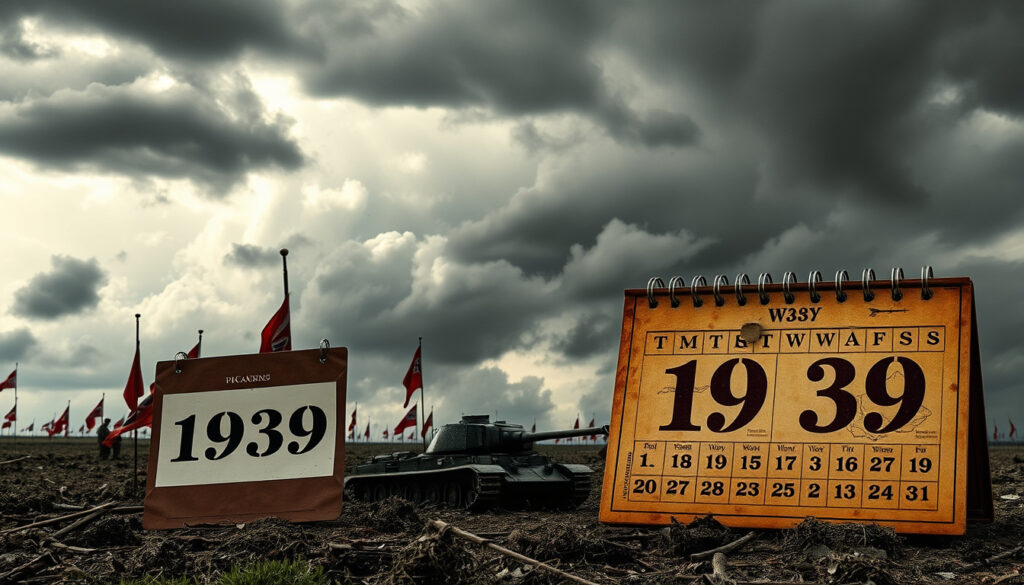
When Was World War 2? Dates, Causes, and End Explained
World War II started at different times in Europe and Asia, beginning on September 1, 1939, with Germany’s invasion of Poland (United States Holocaust Memorial Museum (official museum and education center)), while Japan had been waging war in China since 1937 (PBS (public broadcaster)). This article breaks down the key dates, causes, and players to give you a clear picture.
Duration: 6 years (1939 to 1945) ·
Start of European War: September 1, 1939 (German invasion of Poland) ·
Major Combatants: Allied Powers vs. Axis Powers ·
Estimated deaths: 70–85 million (including civilians) ·
War in the Pacific began: December 7/8, 1941 (Attack on Pearl Harbor) ·
Official end in Europe: May 8, 1945 (V-E Day)
Quick snapshot
- World War II began on September 1, 1939 (United States Holocaust Memorial Museum)
- The war in Europe ended on May 8, 1945 (V-E Day) (Encyclopaedia Britannica (reference publisher))
- The war in the Pacific ended on September 2, 1945 (V-J Day) (HISTORY (editorial publisher))
- Estimated total deaths: 70–85 million (Encyclopaedia Britannica)
- Exact total death toll varies across sources (70–85 million) (Encyclopaedia Britannica)
- Which country suffered worst is subjective — Soviet Union had highest absolute deaths, Poland had highest proportional (United States Holocaust Memorial Museum)
- Counterfactual outcome if US hadn’t entered remains speculative (HISTORY)
- September 1, 1939: Germany invades Poland (United States Holocaust Memorial Museum)
- June 22, 1941: Operation Barbarossa — Germany invades USSR (Encyclopaedia Britannica)
- December 7, 1941: Japan attacks Pearl Harbor (Franklin D. Roosevelt Presidential Library (presidential archives))
- June 6, 1944: D-Day — Allied invasion of Normandy (HISTORY)
- May 8, 1945: Germany surrenders (United States Holocaust Memorial Museum)
- September 2, 1945: Japan surrenders (Encyclopaedia Britannica)
- Post-war: Nuremberg Trials prosecuted Nazi leaders (United States Holocaust Memorial Museum)
- The Cold War began between the US and USSR (Encyclopaedia Britannica)
- The United Nations was founded in 1945 to prevent future conflicts (United Nations (international organization))
Five key facts, one pattern: the conflict’s duration and death toll dwarfed all previous wars in history.
| Attribute | Value | Source |
|---|---|---|
| Duration | 6 years | USHMM |
| Start date | September 1, 1939 | Britannica |
| End date (Europe) | May 8, 1945 | HISTORY |
| End date (Pacific) | September 2, 1945 | Britannica |
| Total deaths | 70–85 million | Britannica |
When did World War II start and end?
World War II in Europe: 1939 to 1945
- The war in Europe began on September 1, 1939, when Germany invaded Poland (United States Holocaust Memorial Museum).
- Britain and France declared war on Germany on September 3, 1939 (Encyclopaedia Britannica).
- Germany surrendered unconditionally on May 7–8, 1945, celebrated as V-E Day (HISTORY).
World War II in the Pacific: 1941 to 1945
- Japan attacked Pearl Harbor on December 7, 1941, bringing the United States into the war (Franklin D. Roosevelt Presidential Library).
- The war in the Pacific ended with Japan’s surrender on September 2, 1945, after atomic bombs were dropped on Hiroshima (August 6) and Nagasaki (August 9) (Encyclopaedia Britannica).
The implication: The split start and end dates reflect a truly global war that unfurled at different times across theaters, shaping the modern world order.
What started World War II and why?
The Treaty of Versailles and German resentment
- The Treaty of Versailles (1919) imposed heavy reparations, territorial losses, and a war-guilt clause on Germany (Encyclopaedia Britannica).
- This fueled deep resentment and economic hardship, which Adolf Hitler exploited to rise to power (HISTORY).
Adolf Hitler’s expansionist policies
- Hitler pursued aggressive territorial expansion: the annexation of Austria in 1938 and the occupation of Czechoslovakia in 1939 (Encyclopaedia Britannica).
- He outlined his ambitions in Mein Kampf and systematically rearmed Germany in violation of the Treaty (United States Holocaust Memorial Museum).
Invasion of Poland as the trigger
- Germany invaded Poland on September 1, 1939, after signing the Molotov-Ribbentrop Pact that ensured Soviet non-intervention (Encyclopaedia Britannica).
- Britain and France, having guaranteed Poland’s borders, declared war on Germany on September 3, 1939 (HISTORY).
The Treaty of Versailles didn’t just punish Germany—it created the conditions for a second, far deadlier war. For historians, the lesson is that punitive peace deals can backfire catastrophically.
The pattern: A chain of unresolved grievances, unchecked aggression, and a flawed peace treaty combined to create a flashpoint that pulled the entire world into war.
Which countries were involved in World War II?
Allied Powers
- The major Allied powers were the United States, the United Kingdom, the Soviet Union, China, and France (Encyclopaedia Britannica (summary)).
- More than 50 countries eventually joined the Allies, including Canada, Australia, India, and many occupied nations (United States Holocaust Memorial Museum).
Axis Powers
- The main Axis powers were Germany, Italy, and Japan (Encyclopaedia Britannica).
- Other Axis members included Hungary, Romania, Bulgaria, and several client states (HISTORY).
Neutral countries
- A small number of countries remained neutral, including Switzerland, Sweden, Spain, Portugal, and Turkey (Encyclopaedia Britannica).
Neutrality often came with a cost: these countries were pressured by both sides, and some (like Sweden) traded with Nazi Germany while officially staying out of the conflict.
What this means: World War II was a global war in the truest sense—almost every independent state was involved either directly or indirectly, making it the most widespread conflict in history.
How did WWII actually end?
End of the war in Europe: Germany’s surrender
- Germany surrendered unconditionally on May 7, 1945 at Reims, France, with the surrender taking effect on May 8 (V-E Day) (United States Holocaust Memorial Museum).
- Adolf Hitler had committed suicide on April 30, 1945, as Soviet forces closed in on Berlin (Encyclopaedia Britannica).
End of the war in the Pacific: atomic bombs and Japan’s surrender
- The United States dropped atomic bombs on Hiroshima on August 6, 1945, and on Nagasaki on August 9, 1945 (United States Holocaust Memorial Museum).
- Japan announced its surrender on August 15, 1945, and formally signed the Instrument of Surrender on September 2, 1945, aboard the USS Missouri — V-J Day (Encyclopaedia Britannica).
The catch: The war in Europe ended with a clear military defeat, but the Pacific war ended with a weapon that changed the nature of conflict forever—the atomic bomb, whose use remains a subject of intense debate.
Who won World War II?
Allied victory over the Axis powers
- The Allied Powers—led by the US, UK, USSR, and China—decisively defeated the Axis Powers (Encyclopaedia Britannica).
- Germany surrendered unconditionally; Japan surrendered unconditionally; Italy switched sides in 1943 after Mussolini was ousted (HISTORY).
Which country lost World War II?
- The major Axis powers—Germany, Japan, and Italy—were the losers. Their governments were dissolved, territories occupied, and leaders prosecuted for war crimes (United States Holocaust Memorial Museum).
Why this matters: The defeat of the Axis powers reshaped global politics: the United States and Soviet Union emerged as superpowers, Europe was divided, and the United Nations was created to prevent another world war.
Which country suffered the worst in WWII?
Human cost by country
- The Soviet Union suffered the highest number of casualties, with an estimated 20–27 million deaths (United States Holocaust Memorial Museum).
- Poland also experienced massive civilian and military losses, including the Holocaust, and suffered the highest proportional losses relative to its population (United States Holocaust Memorial Museum).
The Soviet Union’s losses
- Military deaths are estimated at 8.7–10.7 million, and civilian deaths at 15–20 million due to war, famine, and atrocities (United States Holocaust Memorial Museum).
- Poland lost about 6 million people, including 3 million Polish Jews, representing about 17% of its prewar population (United States Holocaust Memorial Museum).
The human toll: The war’s deadliest impact fell on the Soviet Union and Poland, with losses that still shape national memory and policy today.
Which country was blamed for starting WWII?
The Treaty of Versailles and the war guilt clause
- The Treaty of Versailles assigned sole responsibility for World War I to Germany, but it was Nazi Germany under Hitler that initiated the invasion of Poland, starting World War II in Europe (Encyclopaedia Britannica).
- Historians generally agree that while multiple factors led to the war, Nazi Germany’s aggression was the proximate cause (HISTORY).
Hitler’s role and Nazi Germany’s aggression
- Adolf Hitler’s expansionist policies and racist ideology drove Germany’s annexation of Austria, occupation of Czechoslovakia, and ultimately the invasion of Poland (United States Holocaust Memorial Museum).
The implication: The “blame” is not just historical—it shaped the post-war order, with Germany accepting responsibility and paying reparations, while Japan’s role remains a sensitive issue in East Asian diplomacy.
Timeline of World War II
- September 1, 1939 — Germany invades Poland; WWII begins. (USHMM)
- June 22, 1941 — Germany invades the Soviet Union (Operation Barbarossa). (Britannica)
- December 7, 1941 — Japan attacks Pearl Harbor; US enters the war. (FDR Library)
- June 6, 1944 — D-Day: Allied invasion of Normandy. (HISTORY)
- May 8, 1945 — V-E Day: Germany surrenders. (USHMM)
- September 2, 1945 — V-J Day: Japan surrenders, war ends. (Britannica)
The pattern: Each milestone escalated the conflict further, from a European invasion to a global conflagration.
Clarity check: What we know vs. what remains uncertain
Confirmed facts
- WWII started on September 1, 1939, with the German invasion of Poland (USHMM)
- WWII ended in 1945 (Europe: May 8; Pacific: September 2) (Britannica)
- Germany, Japan, and Italy were the main Axis powers (Britannica)
- Allied victory was decisive and unconditional (HISTORY)
What’s unclear
- Exact total death toll varies across sources (70–85 million) (Britannica)
- Which country “suffered worst” is subjective; Soviet Union had highest absolute deaths, Poland highest proportional (USHMM)
- Counterfactual outcome if US hadn’t entered remains speculative (HISTORY)
- The exact start date of the Pacific war is debated (1937 vs 1941) (PBS)
The balance: While key dates are settled, precise human cost and some counterfactuals remain under debate.
“World War II began in Europe on September 1, 1939, with the German invasion of Poland.”
— United States Holocaust Memorial Museum (source)
“World War was an international conflict that involved virtually every part of the world. The principal belligerents were the Axis powers—Germany, Italy, and Japan—and the Allies—France, Great Britain, the United States, the Soviet Union, and, to a lesser extent, China.”
— Encyclopaedia Britannica (source)
For students of history, the clear lesson is that the combination of unresolved grievances from World War I, expansionist ambitions, and failed diplomacy led directly to the deadliest conflict in human history. The choice is not just to memorize dates, but to understand the patterns of escalation. For anyone trying to learn from the past, the implication is clear: addressing the root causes of conflict early is essential, or the cost in human lives becomes immeasurable.
en.wikipedia.org, historyextra.com, thecollector.com, britannica.com, thoughtco.com, pbs.org, sites.google.com
Frequently asked questions
What was the main cause of World War II?
The main cause was the aggressive expansionism of Nazi Germany under Adolf Hitler, fueled by resentment over the Treaty of Versailles and the failure of appeasement. The immediate trigger was the German invasion of Poland on September 1, 1939 (Britannica).
How long did World War II last?
The war lasted 6 years, from September 1, 1939, to September 2, 1945, though the fighting in the Pacific began later for the United States (USHMM).
Did World War II end in 1945?
Yes, the war ended in 1945. Germany surrendered on May 8 (V-E Day) and Japan surrendered on September 2 (V-J Day) (Britannica).
Which countries were part of the Axis powers?
The main Axis powers were Germany, Italy, and Japan. Other members included Hungary, Romania, Bulgaria, and several puppet states (Britannica).
Which country lost the most soldiers in World War II?
The Soviet Union suffered the highest military and civilian losses, with an estimated 20–27 million deaths. Poland also suffered proportionally huge losses (USHMM).
When did the US enter World War II?
The US entered the war on December 8, 1941, after Japan attacked Pearl Harbor on December 7. Germany and Italy declared war on the US on December 11 (FDR Library).
Related reading
More related posts
 Cast of Marvel Zombies: Voice Actors, Characters & Episode Guide
 3/8 Inch to mm – Exact 9.525 mm Value, Formula & Chart
 Dark Side of the Ring Season 7: Premiere, Episodes, Streaming
 Demon Slayer Movie Release Date – Hashira Training Timeline 2024
 What Does Ozempic Do? Weight Loss, Results & Side Effects
 What Is a Cash Advance? Fees, APR & Credit Impact
 Pdf Editor Online Free – Best No Watermark Tools 2025
 Redmi Note 11 Pro 5G to Buy – Prices, Deals and Availability