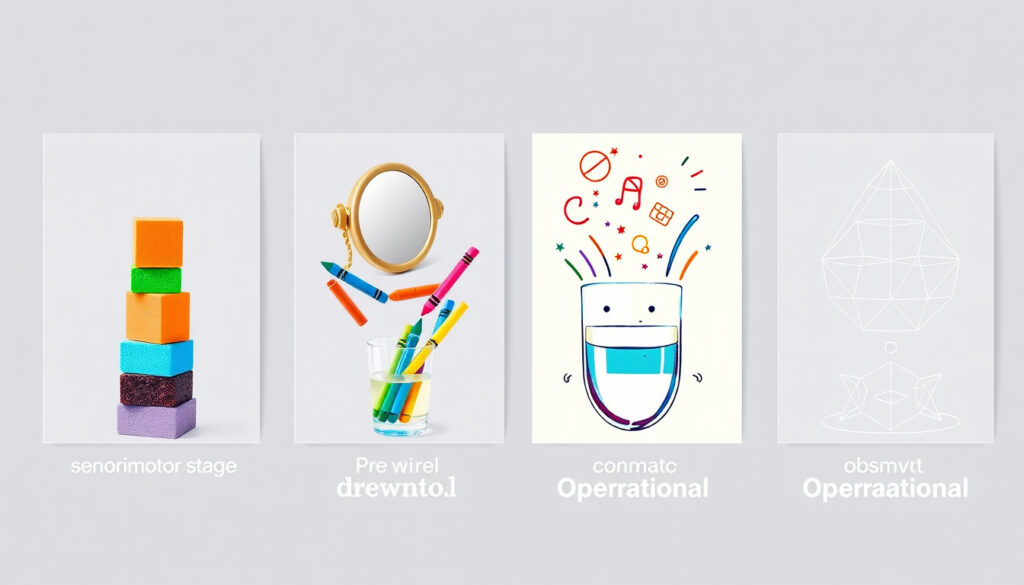
Piaget’s Theory of Cognitive Development: 4 Stages Explained
If you’ve ever watched a toddler drop a spoon from a high chair — again and again, eyes wide with fascination — you’ve witnessed a psychologist’s puzzle in action. That repetitive drop is not mischief; it’s a child testing whether the spoon still exists when it leaves sight.
Jean Piaget spent decades documenting exactly these moments, building a theory that still shapes how classrooms work today. Below, you’ll find a clear breakdown of Piaget’s four cognitive stages, what they mean for teachers, and where the theory still sparks debate.
Stages Proposed: 4 · Key Stages: Sensorimotor, Preoperational, Concrete Operational, Formal Operational · Developer: Jean Piaget · Core Concepts: Schemas, Assimilation, Accommodation · Focus: Progression of Children’s Thinking
Quick snapshot
- Four stages universally recognized (NCBI StatPearls)
- Stage names and age ranges from primary sources (Simply Psychology)
- Exact publication year variations across Piaget’s works (Simply Psychology)
- Whether cultural contexts shift stage timing in non-Western settings (ERIC)
- 1967 Plowden Report applied Piaget’s ideas to UK education policy (Simply Psychology)
- Modern tech integration in early years reflects ongoing adaptation (He Kupu)
- Educators weighing Piaget against Vygotsky’s social learning model (Teach HQ)
- Play-based curricula increasingly informed by Piaget’s readiness principles (Gowrie NSW)
The table below consolidates core facts about Piaget’s framework for quick reference.
| Label | Value |
|---|---|
| Proposer | Jean Piaget (NCBI StatPearls) |
| Number of Stages | 4 (NCBI StatPearls) |
| First Stage Age | Birth to 2 years (Simply Psychology) |
| Last Stage Age | 12 years and up (Simply Psychology) |
| Core Idea | Children actively construct knowledge (NCBI StatPearls) |
What is the Piaget theory of cognitive development?
Piaget’s theory proposes that children progress through four distinct stages of cognitive development, each marked by characteristic ways of thinking and understanding the world. Rather than passively receiving information, children actively build knowledge through interaction with their environment — a process driven by innate developmental mechanisms (NCBI StatPearls). This framework remains one of the most influential explanations of how human intelligence develops from infancy through adolescence.
Effective teaching must take account of the child’s stage of cognitive development.
— Simply Psychology, Psychology Resource
The theory rests on a few core ideas. Schemas are mental frameworks that help children organize and interpret information. When a toddler sees a cup and knows it can hold liquid, that’s a schema at work. When new information arrives, children either assimilate it — fitting it into an existing schema — or accommodate it — adjusting the schema to make room for something new (NCBI StatPearls). This push and pull between old understanding and new experience creates what Piaget called equilibration, the engine of cognitive growth.
Simple definition of cognitive development
Cognitive development refers to how children build their capacity to think, reason, and solve problems over time. Piaget saw it as a progression through qualitatively different stages, not just a steady accumulation of facts. Each stage brings new capabilities that weren’t possible before — a shift that happens when biological maturation meets the right kind of experience.
Main focus of Piaget’s cognitive theory
The main focus is developmental readiness. Piaget argued that children can only learn certain concepts when their cognitive structures are mature enough to handle them. This idea directly shaped educational practice: instruction must match where the child actually is, not where curriculum designers assume they should be (eSchool News).
Teachers who understand Piaget’s stages can avoid the common mistake of introducing abstract concepts before children have the cognitive scaffolding to grasp them. The cost of mismatched instruction isn’t just confusion — it’s lost momentum in a child’s learning trajectory.
What are the 4 stages of cognitive development Piaget proposed?
Piaget identified four stages that unfold in a fixed sequence — no stage can be skipped, and each builds on the last. The ages associated with each stage are approximate benchmarks, not strict deadlines. Children progress at different rates, and some may not reach the later stages depending on individual development and opportunity (Simply Psychology).
The stages break down into four distinct phases with characteristic capabilities at each age range.
| Stage | Age Range | Key Characteristics |
|---|---|---|
| Sensorimotor | Birth to 2 years | Sensory exploration, trial-and-error learning, object permanence |
| Preoperational | 2 to 7 years | Symbolic thinking, egocentrism, imaginative play |
| Concrete Operational | 7 to 11 years | Logical thinking about concrete objects, conservation, seriation |
| Formal Operational | 12 years and up | Abstract reasoning, hypothetical thinking, systematic problem-solving |
The implication is that curriculum designers and teachers cannot assume linear progression based on age alone — they must assess each child’s cognitive readiness individually.
Sensorimotor stage
During the sensorimotor stage, infants learn about the world through their senses and motor actions. They suck, grasp, look, and listen — building schemas through direct physical interaction. A critical milestone emerges around 8 months: object permanence, the understanding that objects continue to exist even when out of sight (University HQ). Before this develops, a hidden toy is simply gone — a puzzling absence for a child who hasn’t yet built the schema for object permanence.
Symbolic function — the ability to use mental symbols to represent objects — begins to emerge between 18 and 24 months, signaling the transition toward the next stage (Simply Psychology).
Preoperational stage
Toddlers and young children in the preoperational stage become capable of symbolic thought. They can use words to represent objects, engage in pretend play, and create mental images of things not currently present. However, thinking remains egocentric — young children assume others see the world exactly as they do. A child at this stage may cover their eyes during hide-and-seek, genuinely believing that if they can’t see others, others cannot see them (Simply Psychology).
Classroom applications at this stage focus on role-playing, hands-on activities with symbols, and perspective-taking exercises to gently expand beyond egocentrism (Simply Psychology).
Concrete operational stage
Children aged 7 to 11 years enter the concrete operational stage, gaining the ability to think logically about concrete, tangible problems. They master conservation — understanding that quantity stays the same despite changes in appearance (a liter of water poured into a taller, thinner glass is still a liter). Seriation — arranging items in order by a property like size — develops around ages 7 to 9 (Simply Psychology).
Teaching strategies at this stage use classification tasks, simple experiments, and conservation tasks that challenge children to apply logical operations to physical materials (Simply Psychology).
Formal operational stage
Adolescents from roughly 12 years onward enter the formal operational stage, where abstract and hypothetical reasoning becomes possible. They can consider “what if” scenarios, think systematically about possibilities, and reason about relationships between ideas rather than just objects (University HQ). Scientific thinking, philosophical inquiry, and long-term planning all become accessible in ways they weren’t during the concrete stage.
Development is not uniform. A 10-year-old may reason like an adult about concrete problems but struggle with abstract ones — and that’s exactly what Piaget’s framework predicts. Expecting formal operational thinking from a child in the concrete stage sets up frustration for everyone.
What is a short summary of Piaget’s theory?
Piaget’s theory can be summarized in a few core principles. Children’s thinking becomes more advanced through a combination of biological maturation and interaction with the environment. Knowledge is not received passively — it is constructed through active engagement with the world. Development progresses in a fixed sequence of qualitatively different stages, each requiring the previous one as a foundation (Simply Psychology).
Piaget’s theory emphasizes the importance of developmental readiness and individualized instruction.
— eSchool News, Education Publication
Piaget called his approach genetic epistemology — the study of how knowledge develops in humans, particularly children. Through careful observation and clinical interviews with subjects ranging from infants to teenagers, he mapped the progression of cognitive structures that enable increasingly complex thought (Gowrie NSW).
Key principles
Three key principles emerge from the theory. First, children are active learners who build knowledge through interaction rather than passive absorption. Second, cognitive development occurs in a sequence of stages, each characterized by distinct mental structures. Third, learning is driven by disequilibrium — when new experiences conflict with existing schemas, children are motivated to restore balance by either adjusting old ideas or building new ones (NCBI StatPearls).
Genetic epistemology
Piaget coined the term “genetic epistemology” to describe his investigation into the origins and development of knowledge itself. His work blended biology, psychology, and philosophy, arguing that intelligence evolves according to biological laws — but only when children encounter the right kinds of experiences at the right developmental moments (NCBI StatPearls).
What are some examples of Piaget’s theory?
Concrete examples make Piaget’s abstract stages tangible. In a classroom setting, each stage requires different kinds of activities and different expectations from educators.
Schemas and examples
Consider a child’s schema for “bird.” A toddler’s initial schema might be simple: birds are things that fly. When that child encounters a penguin and sees it cannot fly, a conflict arises. The child may assimilate the penguin into the bird schema despite the discrepancy, or accommodate by creating a new category — a process that demonstrates how schemas evolve through experience (Simply Psychology).
For object permanence in the sensorimotor stage, peek-a-boo is a classic example. When a parent’s face disappears behind hands, the infant learns through repetition that the face still exists — it’s just hidden. This simple game builds a foundational cognitive schema that later enables more complex understanding.
Real-world applications
Piaget’s theory has shaped educational practice for decades. The UK’s 1967 Plowden Report explicitly recommended Piaget-informed age-appropriate activities, leading to widespread use of hands-on manipulatives and discovery-based learning in primary education (Simply Psychology). In early childhood settings, sensory-rich experiences like tactile play, water tables, and textured materials support schema development during the sensorimotor stage (Simply Psychology).
Technology integration in early childhood settings also reflects Piaget’s principles. When educators set up intentional digital and physical resources, they create conditions for children to test, experiment, and build schemas — whether through touchscreens or traditional toys (He Kupu).
The pattern shows that educator assumptions about readiness often lag behind what children can actually accomplish when given appropriate support.
Piaget’s critics argue that the theory underestimates what children can achieve, particularly in cultures or contexts that emphasize collaborative learning. Children in some settings reach formal operational thinking earlier — or not at all, depending on the demands placed on them.
What are the 4 elements of Piaget’s theory?
Piaget’s framework rests on four interconnected elements that together explain how cognitive development unfolds. These elements — schemas, assimilation, accommodation, and equilibration — form the basic machinery of his theory.
Schemas
Schemas are the mental building blocks through which children organize knowledge. Each schema is a coherent cluster of concepts, actions, and expectations that a child uses to interpret and interact with the world. As children encounter new experiences, they either fit new information into existing schemas or modify schemas to accommodate the new data (Gowrie NSW).
Assimilation and accommodation
Assimilation and accommodation are the twin adaptive processes driving cognitive development. Assimilation integrates new information into existing schemas without changing the schema itself — a child who knows dogs and encounters a cat may call it a “dog” until the schema expands. Accommodation modifies an existing schema or creates a new one to handle genuinely new information (NCBI StatPearls).
Both processes work together. When a child cannot fit new information into an existing schema, cognitive conflict arises — and that conflict creates the motivation to either assimilate differently or accommodate by restructuring thinking (NCBI StatPearls).
Equilibration
Equilibration is the process by which children move from a state of cognitive disequilibrium back to balance. When existing schemas cannot explain new experiences, the child experiences discomfort or confusion. Through assimilation, accommodation, or a combination of both, the child reaches a new equilibrium — a higher level of understanding that enables more complex thinking (NCBI StatPearls).
This cycle of disequilibrium and equilibration repeats throughout development, driving children toward increasingly sophisticated cognitive structures. The teacher, in Piaget’s framework, creates the conditions that provoke this cycle — providing experiences that challenge but do not overwhelm (Simply Psychology).
The implication for educators is that planned cognitive conflict — not passive content delivery — is what moves children through Piaget’s stages.
Piaget’s theory has faced critiques despite its lasting influence on developmental psychology. Researchers note that children often demonstrate capabilities earlier than Piaget’s ages suggest, and that cultural factors shape development in ways the theory does not fully address (ERIC).
Related reading: stages of development
myteachingcupboard.com, saspublishers.com, rajeevelt.com, piaget.org
Piaget’s framework emerged from observing children’s interactions, much like the Piagets four stages explained that highlights sensorimotor to formal operational progression in everyday examples.
Frequently asked questions
What year was Piaget’s theory of cognitive development published?
Piaget published key works throughout the mid-20th century, with Cognitive Development in Children appearing in 1964. The stages themselves were developed through decades of observation starting from the early 1900s.
What is the difference between assimilation and accommodation?
Assimilation integrates new information into existing schemas without changing the schema. Accommodation modifies or creates new schemas to handle information that does not fit existing categories.
How is Piaget’s theory used in classrooms?
Teachers use Piaget’s stages to match instruction to developmental readiness. Activities are designed to provoke cognitive conflict and support children as they construct understanding, rather than simply memorizing facts.
What are limitations of Piaget’s theory?
Critics point out that children may reach certain milestones earlier than Piaget suggested, and that cultural contexts influence development in ways the theory does not fully capture. Some children do not reach the formal operational stage, and social factors play a larger role than Piaget emphasized.
Can adults regress to earlier Piaget stages?
Under significant stress or in unfamiliar domains, adults may rely on concrete operational thinking even if they have reached formal operational thinking in familiar areas. Cognitive flexibility varies by context.
What resources explain Piaget’s theory in detail?
The NCBI StatPearls overview provides an authoritative summary of Piaget’s core mechanisms. Simply Psychology offers detailed stage-by-stage breakdowns with classroom applications. eSchool News covers modern educational implementations.
How does cognitive development relate to language?
Language development and cognitive development are intertwined. Symbolic function — a cognitive milestone emerging around 18-24 months — enables children to use words as mental symbols, which supports rapid language acquisition. Conversely, language gives children tools to express and refine their thinking.
Upsides
- Clear, practical framework for matching instruction to developmental level
- Emphasizes active, discovery-based learning over passive reception
- Shapes curriculum design from early childhood through adolescence
- Foundation for play-based learning and hands-on manipulatives
- Encourages individualized rather than one-size-fits-all teaching
Downsides
- Underestimates children’s capabilities in some contexts
- Stage ages may not apply uniformly across cultures
- Less emphasis on social interaction than theories like Vygotsky’s
- Individual variation within stages is significant
- Critics argue it oversimplifies the relationship between biology and environment
For teachers and parents, Piaget’s framework offers a powerful starting point for understanding how children think at different ages — but it should be used as a guide, not a rigid checklist. The real work comes in observing each child individually, identifying where they are in their cognitive journey, and creating experiences that stretch their thinking without overwhelming it.
More related posts
 Nothing Beats a Jet2 Holiday: Meme, Meaning & Voice Actress
 Best Deodorant for Men: Expert Picks for Sweat & Odor
 Bill Skarsgård Movies and TV Shows: Complete List 2025
 179 cm in Feet: Exact Conversion to Feet and Inches
 Miami Hurricanes Football: D1 Status & Key Facts
 RuPaul’s Drag Race Season 15: Winner, Cast, Streaming
 Torn Meniscus Symptoms Test: Signs & When to Seek Help
 James Gunn Movies and TV Shows – Complete Filmography and Rankings