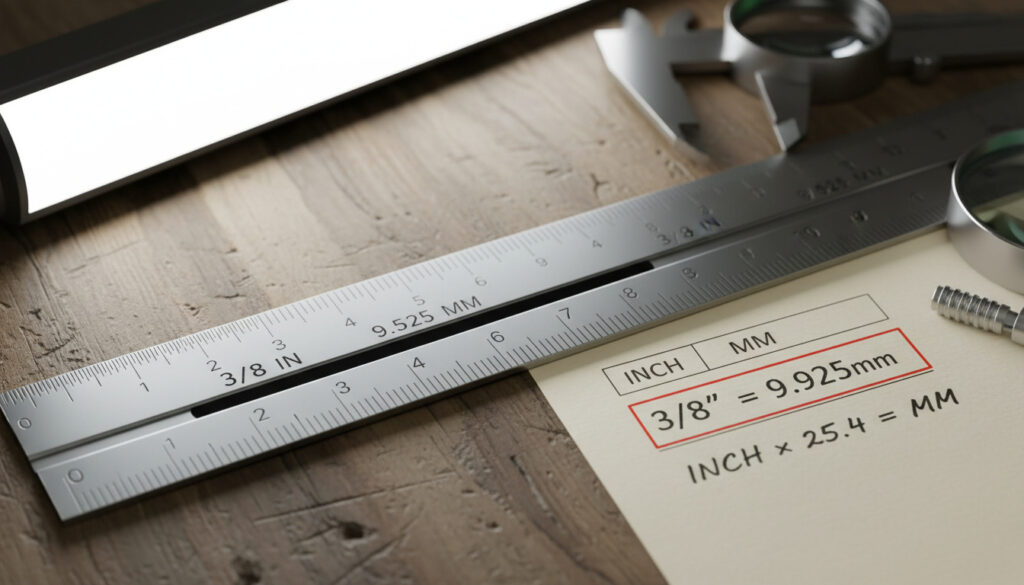
3/8 Inch to mm – Exact 9.525 mm Value, Formula & Chart
Three-eighths of an inch translates to exactly 9.525 millimeters, a conversion anchored in the 1959 international agreement that defined one inch as precisely 25.4 millimeters. This specific measurement appears constantly across woodworking benches and engineering drawings, yet confusion persists about whether the figure rounds to 9.5 millimeters or the commonly mistaken 10 millimeters.
The fraction 3/8 represents a fundamental unit in the SAE (Society of Automotive Engineers) system, appearing in drill bits, bolt diameters, and pipe fittings. Unlike approximate conversions often used in casual contexts, the engineering standard demands exactitude down to three decimal places to ensure component interoperability across metric and imperial manufacturing systems.
Understanding this conversion requires more than memorizing the final number. The calculation depends on a universally fixed formula recognized by the National Institute of Standards and Technology (NIST), providing a bridge between two measurement systems that continue to operate side by side in global industry.
What Is 3/8 Inch in mm?
- One inch equals 25.4 millimeters exactly, established by international treaty in 1959 and maintained by NIST as the legal US standard.
- The calculation 0.375 × 25.4 yields 9.525 mm without rounding.
- This dimension governs common woodworking tools, including 3/8-inch drill bits and router guides.
- Assuming 3/8 inch equals 10 mm introduces a 5 percent error, unacceptable in precision engineering.
- SAE fasteners and metric sockets require exact conversion to prevent cam-out and material damage.
- ISO 2768 tolerance classes apply to this dimension for manufactured parts.
| Fraction | Decimal (inches) | Millimeters (exact) |
|---|---|---|
| 1/32″ | 0.03125 | 0.794 |
| 1/16″ | 0.0625 | 1.588 |
| 3/32″ | 0.09375 | 2.381 |
| 1/8″ | 0.125 | 3.175 |
| 3/16″ | 0.1875 | 4.763 |
| 1/4″ | 0.25 | 6.35 |
| 5/16″ | 0.3125 | 7.938 |
| 3/8″ | 0.375 | 9.525 |
| 7/16″ | 0.4375 | 11.113 |
| 1/2″ | 0.5 | 12.7 |
How to Convert Inches to mm
Converting the Fraction to Decimal
Every fractional inch conversion begins with transforming the fraction into its decimal equivalent. For three-eighths, dividing three by eight yields exactly 0.375. This decimal representation serves as the essential intermediate step before applying the metric multiplier.
Applying the Standard Formula
The universal formula multiplies the inch measurement by 25.4. For 3/8 inch, the calculation proceeds as 0.375 × 25.4 = 9.525 mm. Rothko and Frost confirms this method as the standard approach for all SAE-to-metric translations.
Always carry the calculation to three decimal places. Stopping at 9.5 mm loses 0.025 millimeters of precision, which compounds across multiple components in mechanical assemblies.
For rapid verification, reference the SAE to Metric Calculator, which automates this exact calculation sequence.
Verification Through Reverse Calculation
To confirm accuracy, divide the millimeter result by 25.4. The equation 9.525 ÷ 25.4 must return exactly 0.375, validating the initial conversion.
Inch Fractions to mm Conversion Chart
Common Workshop Measurements
Woodworkers and machinists encounter 3/8 inch in drill bits, dowel rods, and plywood thicknesses. While full conversion charts list thirty-seconds and sixty-fourths, practical workshop use typically requires memorizing eighths and quarters. Inches to mm guide provides comprehensive tables for specialized applications.
The 10 mm Misconception
A persistent error assumes 3/8 inch approximates 10 mm. In reality, 9.525 mm falls nearly half a millimeter short. This discrepancy becomes critical when selecting sockets or ordering metric hardware, as 10 mm tools grip 3/8 inch fasteners loosely, risking stripping.
Practical Applications and Common Pitfalls
Engineering and Manufacturing Contexts
Mechanical engineers specify 9.525 mm for shaft diameters and bearing seats when converting legacy imperial designs. Manufacturing tolerances often reference this exact conversion when machining components for international supply chains.
Critical Calculation Errors
Common mistakes include treating the fraction “3/8” as the integer 3, resulting in 76.2 mm, or using the approximate factor 25 mm per inch, which yields 9.375 mm. Confusing 3/8 inch with 3.8 inches produces a 96.52 mm result, an order of magnitude error that destroys project specifications.
Prematurely rounding 9.525 mm to 9.5 mm violates ISO 2768 precision classes. Use the exact three-decimal value when programming CNC machines or specifying press fits.
In woodworking, 9.5 mm drill bits often substitute for 3/8 inch due to availability, but this creates slightly loose holes for 3/8 inch dowels. Adjust glue quantities accordingly.
History of the Inch-to-Metric Standard
-
The United States, United Kingdom, Canada, Australia, New Zealand, and South Africa sign the international yard and pound agreement, defining the inch as exactly 25.4 millimeters.
-
NIST adopts the 25.4 mm standard as the legal definition for all US commercial and scientific measurements, replacing previous variations between English and American inches.
-
ISO publishes general tolerance standards for technical drawings, incorporating the 25.4 mm conversion factor for imperial-metric hybrid designs.
Established Facts vs. Common Approximations
Verified Standards
- 3/8 inch = 9.525 mm exactly
- Conversion factor: 25.4 mm/inch (defined 1959)
- Decimal equivalent: 0.375 inches
- NIST legal standard status
Problematic Approximations
- 3/8 inch ≈ 10 mm (5% error)
- Using 25 mm/inch factor (0.4% error)
- Rounding to 9.5 mm (0.26% error)
- Treating fraction as whole number (700%+ error)
Why Exact Conversion Matters
Global manufacturing relies on interchangeability. A bearing manufactured in Germany to 9.525 mm specifications must fit a shaft designed in the United States using 3/8 inch callouts. The 1959 standard eliminated the 0.0002 inch variation previously existing between English and American inches, ensuring that modern conversions maintain precision across international borders.
In metrology laboratories, the 9.525 mm standard serves as a calibration checkpoint for micrometers and calipers. Precision measurement equipment requires this exactitude to maintain traceability to national standards.
Authority and Verification
The National Institute of Standards and Technology maintains the definitive standard for inch-to-millimeter conversion. Their publications confirm that 3/8 inch derives directly from the 25.4 mm definition, with no additional constants or regional variations permitted in legal commerce.
The international agreement of 1959 established the inch as exactly 25.4 millimeters, eliminating previous discrepancies between measurement systems and enabling precise global engineering collaboration.
Derived from NIST standard reference materials and international treaty documentation
Essential Summary
Three-eighths inch equals exactly 9.525 millimeters, calculated by multiplying 0.375 by 25.4. This value, established by international agreement and maintained by NIST, separates precise engineering from approximate guesswork. For quick reference, consult the Inches to mm guide or verify calculations using the standard formula.
Frequently Asked Questions
Is 3/8 inch exactly 10 mm?
No. Three-eighths inch equals exactly 9.525 mm. The 0.475 mm difference represents a 5 percent error, significant in mechanical and engineering applications.
What is the formula for converting inches to millimeters?
Multiply the inch measurement by 25.4. For fractions, first convert to decimal (3 ÷ 8 = 0.375), then multiply by 25.4.
Can I use a 9.5 mm socket on a 3/8 inch bolt?
A 9.5 mm socket fits loosely on a 9.525 mm (3/8 inch) fastener, risking rounding. Use a 3/8 inch (9.525 mm) socket or wrench for proper engagement.
Why do some charts show 3/8 inch as 9.53 mm?
Practical reference charts often round to two decimal places for readability. The exact value remains 9.525 mm; rounding occurs for convenience, not precision.
What are common inch fractions in millimeters?
Key conversions include 1/8 inch = 3.175 mm, 1/4 inch = 6.35 mm, 3/8 inch = 9.525 mm, and 1/2 inch = 12.7 mm.
More related posts
 Star Wars Battlefront 2 – Still Worth Playing in 2024
 Roche ter In titute of Technology v MIT: Which I Better?
 Who Is the New Pope – Still Francis in March 2025
 Air France A350 Chicago Return: Comfort, Meals & Seat Tips
 Russian Invasion of Ukraine: Key Facts, Timeline, FAQs
 Yoonchae (Jeung Yoon-chae): Age, English, Crush & More
 Hornets vs Lakers Player Stats: Jan 15, 2026
 Fascist Definition: Simple Meaning, Examples & Differences