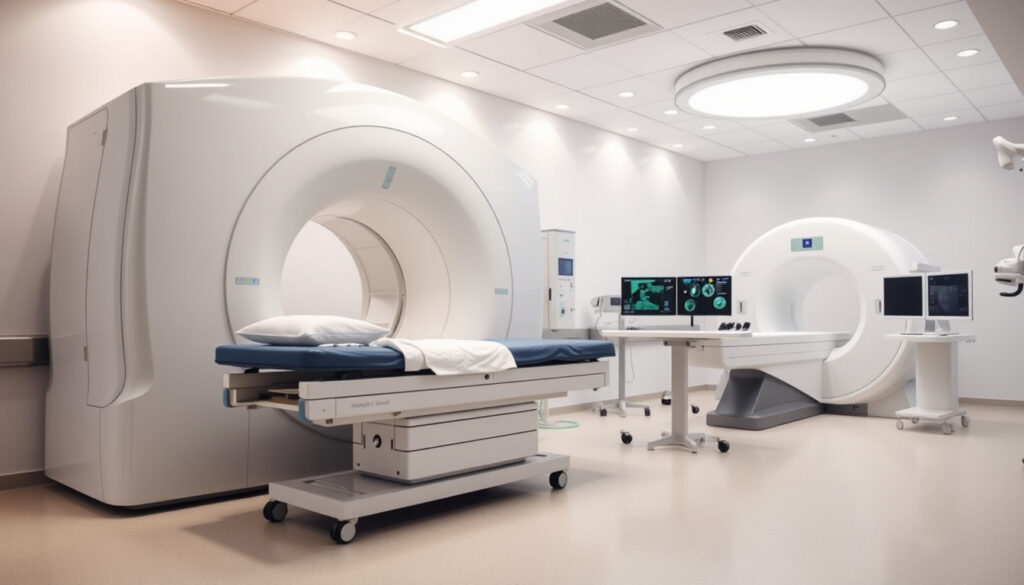
What Is a CT Scan? Uses, Preparation, and Differences from MRI
A CT scan is usually pictured as a giant doughnut, but the more useful image is a loaf of bread: the machine captures thin slices of the body, not a single shadow. That slice-by-slice view is why CT has become the first-line test for strokes, major trauma, and many cancers — and why knowing how to prepare can change the outcome.
Full name: Computed Tomography (CT) scan · Technology: X-ray based · Average scan duration: 10–30 minutes · Typical radiation dose: 2–10 mSv · First clinical use: 1972 · Common diagnostic use: Cancer, fractures, infections
Quick snapshot
- Non-invasive imaging test using X-rays to create cross-sectional images. Agency for Clinical Innovation
- Also called a CAT scan. Mayo Clinic
- The scanner rotates an X-ray tube around the body while detectors measure the altered beam. American Society of Neuroradiology
- Detects cancers, fractures, internal bleeding, kidney stones, and infections. University of Michigan Health
- Images the chest, abdomen, pelvis, skull, spine, and skeleton in detail. Cleveland Clinic
- CT angiography can evaluate blood vessels and blood flow. RadiologyInfo.org
- If contrast is planned, you may be asked not to eat for about 4 hours before the scan. Leicestershire Hospitals NHS Trust
- Remove jewelry, glasses, dentures, hairpins, and clothing with metal. NHS
- Tell the team about allergies, kidney problems, diabetes, thyroid disease, and pregnancy. UCSF Radiology
- CT uses ionizing radiation, so the dose is low but measurable. PM&R KnowledgeNow
- Contrast agents can rarely cause an allergic reaction or kidney strain. FDA
- The scan itself is painless, and the clinical benefit usually weighs more than the small radiation risk. National Cancer Institute
Key facts at a glance
Here is the short reference version of the same data used throughout this guide.
| Fact | Detail |
|---|---|
| Full name | Computed Tomography (CT) scan |
| Invented by | Godfrey Hounsfield, 1972 |
| Technology | X-rays + computer processing |
| Average radiation dose | 2–10 mSv (about 1–5 years of natural background radiation) |
| Scan duration | 10–30 minutes |
| Contrast agent | Often iodinated contrast, given orally or intravenously |
What does CT scan stand for?
How a CT scanner works
CT stands for computed tomography. The scanner combines an X-ray tube, detector rings, and a computer to produce images of the body in cross-section. Instead of one flat X-ray image, the machine takes many angled measurements and reconstructs them into slices.
What does CT mean in medical terms
In medical usage, CT and CAT are used interchangeably. Both refer to the same technique: computer-assisted tomography. The word “axial” in CAT describes the circular path of the scanner around the patient.
The implication: CT did not replace X-rays; it added a dimension — depth.
What is the difference between an MRI and a CT scan?
When is CT preferred over MRI
CT is the first choice in many situations where speed and hard-tissue detail matter. It is excellent for acute bleeding, fractures, kidney stones, lung conditions, and trauma. Because the scan is fast, it is often the go-to imaging test for emergency patients who cannot stay still for long.
When is MRI preferred
MRI is preferred when soft-tissue contrast matters more than speed. The brain, spinal cord, ligaments, cartilage, inner ear, and female pelvic organs are often seen more clearly with MRI. It also avoids ionizing radiation, but it takes longer and can be more uncomfortable for people with claustrophobia.
The table below turns that difference into a practical side-by-side comparison.
| Aspect | CT scan | MRI |
|---|---|---|
| Radiation | Uses ionizing X-rays | Uses magnetic field and radio waves; no ionizing radiation |
| Best for | Bones, acute bleeding, trauma, lungs | Soft tissue, brain, spinal cord, ligaments, cartilage |
| Speed | Fast; typical scan lasts 10–30 minutes | Slower; often 20–45 minutes |
| Contrast | Iodine-based, if needed | Gadolinium-based, if needed |
| Access | Usually quicker and less expensive | More expensive and often requires a longer appointment |
The pattern: if the question is hard tissue or time, CT wins; if the question is soft tissue, MRI usually gives the sharper answer.
What should you not do before a CT scan?
Fasting requirements
If contrast is planned, most imaging centers advise a short fast. The usual instruction is nothing to eat for 4 hours before the scan. Clear liquids are often allowed up to 2 hours before, but the exact rule can vary by hospital and by exam type.
What to avoid if contrast is used
Contrast material can interact with certain conditions. Patients are commonly asked to mention any history of allergic reactions, asthma, kidney disease, diabetes, thyroid disease, or pregnancy before the injection is given.
Medication and metal objects
Most routine medications can be taken as usual, but you should confirm with the radiology team. Metal is a separate issue: jewelry, glasses, hairpins, dentures with metal parts, and under-wire bras are usually removed before a CT.
What this means for you: prepare for the metal check, be honest about your medical history, and follow the fasting note exactly.
How long does a CT scan take?
Factors affecting scan time
- The actual scan can be completed in as little as a few minutes for a simple head CT.
- Studies using contrast or imaging multiple body parts may take 20–30 minutes.
- The total appointment time is usually 30–60 minutes, including check-in, gown change, and IV placement.
What to expect during the scan
You lie on a padded table while the ring-shaped scanner rotates around you. You may be asked to hold your breath for a few seconds to stop motion blur. The scan itself is quick and painless; contrast can cause a warm feeling or a metallic taste.
The takeaway: the scanner moves fast, but your preparation and arrival time shape the overall experience.
What diseases can a CT scan detect?
Common conditions diagnosed with CT
- Fractures and complex bone injuries.
- Internal bleeding, aneurysms, and blood clots.
- Kidney stones, lung nodules, and abdominal infections.
CT is also used when a connective-tissue disorder raises concern about vascular injury; for example, Ehlers-Danlos syndrome may involve imaging of blood vessels when symptoms suggest a problem.
CT in cancer detection
CT is a workhorse in cancer care. It can detect suspicious masses, measure tumor size, guide biopsy needles, and help radiation oncologists plan treatment. It is also used after treatment to see whether a tumor has shrunk or remained stable.
CT for trauma and emergency
In major trauma, whole-body CT is often the fastest way to find life-threatening injuries. Because the entire scan can be done in minutes, it helps emergency teams decide quickly about surgery, blood transfusion, or transfer to a specialized center.
The takeaway: CT tells doctors where a problem is, how big it is, and often how urgent it is — even when the cause is not yet confirmed.
How is a CT scan performed?
The practical path through a CT scan is straightforward when you know the steps.
- Check in and change into a hospital gown if the imaging area includes the chest, abdomen, or pelvis.
- Remove metal items, including jewelry, glasses, and hair accessories.
- An IV may be placed in your arm or hand if contrast is needed.
- You lie on the scanning table; it slides through the ring while you hold your breath briefly when asked.
- After the scan, the IV is removed, and you can usually return to normal activity.
The catch: the more still you can hold, the less repeat scanning is needed.
Confirmed facts vs. open questions
Confirmed facts
- CT scans use ionizing radiation — PM&R KnowledgeNow.
- CT can detect many cancers, fractures, infections, and internal bleeding — University of Michigan Health.
- Contrast agents can cause allergic reactions and kidney strain — FDA.
What remains unclear
- Long-term cancer risk from a single CT scan is small but still debated.
- Optimal screening intervals are not fixed for every condition found incidentally.
- Low-dose CT protocols are not equally effective in all body areas and all patient sizes.
“CT (computed tomography) uses x-rays and computer technology to create cross-sectional images of the body.”
Agency for Clinical Innovation
“MRI does not use x-rays and instead uses a magnetic field and radio-frequency-based signal processing.”
PM&R KnowledgeNow
gerisage.com, cuh.nhs.uk, radiologyinfo.org, solvhealth.com, healthline.com
Frequently asked questions
Is a CT scan painful?
No. The scan itself is painless. If contrast is given, you may feel warmth or a metallic taste, but that passes quickly.
How much radiation is in a CT scan?
A typical adult CT delivers 2–10 mSv, roughly the background radiation of 1–5 years. The risk is small, and doctors usually order CT only when the clinical benefit outweighs it.
Can I eat or drink before a CT scan?
If contrast is planned, most centers ask you not to eat for 4 hours. Clear liquids may be allowed up to 2 hours before. Check your appointment letter for the exact rule.
Do I need to undress for a CT scan?
Often yes for the upper body. You will usually change into a gown and remove metal items such as glasses and under-wire bras.
Can you have a CT scan if you are claustrophobic?
Yes. CT scanners are open at both ends and usually less confining than MRI. If you are anxious, tell the radiology team beforehand so they can help.
How soon will I get CT scan results?
Not in the scanner. Reports often take hours to days, depending on the institution and on whether an urgent finding needs immediate action.
What is the difference between a CT scan and an X-ray?
A CT is a series of X-rays reconstructed into cross-sections; a plain X-ray is a single flat image. CT shows more depth and detail but delivers more radiation.
Can a CT scan detect cancer?
CT can detect suspicious tumors and show their size and spread, but a biopsy is needed for a definitive cancer diagnosis.
Related reading
More related posts
 Ghost of Yotei: Release date, controversy and Easter egg
 How to Copy and Paste on Any Device: Step-by-Step Guide (2025)
 How Many Calories to Lose Weight – Safe Deficit Guide
 Samsung Galaxy A56 5G: Specs, Price & Reviews in Ireland
 Giants vs Saints 2025: Final Score & Player Stats
 Taylor Swift Engagement Ring Travis Kelce – Design, Value & Photos
 Cast of Happy Gilmore: Original 1996 and 2025 Sequel Cast Guide
 John Turturro Movies and TV Shows: Full Filmography