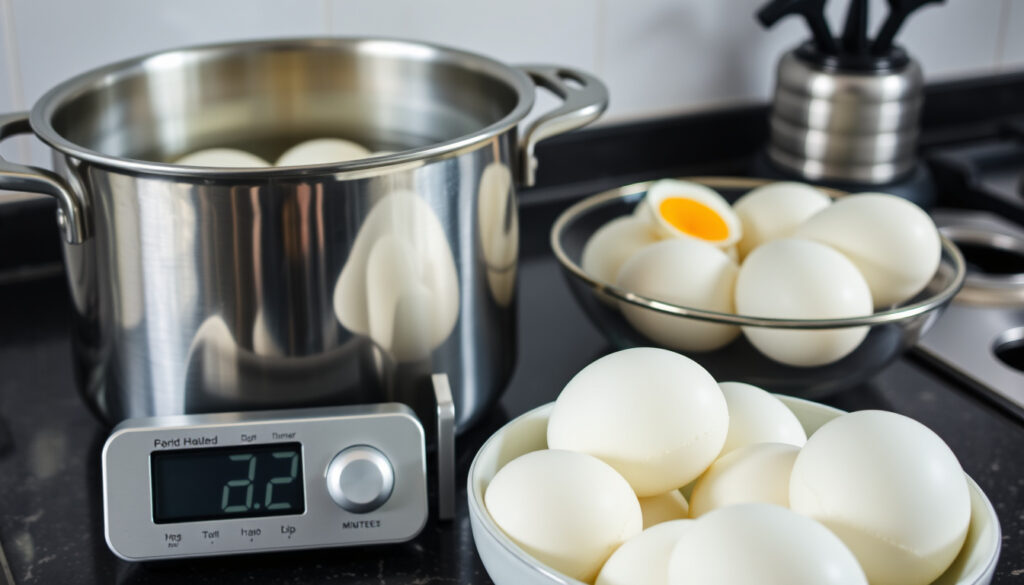
How to Cook Hard Boiled Eggs: Perfect Timing & Easy Method
There’s a small, private victory in peeling a hard-boiled egg and watching the shell come off in one piece. The rest of us usually settle for a pitted white and a gray-green yolk. The lasting fix is more about timing than talent: a cold-water start or a boiling-water start both work, and the FDA and USDA settle the safety rules. By the end, you’ll know exactly which method fits your kitchen.
Cooking time (large eggs): 10–12 minutes ·
Cold water start: Recommended to prevent cracking ·
Ice bath duration: 5–10 minutes ·
Altitude effect: +1–2 min per 1,000 ft ·
Peeling hack: Use eggs 7–10 days old
Quick snapshot
- An ice bath stops carryover cooking after the eggs leave the hot water (Smitten Kitchen (home-cooking blog))
- Hard-cooked eggs keep up to a week in the fridge (USDA Agricultural Research Service (USDA’s research arm))
- Boiling time depends on egg size; large eggs are the standard reference (Simply Recipes (reader-tested recipe site))
- Exact timing shifts with altitude and egg size
- Whether vinegar in the water improves peelability isn’t settled
- The 5-5-5 rule is a useful mnemonic, not a tested standard
- Cold start: boil + 10-minute covered rest + 5-minute ice bath (Smitten Kitchen)
- Boiling water: 10-minute boil + 15-minute ice bath (Smitten Kitchen)
- Either route: about 25–30 minutes from pot to peel-ready (Smitten Kitchen)
- Refrigerate within 2 hours of cooking (U.S. Food and Drug Administration (federal food-safety regulator))
- Peel under running water if the shell fights back (U.S. Food and Drug Administration (federal food-safety regulator))
- Eat within a week for best quality and safety (U.S. Food and Drug Administration (federal food-safety regulator))
Six figures, one pattern: nearly every hard-boiled egg failure is a timing failure, not a technique failure.
| Label | Value |
|---|---|
| Cooking time (large eggs) | 10–12 minutes |
| Water start preference | Cold start recommended to prevent cracking |
| Ice bath duration | 5–10 minutes |
| Peeling tip | Use older eggs (7–10 days old) |
| Altitude effect | Add 1–2 minutes per 1,000 ft above sea level |
| Refrigerated shelf life | Up to 7 days (USDA Agricultural Research Service) |
How Long Does It Take to Hard Boil an Egg?
For large eggs, the reliable window is 10–12 minutes of hot-water exposure, depending on how you start. The U.S. Food and Drug Administration defines “done” in texture terms: the white and the yolk should both be firm (FDA (federal food-safety regulator)).
Is 10 minutes long enough for a large egg?
- 9 minutes in boiling water: yolk set at the edges but not completely opaque (Simply Recipes (reader-tested recipe site))
- 10 minutes in boiling water, then an ice bath: fully hard and still tender
- 10-minute covered rest after the pot boils: the cold-start standard
So yes, 10 minutes is enough for large eggs, whether those minutes are spent simmering or standing off the heat. Around 12 minutes you’re firmly in hard-boiled territory.
Is 20 minutes too long?
Past roughly 15 minutes of hot-water exposure, the yolk develops a green-gray ring and the white turns rubbery. It’s still safe to eat; it just stops being pleasant.
Yes, 20 minutes is too long for most tastes. Simply Recipes’ comparison testing found that longer cooking produces a firmer yolk, and at 20 minutes the texture has crossed into sponge territory (Simply Recipes).
The pattern: pick 10–12 minutes for large eggs, then respect the ice bath — the eggs keep cooking from their own heat after they leave the water.
Do You Put Eggs in Boiling Water or Cold Water?
Both approaches work; they just distribute the risk differently. The boiling-water start gives you an honest timer, while the cold start gives the shell time to adjust.
Is it better to boil eggs in already boiling water?
- Boiling-water start: the moment eggs hit the water is the moment the timer starts, so results repeat batch after batch
- Cold start: slower warming reduces the chance of cracked shells
- Fresh eggs: tighter whites and a smaller air pocket make a hot plunge more likely to crack them
Smitten Kitchen (home-cooking blog) prefers the boiling-water route and adds one non-negotiable detail: lower refrigerated eggs gently into the pot rather than dropping them in (Smitten Kitchen’s hard-boiled method).
Should I put my eggs in the water before or after it starts boiling?
Cold start: eggs in pot → cold water covers them → boil → cover → rest ·
Boiling start: water boils → eggs in → boil → ice bath
Before boiling is the cold-start school: eggs begin in cold water, the pot comes to a boil, you cover it, kill the heat, and let time finish the job. After boiling is the precision school: the water is already rolling, so heat transfer starts the second the eggs land.
Cold start forgives a wandering eye; boiling start rewards a precise one. Choose the failure mode you’d rather live with — cracked shells or a slightly fuzzy start time.
What this means: if you want the most reproducible results, boiling-water wins. If you want the lowest crack rate and the gentlest learning curve, cold-water wins.
What Is the Best Trick to Boiling Hard Boiled Eggs?
There isn’t a secret ingredient — there’s a sequence: cook to firm, chill fast, then peel with water on your side.
How do I make perfect hard-boiled eggs?
- Cook until both white and yolk are firm: the FDA’s baseline for hard-cooked eggs
- Move the eggs straight into an ice bath to stop carryover cooking
- Give them 5–15 minutes of chill time before peeling
- Peel under running water when the membrane resists
The “perfect” egg is the one that matches your breakfast: a fully set yolk for egg salad, a slightly softer center for soldiers. The method stays the same — only the minutes change.
How does Gordon Ramsay boil eggs perfectly?
- Bring the water to a rolling boil first
- Lower the eggs in and boil for 6.5 minutes
- Drain, then shake the pot to crack the shells
- Ice bath, then peel
Ramsay’s method is shorter than the standard window, so the yolk stays noticeably softer than the 12-minute version — a set white with a yolk that’s still a little rich at the center. If you want a fully firm yolk, extend the cooking time toward the 10-minute mark.
What is the 5 5 5 rule for eggs?
The 5-5-5 rule is a memory aid, not a lab standard: 5 minutes of boiling, 5 minutes off the heat under the lid, 5 minutes in an ice bath.
It’s a handy rhythm for a quick soft-to-medium result, but large eggs will land softer than the 10- to 12-minute methods above. Extend the resting step to 10 minutes if you want a firmly set yolk.
How to Cook Hard Boiled Eggs on the Stove?
The stovetop is the default for a reason: it gives you the most control over heat, timing, and the all-important fast chill.
How to cook hard boiled eggs in boiling water?
- Bring a pot of water to a full, rolling boil
- Lower refrigerated eggs in gently with a spoon
- Boil about 10 minutes for large eggs
- Move them straight into an ice bath
This is the timer’s method — the clock starts the second the eggs hit the water, which is why the gentle lowering technique matters as much as the minutes.
How to cook hard boiled eggs from cold water?
- Put eggs in a pot and cover with about one inch of cold water
- Bring to a boil over high heat
- Cover, remove from heat, and rest for 10 minutes
- Chill in an ice bath for 5–10 minutes
This is the gentler road: the eggs warm up with the water, so the shell expands gradually and cracks are less likely. The trade-off is a less precise starting moment — the boil’s arrival time depends on your pot, stove, and water volume.
The full routine, with the exact cold-start steps, is laid out in the step-by-step section below.
How to cook hard boiled eggs without ice bath?
An ice bath does two jobs: it stops carryover cooking and it cools the eggs fast enough to handle. Skip it, and the yolk keeps cooking from residual heat.
No ice in the freezer? Run the eggs under cold water and keep turning them until they’re fully cool. It works, but it uses more water and takes longer — and you lose the carryover-cooking stop that an ice bath provides (Smitten Kitchen). Steaming is the third stovetop option: a steamer basket over simmering water follows roughly the same timing as the boiling-water method.
Why Is My Boiled Egg Floating in Cold Water?
- Floating egg: the air cell inside grew larger as the egg aged, so buoyancy is an age marker
- Fresh egg: small air cell, sinks to the bottom
- Old egg doesn’t equal bad egg: age changes texture and peelability, not automatically safety
An egg that floats before cooking is telling you it’s older, not that it’s spoiled. The shell is porous, so moisture slowly escapes and the air cell expands. Cooked properly and refrigerated promptly, an older egg is still fine to eat.
At higher altitude, this is also where timing bites: water boils at a lower temperature, so eggs need a bit more time — roughly 1–2 extra minutes per 1,000 feet. If you’re working from a recipe in Celsius, our Celsius-to-Fahrenheit conversion guide keeps the math straight.
The safety clock starts after cooking: cooked eggs shouldn’t sit out more than two hours, or one hour when it’s above 90°F. Buoyancy doesn’t change that.
What this means: a floating egg is a heads-up about age, not a verdict on edibility. The real tests are your fridge’s temperature and the firmness of the white and yolk.
The Foolproof Stovetop Method, Step by Step
This is the cold-start routine that balances forgiveness with consistency — the best entry point if you want the same result every week.
- Set eggs in a single layer in the pot.
- Cover with cold water by about one inch (Simply Recipes (reader-tested recipe site)).
- Bring to a boil, then cover and remove from heat.
- Let stand 10–12 minutes for large eggs.
- Transfer to an ice bath for 5–10 minutes.
- Tap, roll, and peel under running water.
- Refrigerate promptly; use within a week.
The time math is simple: about 10 minutes to reach a boil, 10 minutes of rest, and 5–10 minutes of chilling. The same timer discipline carries into other kitchen projects — our air-fryer chicken wings guide leans on the same precision-timing approach.
Separating Egg Facts from Egg Lore
A quick truth-check before you commit to a method: some claims are solid, others are inherited kitchen mythology.
Confirmed
- Boiling time depends on egg size (Simply Recipes)
- An ice bath stops carryover cooking (Smitten Kitchen)
Unverified
- Vinegar in the water makes eggs easier to peel
- One universal minute-count works for every kitchen, altitude, and pot
- The 5-5-5 rule is a tested standard rather than a mnemonic
- An ice bath is the only way to stop carryover cooking
- Fresh eggs are harder to peel
- A floating egg is an older egg
The pattern: the claims that survive are the ones backed by temperature and time — the rest is habit, hope, and good marketing.
What the Pros Say
Two credible kitchens, two very different clocks. The American Egg Board’s Incredible Egg program keeps the cold-start advice simple:
Stand in hot water about 12 minutes for large eggs.
— Incredible Egg, American Egg Board
Gordon Ramsay’s version is faster and more aggressive:
6.5 minutes boiling for perfect hard-boiled.
— Gordon Ramsay
Two numbers, two philosophies: 12 minutes of gentle standing heat lands a uniformly firm yolk; 6.5 minutes of active boiling lands a set white with a softer, richer center. Both are fully cooked — they just answer different breakfast questions.
The Takeaway
Mastering hard-boiled eggs is a timing problem, not a talent problem. Choose the cold-start method for the gentlest learning curve, or the boiling-water method when you want the timer to start at the exact second — both end at the same safety checkpoint: refrigerate within two hours, eat within a week. For the weekday meal-prepper, the choice is clear: get the cold-start routine down once, and you’ll have a week of clean-peeling protein instead of a daily negotiation with a stubborn shell.
Frequently Asked Questions
Can you hard-boil eggs in the microwave?
Not in the shell — trapped steam can make the egg burst. If you try it, use shelled eggs in a microwave-safe bowl of water, cover it, and heat in short bursts. For predictable timing, the stovetop methods above are the easier path.
How long do hard-boiled eggs last in the fridge?
About one week. The FDA says hard-cooked eggs should be eaten or used within one week of cooking (FDA egg-safety guidance), and the USDA Food Safety and Inspection Service advises keeping eggs and egg dishes refrigerated at 40°F or below (USDA Food Safety and Inspection Service (federal food-safety agency)).
How to store hard-boiled eggs?
Refrigerate them promptly — within the two-hour window from cooking — and keep them in the shell until you’re ready to eat. The shell slows moisture loss and keeps the eggs from picking up fridge odors.
Why do some eggs crack while boiling?
Temperature shock is the usual cause: cold eggs dropped into violently boiling water. A cold start lets the shell warm gradually, which is why the cold-water method cracks less. Older eggs also carry a larger air pocket, which changes how they behave in the pot.
Is it necessary to use an ice bath?
No, but it’s the fastest stop. Chilling stops carryover cooking so the yolk doesn’t keep firming after the eggs leave the water. No ice? Run the eggs under cold water and keep turning them until fully cool.
Can you reheat hard-boiled eggs?
Yes, gently — a minute in hot water or a quick microwave burst without the shell. Reheating firms the white further and can make the yolk chalky, so many cooks prefer them cold or at room temperature.
How to tell if hard-boiled eggs are done?
Cut one open: the white and yolk should both be fully firm, with no jammy or runny center. For large eggs by the methods above, that happens around 10–12 minutes.
What size eggs are best for hard boiling?
Large eggs are the standard — the 10- to 12-minute timings above assume large. Medium eggs need a bit less time, extra-large a bit more; the firm-white-and-firm-yolk test is the final judge.
More related posts
 Nizoral Anti-Dandruff Shampoo: Does It Work? Side Effects & Usage
 Hurricane Erin Spaghetti Models: Live Tracking and Analysis
 GTA 6 Release Date: When Will GTA 6 Come Out
 What Causes Low Blood Sugar? Causes, Symptoms, and Treatment
 Wells Fargo Credit Card – Top Options Rewards and How to Choose
 Nothing Beats a Jet2 Holiday: Meme, Meaning & Voice Actress
 3/8 Inch to mm – Exact 9.525 mm Value, Formula & Chart
 The Rookie Season 8: Premiere, Episodes, Cast & Renewal