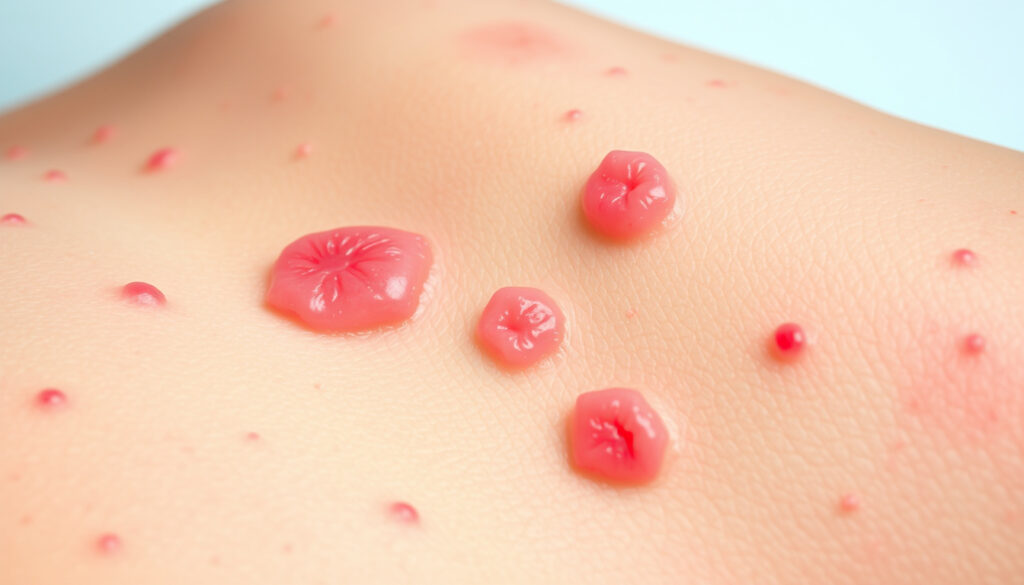
What Do Herpes Look Like? Visual Guide and Stages
Herpes sores are often mistaken for other skin conditions, but their distinct stages and patterns can help with identification. This guide covers what herpes looks like at each stage, compares it to common look-alikes, and explains when to see a doctor.
Genital Herpes
- Small, painful blisters on genitals, anus, or thighs CDC
- Blisters burst to form open sores MedicineNet
- May cause itching and flu-like symptoms MedicineNet
Oral Herpes (Cold Sores)
- Blister clusters around mouth or lips North Dakota HHS
- Often start with tingling MedicineNet
- Can spread to nose or chin North Dakota HHS
Herpes on Buttocks
- Appears as clusters of blisters on the buttocks or lower back Verywell Health
- May be mistaken for acne or shingles Verywell Health
- Typically recurs in same spot Verywell Health
Common Characteristics
- Small, fluid-filled blisters on a red base MedicineNet
- May be painful or itchy MedicineNet
- Recur in same area Cleveland Clinic
- Typically heal within 2–4 weeks MedicineNet
Prevalence of genital herpes in the US: 1 in 6 people aged 14-49 (CDC) · Asymptomatic carriers: Up to 90% of infected individuals have no symptoms · Typical first outbreak duration: 2-4 weeks · Average number of yearly recurrences: 4-5 (varies widely).
| Attribute | Details | Source |
|---|---|---|
| Caused by | HSV-1 or HSV-2 | CDC |
| Transmission | Direct contact with infected area | CDC |
| Incubation period | 2-12 days | Cleveland Clinic |
| First outbreak | Usually most severe | MedicineNet |
| Recurrence | Can be triggered by stress, illness, sun exposure | Cleveland Clinic |
What can be mistaken for herpes?
Many skin conditions resemble herpes. This table compares key features to help differentiate.
| Condition | Appearance | Sensation | Key distinction |
|---|---|---|---|
| Herpes | Clusters of small blisters on red base; may crust or ulcerate | Pain, burning, itching, tingling before sores | Recurrent, same location, prodrome |
| Ingrown hair | Single red bump with visible hair under skin | Mild tenderness | No cluster, no tingling, single follicle |
| Pimple | Pustule with white/yellow head, often solitary | May be tender | No preceding tingling, not recurrent in same spot |
| Yeast infection | Red, itchy rash with white discharge (genital) | Intense itching, burning | No blisters, not clustered; discharge present |
| Allergic reaction | Red, raised rash, often widespread | Itching, sometimes stinging | History of new product or allergen; not recurrent |
Herpes vs ingrown hair
Ingrown hairs appear as a single bump with a visible hair trapped beneath the skin. Herpes blisters are typically painful and appear in clusters MedicineNet.
Herpes vs pimple
Pimples are pustules without preceding tingling, and they do not tend to recur in the exact same location. Herpes blisters often recur at the same site and are preceded by a prodromal sensation MedicineNet.
Herpes vs yeast infection
Yeast infections cause itching and discharge but not blisters. Herpes lesions are fluid-filled and eventually break open MedicineNet.
Herpes vs allergic reaction
Allergic reactions typically appear as a diffuse red rash without the vesicular stage of herpes. They also lack the recurrent pattern and prodrome Verywell Health.
Does herpes go away?
Herpes is a lifelong infection, but outbreaks do heal on their own.
Can herpes be cured?
There is no cure for herpes CDC. Antiviral medication can reduce outbreak frequency and severity, but the virus remains in the body.
How long do outbreaks last?
Outbreaks usually heal within 2–4 weeks MedicineNet. The first outbreak is often the longest and most severe.
Does herpes go away on its own?
Yes, the sores will eventually heal without treatment, but the virus stays dormant and can reactivate later Cleveland Clinic.
“Genital herpes is a common sexually transmitted infection caused by HSV.” — CDC
What are the 7 warning signs of herpes?
The seven key signs include early sensory changes, visible blisters, and systemic symptoms.
- Early symptoms: tingling and itching — a prodrome that occurs 1–2 days before sores STD Center NYC
- Blisters and sores — small, fluid-filled bumps that cluster and break open MedicineNet
- Flu-like symptoms — fever, body aches, fatigue during first outbreak MedicineNet
- Pain during urination — if blisters are near the urethra MedicineNet
- Swollen lymph nodes — in the groin or neck Cleveland Clinic
Additional signs include redness and irritation before blisters appear Verywell Health and crusting during healing, though in moist areas sores may re-skin without a crust Science Insights.
“An HSV infection has three broad stages: primary infection, latency, and reactivation.” — Cleveland Clinic
Can you visually tell if someone has herpes?
Herpes has a characteristic appearance, but visual diagnosis alone is unreliable.
Visual cues of herpes blisters
Herpes sores have a characteristic appearance: small (1–3 mm), fluid-filled blisters on a red base, often in clusters MedicineNet. They can appear on the genitals, mouth, or elsewhere.
Limitations of visual diagnosis
Many other conditions mimic herpes, including ingrown hairs, pimples, yeast infections, and allergic reactions. Atypical presentations are common Verywell Health.
Why testing is needed
PCR or viral culture tests are confirmatory CDC. Visual inspection often leads to misdiagnosis.
Do not pick at herpes sores. Breaking the crust can delay healing and increase the risk of secondary infection. Let them heal naturally or with prescribed treatment.
If you suspect herpes, see a healthcare provider for a PCR swab test. Early antiviral treatment can shorten the outbreak and reduce discomfort.
How to tell if a rash is herpes or not?
Use these steps to evaluate a skin lesion.
- Step 1: Identify the appearance — Look for small, clear or cloudy fluid-filled blisters on a red base. Herpes blisters are often about 1–3 mm and rarely appear alone Doctor2me.
- Step 2: Check location — Herpes commonly recurs in the same area, such as the genitals, mouth, or buttocks Verywell Health.
- Step 3: Look for clusters and tingling — A cluster of small blisters, often accompanied by a pre-eruption tingling or burning sensation, is a key clue MedicineNet.
- Step 4: Consider other symptoms — Flu-like symptoms, swollen lymph nodes, and pain during urination suggest a first outbreak MedicineNet.
- When to see a doctor — Any unexplained blistering rash, especially if recurrent, warrants a medical evaluation. Rashes from contact dermatitis are not typically recurrent Verywell Health.
For more on symptom identification of connective tissue disorders, see Ehlers-Danlos Syndrome Symptoms: Signs, Diagnosis & More. Understanding contagious viral infections can also help differentiate; read Is a Sinus Infection Contagious? Viral vs. Bacterial.
“Herpes blisters are commonly described as small, red, fluid-filled bumps that may cluster together on a reddened base.” — MedicineNet
columbusinsight.com, freemedicaljournals.com, int.livhospital.com, denverinsight.com, sticlinic.co.uk
Frequently Asked Questions
Can you get herpes from a toilet seat?
No. Herpes is transmitted through direct skin-to-skin contact with an infected area, not from surfaces like toilet seats CDC.
Is herpes contagious when no sores are present?
Yes. Asymptomatic shedding can transmit the virus even when no visible sores are present CDC.
What triggers herpes outbreaks?
Common triggers include stress, illness, fatigue, sun exposure, and hormonal changes. They vary per individual Cleveland Clinic.
Can herpes be transmitted through kissing?
Yes. Oral herpes (HSV-1) spreads through saliva and kissing, especially during an active outbreak North Dakota HHS.
How long after exposure do symptoms appear?
The incubation period is 2–12 days, but some people never develop symptoms Cleveland Clinic.
Is there a vaccine for herpes?
No. There is no approved vaccine for herpes. Research is ongoing CDC.
More related posts
 The Rookie Season 8: Premiere, Episodes, Cast & Renewal
 Grand Canyon National Park: Fees, Safety & Cities Guide
 He’s Just Not That Into You: Signs, Meaning & Review
 Play It Again Sports Near Me: Find Locations, Hours & Gear
 Mission Lane Credit Card Review: A 2025 Guide
 What Is the Moon Phase Tonight? Current Waxing Gibbous
 Apple Watch Ultra 2: Discontinued? Worth Buying in 2025
 National Ice Cream Day 2026: Date, Deals & Facts