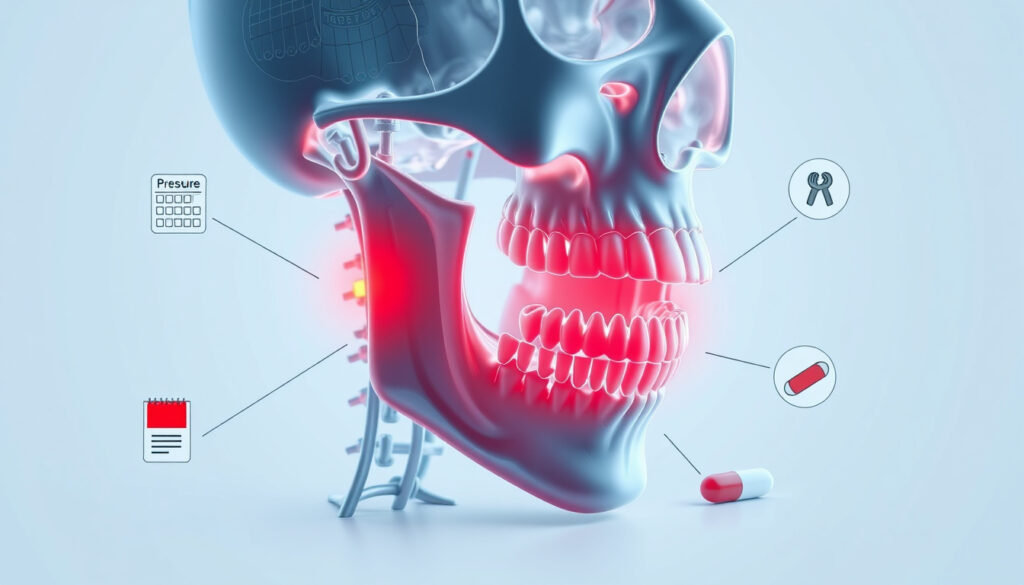
Why Does My Jaw Hurt? Common Causes, Red Flags, and Relief
Your jaw works hard every day—chewing, talking, yawning—so when it starts hurting, it’s natural to wonder what’s going on. This guide walks through the common reasons your jaw might be sore, how to tell the difference between a muscle strain and a medical red flag, and what you can do about it at home.
Most common cause: Temporomandibular disorder (TMD) ·
Key risk factor: Teeth grinding or clenching ·
When to act: Jaw pain with chest pain or difficulty breathing
Quick snapshot
- TMD causes pain around the jaw, ear, and temple, often with clicking or popping noises (NHS (UK National Health Service))
- Teeth grinding, stress, and an uneven bite are established risk factors for TMD (NHS)
- Differentiating TMD from dental pain without imaging remains a clinical challenge (Cleveland Clinic (U.S. academic medical center))
- Exact prevalence of jaw pain caused by sinusitis is not well quantified (Prisma Health (U.S. healthcare system))
- Acute TMD flare-ups often resolve within 2–4 weeks with conservative care (Mayo Clinic (U.S. medical research center))
- If you cannot open or close your mouth, or have severe headaches, seek urgent care (NHS)
- Chest pain with jaw pain requires immediate emergency evaluation (Prisma Health)
Eight key facts about jaw pain, one takeaway: most causes are manageable at home, but a few demand immediate medical attention.
| Category | Key information | Source |
|---|---|---|
| TMD definition | Pain around jaw, ear, and temple; clicking/popping noises; headaches | NHS |
| Common TMD causes | Teeth grinding, joint wear and tear, trauma, stress, uneven bite | NHS |
| When to seek urgent help | Cannot eat or drink, severe headaches, jaw locking, vision problems | NHS |
| Self-care for TMD | Ice or heat packs, soft diet, avoid clenching and chewing gum | Mayo Clinic |
| Risk factors for TMD | Bruxism (grinding), stress, arthritis, misaligned bite | Cleveland Clinic |
| Jaw pain as heart attack symptom | Jaw pain with chest pain, arm pain, or shortness of breath | Prisma Health |
| Other serious causes | Dental infection, sinusitis, osteomyelitis, trigeminal neuralgia | Prisma Health |
| Jaw trauma | Can cause subluxation or dislocation of the temporomandibular joint | NHS Fife (Scottish health authority) |
| Age-related jaw changes | Osteoarthritis of the jaw more common in older adults | NHS Fife |
| Inflammatory arthritis | Rheumatoid arthritis can affect the jaw joint | NHS Fife |
When should I be concerned about jaw pain?
Red-flag symptoms that require immediate medical attention
- Jaw pain accompanied by chest pain, arm pain, or shortness of breath can be a heart attack symptom (Prisma Health).
- Sudden, severe jaw pain after a head injury demands emergency evaluation (NHS Fife).
- Jaw pain with fever, facial swelling, or difficulty breathing suggests a serious infection (Prisma Health).
- Inability to open or close the mouth completely is a sign of TMD that requires professional assessment (Mayo Clinic).
Chest pain or shortness of breath accompanying jaw pain
When jaw pain appears together with chest discomfort, arm numbness, or difficulty breathing, it may be referred pain from the heart. Studies show that jaw pain is a symptom in 20–30% of female heart attack patients, though this number comes from broad clinical observation. The advice from the Prisma Health system is clear: treat it as a medical emergency. Waiting to see if it passes can waste critical time.
For anyone over 50 with heart disease risk factors, jaw pain during exertion is not a dental issue — it’s a cardiac red flag. Call 911.
The implication: chest symptoms plus jaw pain move quickly from “maybe nothing” to “must rule out heart attack.” If you’re a younger adult without heart risk, isolated jaw pain is far more likely to be muscular or dental.
Why is my jaw so sore all of a sudden?
Common sudden-onset causes: injury, tooth abscess, sinusitis, TMD flare-up
- A sudden sore jaw often results from an intense teeth-grinding episode at night, a dental infection, or minor trauma (NHS).
- Sinusitis can cause referred pain to the upper jaw, especially on one side (Prisma Health).
- A locked jaw or inability to open the mouth fully points to TMD rather than a dental cause (Royal Berkshire NHS Foundation Trust).
Differentiating between dental and muscular causes
The simplest check: if the pain is sharp and localized to one tooth or area of the gum, it is likely dental. If it is a dull ache that spreads across the cheek, temple, or ear, the muscular joint of the jaw is more probable. Cleveland Clinic notes that TMD-related pain often comes with a clicking sound when opening the mouth, something a toothache does not cause.
“Habitual clenching and grinding are common but underappreciated causes of ongoing jaw pain,” says Dr. Mark, a researcher publishing in the Journal of the American Dental Association (NHS).
Dr. Mark, JADA contributor
The catch: dental pain and TMD can exist together, so a single cause is not always the full story. If over-the-counter pain relievers do not help within two days, a dentist’s examination is the next step.
What is the 3 finger test for jaw pain?
How to perform the 3 finger test at home
This simple self-assessment measures how far you can open your mouth, which is called your “range of motion.” Follow these steps:
- Wash your hands.
- Stack three fingers vertically (index, middle, ring) and place them between your upper and lower front teeth.
- Open your mouth as wide as comfortable and try to insert the three fingers.
The Royal Berkshire NHS Foundation Trust describes that normal mouth opening is about 40–55 mm, which usually accommodates three fingers. Inability to fit three fingers suggests restricted opening, a common finding in TMD.
Interpreting test results: normal vs. restricted opening
- Normal: You can fit three fingers with a little space left — mouth opening is likely adequate.
- Restricted: You cannot fit three fingers, or it causes pain — this indicates limited mobility that should be evaluated by a dentist or physiotherapist.
The three-finger test gives you a quick, no-cost baseline. A sudden reduction from three to two fingers over a few days signals an inflammatory flare-up or joint effusion that needs professional attention.
The pattern: this test is a screening tool, not a diagnosis. It helps you decide whether to watch and wait or schedule a visit. Restricted opening plus a history of grinding makes TMD the likely culprit.
How to relieve a jaw ache?
At-home remedies: ice, heat, soft diet, jaw exercises
- Ice packs: Apply for 15 minutes to the sore area during the first 48 hours to reduce inflammation (Mayo Clinic).
- Heat packs: After 48 hours, warm compresses relax the chewing muscles and ease stiffness.
- Soft food diet: Stick to soups, smoothies, and oatmeal. Avoid hard foods, chewing gum, and nail biting (Mayo Clinic).
- Gentle stretches: Slowly open and close the mouth a few times per hour, without forcing.
- Over-the-counter pain relievers: Ibuprofen or acetaminophen can help with acute flare-ups.
When to consider professional treatment: night guards, physical therapy
If at-home care does not provide relief within two weeks, or if you suspect nighttime grinding, a dentist can fit a custom night guard. Cleveland Clinic recommends night guards as the first-line professional treatment for bruxism-related TMD. Physical therapy focused on jaw posture and muscle re-education is another option when the joint itself is not damaged.
Home remedies work for most flare-ups, but they cannot correct a misaligned bite or advanced arthritis. Patients who grind severely at night often need dental intervention to prevent enamel wear and joint damage.
Why it matters: the goal is to break the cycle of pain → clenching → more pain. Once you address the habitual clenching, the joint often recovers on its own.
Should I be worried if my jaw hurts on one side?
Common causes of unilateral jaw pain: TMD, dental infection, salivary gland issues
- One-sided jaw pain is often local in origin — a tooth abscess on that side, a TMD flare-up in one joint, or a salivary gland stone (Prisma Health).
- Referred pain from a middle ear infection or a sinus infection can also present as one-sided jaw ache.
When one-sided pain signals a serious condition
Persistent unilateral pain that does not respond to self-care, or that comes with swelling, fever, or numbness, warrants a medical check. NHS advises urgent evaluation if you cannot open your mouth or if the pain is severe enough to keep you from eating. In rare cases, unilateral jaw pain can be the only symptom of a dental abscess that has spread to the jawbone — a condition called osteomyelitis (Prisma Health).
“If your jaw pain is accompanied by chest tightness or shortness of breath, treat it as a medical emergency — do not wait for a dental appointment,” advises a pain specialist from Cleveland Clinic.
Cleveland Clinic pain specialist
The pattern: unilateral pain that switches sides over time suggests a systemic cause like TMD or stress, while fixed one-sided pain points toward a specific local problem. The latter usually requires imaging to rule out abscess or joint damage.
Summary
Most jaw pain is muscular or dental and responds to simple home care — ice, a soft diet, and a few days of rest. The danger lies in the minority of cases where jaw pain is a referred signal from the heart or a spreading infection. For the average U.S. adult under 50 with no cardiac history, the decision is straightforward: start with self-management for 2–3 days, and escalate if the three-finger test shows restriction or if pain wakes you at night. For older adults or those with heart disease risk, the implication is clear: any jaw pain with chest symptoms means skip the ibuprofen and go straight to the emergency room.
111.wales.nhs.uk, treatingtmj.com, youtube.com, sleepidaho.com, mayoclinic.org, wiemeyerdentistry.com, royalberkshire.nhs.uk
Frequently asked questions
Can stress cause jaw pain?
Yes. Stress leads to clenching and teeth grinding, which overworks the jaw muscles and can trigger TMD symptoms. NHS lists stress as a contributing factor.
Does jaw pain go away on its own?
Mild jaw pain from temporary causes — like a day of hard chewing — often resolves in a few days. Chronic TMD may require lifestyle changes or treatment.
Is jaw pain a sign of a sinus infection?
Yes. The upper jaw sits close to the sinuses, so sinus pressure or infection can cause referred pain in the upper teeth and cheek area (Prisma Health).
What is the difference between TMD and TMJ?
TMJ stands for temporomandibular joint — the hinge connecting the jaw to the skull. TMD stands for temporomandibular disorder, the term for pain and dysfunction in that joint.
Can a bad bite cause jaw pain?
An uneven bite (malocclusion) can put uneven pressure on the jaw joint and muscles, leading to TMD symptoms (NHS).
Should I see a dentist or a doctor for jaw pain?
Start with a dentist if you suspect a tooth issue or TMD. See a medical doctor if the pain is paired with chest symptoms, fever, or after an injury.
How long does a TMD flare-up typically last?
Most acute TMD episodes improve within 2–4 weeks with conservative care (Mayo Clinic). Chronic cases can persist for months.
More related posts
 What Does APR Mean? Understanding Annual Percentage Rate
 Matthew 17:21 Meaning, Why It’s Missing, and Fasting Rules
 GTA 6 Release Date: When Will GTA 6 Come Out
 Miami-Dade Property Search: Official Records & Tax Guide
 Who Is Jeff Bezos? Bio, Net Worth, Family & Facts
 Dream Teeth Falling Out? Spiritual Meaning Explained
 Baby Chief Do It: Real Name, Age & Kanye Link
 Fascist Definition: Simple Meaning, Examples & Differences