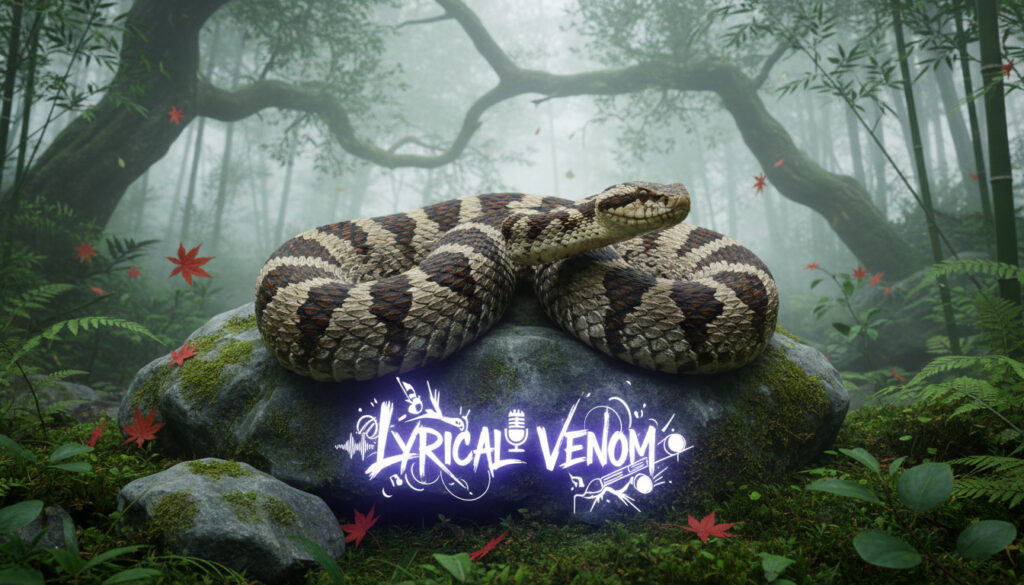
Megan Thee Stallion Mamushi – Lyrics Meaning Yuki Chiba Feature
“Mamushi” emerged as a defining cross-cultural moment in 2024 hip-hop, pairing Houston rapper Megan Thee Stallion with Japanese artist Yuki Chiba over a bilingual track that celebrates wealth, celebrity, and serpentine transformation. Released as part of Megan’s self-titled third studio album MEGAN, the song bridges English and Japanese lyrics while leveraging the symbolism of Japan’s native pit viper to reinforce themes of resilience and rebirth.
The collaboration generated immediate viral momentum on TikTok, driven by a hypnotic chorus declaring stardom in both languages. While the track represents Megan’s continued exploration of snake imagery throughout her discography, it simultaneously introduces international audiences to Chiba’s J-rap aesthetic, marking a rare fusion of Southern hip-hop and Tokyo’s underground scene.
What Does ‘Mamushi’ Mean?
Megan Thee Stallion ft. Yuki Chiba
Hip-Hop / J-Rap Fusion
June 28, 2024
Viral TikTok Hit
The title references the Gloydius blomhoffii, a venomous pit viper endemic to Japan known for its potent hemotoxic venom and camouflaged appearance. Within the track’s narrative, this imagery extends Megan’s established reptilian motifs—previously explored in “Cobra” and “Hiss”—to represent danger, transformation, and the shedding of past hardships for prosperity.
- Bilingual composition alternating between English and Japanese without translation barriers
- Deliberate gendered linguistic contrast: Chiba uses masculine “orera” while Megan uses feminine/neutral “watashi”
- Cross-cultural collaboration initiated during Megan’s March 2024 Tokyo visit
- Snake symbolism representing resilience and striking against opposition
- Viral social media success driven by choreography interpreting the Japanese chorus
- Production by Koshiro Ota (Koshy) blending trap beats with J-pop influences
- Thematic focus on financial acquisition and international stardom
| Fact | Detail |
|---|---|
| Release Date | June 28, 2024 |
| Album | MEGAN |
| Primary Artist | Megan Thee Stallion |
| Featured Artist | Yuki Chiba |
| Producer | Koshiro “Koshy” Ota |
| Writers | M. Pete, Y. Chiba, K. Ota |
| Language | English, Japanese |
| Distribution | Available on Spotify and major platforms |
Who Is Featured on Megan Thee Stallion’s Mamushi?
From KOHH to Global Collaborations
Yuki Chiba previously performed under the moniker KOHH, gaining international recognition in 2015 through his appearance on Keith Ape’s viral track “It G Ma.” Documentation from HerCampus confirms his collaborations extend to Western artists including Frank Ocean on “Nikes” and Mariah Carey’s 2018 remix of “Runway” from her Caution album. More recently, Chiba has performed under his legal name, transitioning from his earlier stage identity.
The Tokyo Meeting
The partnership originated during Megan’s March 2024 appearance at the Crunchyroll Anime Awards in Japan. On March 5, Megan shared photographic documentation of her meeting with Chiba, capturing the moment months before the track’s release. This encounter established the personal connection that facilitated the bilingual collaboration.
The track highlights gendered Japanese pronouns: Chiba employs “orera,” an informal masculine plural indicating “we,” while Megan uses “watashi,” a feminine or gender-neutral singular for “I.” This deliberate contrast underscores distinct cultural perspectives while maintaining thematic unity around stardom and financial success.
Mamushi Lyrics and English Translation
The Japanese Chorus
The hook alternates between Chiba’s declaration “Okane kasegu, orera wa sutaa” (“We make money, we are stars”) and Megan’s response “Okane kasegu, watashi wa sutaa” (“I earn money, I’m a star”). The refrain continues with “Sutaa, sutaa, sutaa, sutaa, kira kira”—the final phrase describing sparkling or glittering light, reinforcing the luminosity of celebrity status.
English Verses and Themes
Megan’s English verses, detailed on Genius, reference stacking currency “like Tetris,” cropped shirts emphasizing physical confidence, and diamond-encrusted jewelry described as “carrot diamonds” performing the “bunny hop.” The lyrics blend Southern hip-hop braggadocio with Japanese cultural references, including the invocation to “Bring them chopsticks to the South,” symbolizing the merger of culinary and cultural traditions.
The mamushi joins Megan’s established snake motif alongside “Cobra” and “Hiss.” In her artistic narrative, snakes represent shedding past struggles for renewed prosperity, striking precision against opposition, and the dangerous beauty of transformed identity.
Mamushi Release Date and Chart Performance
The track released worldwide on June 28, 2024, as part of the MEGAN album launch. While Billboard chart positions remain unverified in available documentation, the song achieved significant viral status through TikTok. The “Watashi wa sutaa” segment inspired widespread choreography challenges, with Megan herself participating alongside influencers including IPHY, who analyzed the gender nuances embedded in the Japanese lyrics.
Precise Billboard Hot 100 positions or verified global streaming figures for “Mamushi” have not been disclosed in publicly available sources as of this report. The song’s commercial success is primarily documented through social media metrics and viral engagement rather than traditional chart rankings.
Where to Watch the Mamushi Music Video
The official visual component premiered on YouTube, featuring cinematic elements that complement the track’s cross-cultural aesthetic. Live performance footage also circulates on the platform, documenting the song’s presentation in concert settings. Viewers can access the primary video through the MAMUSHI (Official Music Video) link.
How Did the Collaboration Timeline Unfold?
- : Megan Thee Stallion meets Yuki Chiba in Tokyo during her Crunchyroll Anime Awards appearance, sharing photographic evidence of their encounter.
- : “Mamushi” releases worldwide as part of the MEGAN album, dropping simultaneously with the project’s launch via Megan’s official channels.
- : The track gains viral traction on TikTok, specifically through user-generated choreography based on the “Watashi wa sutaa” chorus line.
- : Influencer IPHY and Megan post interpretive dances explaining the Japanese gender linguistics, driving further cultural conversation and educational engagement.
What Is Confirmed and What Remains Unclear?
| Established Information | Information Not Fully Verified |
|---|---|
| Release date: June 28, 2024 | Specific Billboard Hot 100 peak positions |
| Featured artist: Yuki Chiba | Exact streaming volume statistics |
| Producer: Koshiro Ota (Koshy) | Potential remix versions or alternate mixes |
| Meeting location: Tokyo, March 2024 | Physical single release or vinyl pressing plans |
| Language: English and Japanese | Planned live television performance schedules |
| Viral TikTok success documented | Long-term chart certification status |
What Is the Cultural Context Behind Mamushi?
The track represents more than a standard feature appearance; it embodies a genuine genre fusion between American Southern hip-hop and Japanese rap. By incorporating the mamushi—a venomous snake native to Japan—Megan extends her recurring reptilian imagery into international symbolism, suggesting danger, earned wisdom, and the ability to strike with precision.
The collaboration reflects evolving trends of J-rap crossing into Western mainstream markets, though “Mamushi” specifically maintains its bilingual integrity rather than forcing either artist into a single linguistic framework. The emphasis on financial success and celebrity status (“sutaa”/star) transcends language barriers, creating a universal anthem of achieved prosperity while respecting the distinct cultural origins of both performers. For those interested in the song’s unique features, you can find the Google barrel roll guide to explore its bilingual lyrics and cultural nuances.
Sources and Attribution
“Mamushi” is a collaboration between Megan Thee Stallion and Japanese rapper Yuki Chiba, released on June 28, 2024, as part of Megan’s album MEGAN.
— HerCampus Cultural Analysis
Yuki Chiba, formerly known as KOHH, is a Japanese rapper who gained international fame in 2015 via Keith Ape’s “It G Ma.”
— HerCampus Artist Biography
Summary
“Mamushi” stands as a testament to Megan Thee Stallion’s global artistic reach and Yuki Chiba’s sustained international relevance. By merging Houston hip-hop with Tokyo’s rap aesthetic over a bilingual hook that dominated TikTok throughout 2024, the track established itself as a significant cross-cultural release. For detailed lyrical analysis and translation notes, see What Do Mamushi Lyrics Mean?.
Frequently Asked Questions
What language is the chorus in?
The chorus alternates between Japanese and English. Chiba performs in Japanese using “orera wa sutaa,” while Megan responds with “watashi wa sutaa” and English variations.
How did Mamushi go viral?
The song exploded on TikTok through dance challenges based on the “Watashi wa sutaa” line. Megan and influencers like IPHY posted choreography explaining the Japanese gender linguistics, amplifying engagement.
Is there a remix of Mamushi?
Available sources do not confirm any official remix versions. The original version featuring Yuki Chiba remains the primary release.
What does the title Mamushi refer to?
Mamushi is a venomous pit viper species native to Japan. In the song’s context, it symbolizes danger, transformation, and resilience, connecting to Megan’s broader snake motif.
Who produced Mamushi?
Koshiro Ota, credited as Koshy, produced the track. He shares writing credits with Megan Thee Stallion (M. Pete) and Yuki Chiba (Y. Chiba).
Where can I find the official music video?
The official video is available on YouTube through the MAMUSHI (Official Music Video) link.
More related posts
 Queens of the Stone Age: 2025-2026 Tour, Health, & History
 How Many Planets Are There? Solar System Planet Count Explained
 What Does Magnesium Do? Benefits for Body, Sleep & More
 How Do You Get Ringworm? Cau e , Tran mi ion, Treatment
 Orange County Clerk of Court – Records, Phone, Locations Guide
 Never Gonna Give You Up Lyrics: Meaning & Rickrolling History
 Friday the 13th 1980 Cast: Killer, Victims & Kevin Bacon
 Pdf Editor Online Free – Best No Watermark Tools 2025