The Devil All the Time: Worth Watching? Plot, Cast, Ending
Faith and violence tangle together in The Devil All the Time — a 2020 Netflix psychological thriller that forces viewers to sit with that darkness for nearly two and a half hours. If you’ve heard the name and wondered whether it earns its reputation, you’re in the right place.
Release Year: 2020 ·
Director: Antonio Campos ·
Based On: Novel by Donald Ray Pollock ·
Setting: Rural Ohio and West Virginia ·
Runtime: 138 minutes
Quick snapshot
- Fictional story adapted from Donald Ray Pollock’s novel (Wikipedia)
- 2020 Netflix psychological crime thriller (Wikipedia)
- Set in rural Ohio and West Virginia, spanning 1950s–1960s (GamesRadar)
- Whether sequel development is actively underway
- Exact streaming viewership figures remain proprietary
- Long-term cultural impact on Netflix’s gothic programming slate
- Rotten Tomatoes: 64% critics / 78% audience (Wikipedia)
- Metacritic: 56/100 critics score (Wikipedia)
- Viewer discussions remain active years after release (Wikipedia)
- Netflix has not announced sequel plans
- Director Campos remains active in indie horror space
- Donald Ray Pollock’s other works occasionally surface for adaptation
The table below consolidates essential facts about the film into a scannable format.
| Category | Details |
|---|---|
| Director | Antonio Campos |
| Lead Actors | Tom Holland, Bill Skarsgård, Robert Pattinson |
| Genre | Psychological crime thriller |
| Platform | Netflix |
| Source Material | Donald Ray Pollock novel |
Is it Worth Watching The Devil All the Time?
Whether this film rewards your time depends heavily on what you’re bringing to it. It’s not a conventional thriller, and it doesn’t apologize for what it is.
Pros and Cons
Upsides
- Robert Pattinson delivers a career-defining performance as the monstrous preacher Preston Teagardin (GamesRadar)
- The film’s unflinching examination of how religious fervor masks and enables abuse resonates strongly
- Tom Holland demonstrates surprising dramatic range away from his Spider-Man persona (Digital Spy)
- Cinematography captures rural decay with unsettling beauty
Downsides
- The 138-minute runtime tests patience, with deliberate pacing throughout
- Multiple interwoven storylines can feel fragmented for viewers expecting linear narrative
- Graphic violence and disturbing imagery will alienate casual viewers
- Some critics found the fatalism overwhelming without sufficient emotional payoff
Audience vs Critic Reception
The gap between audience and critical scores tells its own story. Rotten Tomatoes shows a 14-point divergence: critics landed at 64% while audiences scored it 78% (Wikipedia). Metacritic’s critics aggregate sits at 56/100. Viewers who connected with the film’s wavelength often rave about it; those who couldn’t find footing report feeling manipulated by its darkness. Reddit discussions remain active years later, with fans debating whether the violence serves the themes or overwhelms them.
What is the Main Plot of The Devil All the Time?
The film weaves together several storylines set in rural Ohio and West Virginia, spanning the 1950s and 1960s. What connects them is a recurring question: what happens when faith becomes a tool of harm?
Key Characters
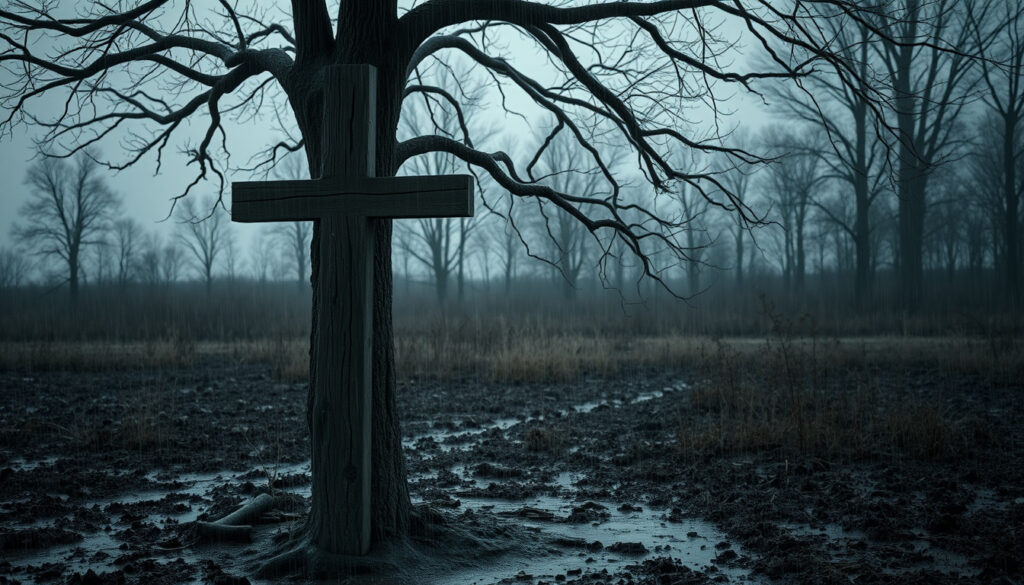
Willard Russell (Bill Skarsgård) is a Vietnam veteran who believes God will cure his wife Charlotte’s cancer if he sacrifices their dog’s life at a roadside cross. Charlotte dies anyway. Willard then takes his own life at that same cross, and his young son Arvin (Tom Holland) discovers both bodies (Wikipedia).
Orphaned Arvin goes to live with his grandmother Emma, who has also taken in Lenora, a girl whose parents died under suspicious circumstances. The parallel between these orphaned children anchors the film’s thematic core. When Lenora is sexually assaulted by the charismatic preacher Preston Teagardin (Robert Pattinson), she becomes pregnant. She attempts suicide by hanging but accidentally kills herself (GamesRadar).
Arvin learns the truth and hunts Preston down, eventually shooting him in the woods — a final act that closes one violent cycle while the film’s thematic questions remain open.
Timeline Overview
The narrative unfolds roughly chronologically, though with significant crosscutting between storylines. The post-WWII setting grounds everything in a specific American moment when returning veterans, small-town isolation, and institutional religion created particular pressures on rural communities. The 1960s setting allows the film to reference changing social conditions without being distracted by them.
Pattinson’s performance as the predatory preacher makes every interaction with Lenora feel dangerous. The character’s charisma is precisely what makes his crimes so disturbing.
Was The Devil All the Time a Hit?
Defining “hit” gets complicated when a title releases exclusively on streaming. Netflix has never disclosed specific viewership data, which means the commercial question doesn’t have clean answers.
Box Office and Streaming Performance
The film debuted simultaneously in limited theatrical release and on Netflix on September 16, 2020. Without theatrical tracking to anchor expectations, analysts can only infer success from Netflix’s continued investment in similar dark fare. The platform has greenlit several psychological thrillers with comparable tonal profiles since, suggesting the 2020 title found its audience — even if that audience was numerically smaller than a theatrical hit would require.
Awards and Nominations
Robert Pattinson received nominations for Best Supporting Actor from the Chicago Film Critics Association and the Detroit Film Critics Society (Wikipedia). The film’s cinematography earned recognition from the American Society of Cinematographers. Notably, it was not nominated for major Academy Awards, which tracks with its mixed critical reception at prestige level.
What this means: The Devil All the Time connected with viewers who found it, earned respect from industry professionals who noticed the craft, and remains a cult favorite without breaking into mainstream awards contention.
Is the Movie The Devil All the Time Based on a True Story?
No. The Devil All the Time is a fictional work adapted from Donald Ray Pollock’s 2011 novel of the same name. No real crimes or individuals are depicted.
Source Material
Pollock, who grew up in southern Ohio, crafted the novel with clear autobiographical resonances — the settings, the class anxieties, the specific flavor of rural religious experience. But when asked about inspiration, Pollock has described the book as fiction built from cultural texture rather than documented events (GamesRadar).
Real-Life Inspirations
The film doesn’t claim any specific real-life inspirations, though certain storylines echo documented American crimes involving predatory clergymen and desperate rural violence. Director Antonio Campos has spoken about approaching the material as a character study rather than a social-problem message. The horror comes from human psychology, not supernatural or extraordinary circumstances.
Fiction about invented crimes ends up more disturbing than many true-crime accounts. By refusing to blame any specific real tragedy, the film forces audiences to confront how ordinary the conditions are that produce such violence.
The Devil All the Time Ending Explained
The film’s conclusion resolves its narrative mechanics while leaving its deeper questions deliberately open. Understanding what happens — and why it matters — requires unpacking both the plot mechanics and the thematic architecture.
Key Twists
After Lenora’s death, Arvin learns she was pregnant. He stalks Preston and observes him grooming another young girl, confirming his suspicions about who fathered Lenora’s child (Wikipedia). Arvin then hunts Preston down in the woods, where he shoots and kills him.
The twist that lands hardest: the cycle doesn’t end with justice. Arvin shoots Preston, drives away, and is presumably arrested. The ending credits roll over a final image that returns us to where the film began — a suggestion that violence begets violence, and individual acts of retribution don’t break collective patterns.
Themes of Sacrifice
Three characters attempt sacrifice to change their circumstances. Willard sacrifices his dog to save Charlotte. Lenora sacrifices herself to escape shame. Arvin sacrifices Preston to avenge Lenora. None of these sacrifices produces redemption. This is the film’s darkest argument: that American mythology around sacrifice as a pathway to grace is itself a kind of delusion.
The implication: Arvin’s action is understandable, even morally defensible, but it doesn’t free him from the conditions that shaped him. The rural landscape that enabled Preston’s predation remains intact. His grandmother Emma still tends her garden. The townsfolk still gossip. Justice was done, but nothing was healed.
The pattern: individual virtue cannot repair structural failure. Arvin is righteous. The system around him is not.
What Reviewers and Audiences Are Saying
Pattinson’s Teagardin is a performance of hypnotic menace — the kind of character who makes you check your own front door locks without quite knowing why.
Digital Spy film review (2020)
The Devil All the Time asks uncomfortable questions about faith, corruption, and the violence we inherit from those who came before us. It doesn’t always answer them, but that’s precisely the point.
GamesRadar film analysis (2020)
Tom Holland proves he can carry a dark drama far beyond his superhero persona, delivering a performance that surprised audiences expecting nothing more than web-slinging.
Digital Spy film review (2020)
Related reading: Flight Risk (Film) – Plot, Cast, Release and Reviews · Cast of the Black Phone 2 – Full List of Actors and Roles
screenrant.com, youtube.com, archive.thetab.com, denofgeek.com, youtube.com
Frequently asked questions
Who is in the cast of The Devil All the Time?
The ensemble cast features Tom Holland as Arvin Russell, Bill Skarsgård as Willard Russell, Robert Pattinson as Preston Teagardin, Mia Wasikowska as Lenora, Eliza Scanlen as young Lenora, and Jason Clarke as Carl Henderson.
What is the book The Devil All the Time about?
Donald Ray Pollock’s novel follows the same interwoven storylines as the film — multiple characters in rural Ohio and West Virginia whose lives intersect through violence, faith, and corruption. The book was published in 2011 and received critical praise for its atmospheric prose and unflinching characters.
Is there a The Devil All the Time sequel?
No sequel has been announced. Director Antonio Campos and author Donald Ray Pollock have not confirmed any active development on a follow-up film.
Where can I watch The Devil All the Time trailer?
The official trailer is available on Netflix’s YouTube channel and on the film’s official Netflix landing page. Search “The Devil All the Time Netflix official trailer” to locate it.
What is the meaning behind The Devil All the Time?
The film explores how faith can become corrupted into excuse for harm, how violence creates cycles that individual righteousness cannot break, and how rural American isolation produces particular vulnerabilities to predatory figures. The title refers to a biblical phrase suggesting that evil is always present — not as supernatural force, but as a persistent human possibility.
What are common criticisms of The Devil All the Time?
The most frequent criticisms center on pacing (many viewers find 138 minutes excessive), violence (some feel the disturbing imagery overwhelms character development), and fatalism (critics who want moral resolution report frustration with the film’s refusal to provide clean answers).
How long is The Devil All the Time?
The film runs for 138 minutes, making it one of the longer Netflix original films. The runtime reflects the source material’s scope and the director’s deliberate pacing choices.
More related posts
 Giants vs Saints 2025: Final Score & Player Stats
 Case Western Reserve University: Prestige, Rankings & Facts
 Tom Glynn-Carney Biography: Height, Age, and House of the Dragon
 Hotels in Los Angeles: Best Areas, Prices & First-Trip Tips
 WWE Crown Jewel 2025 Results, Match Card, and How to Watch
 Teacher Appreciation Week 2025: Dates & Teacher-Tested Gift Ideas
 Planet of the Apes 2001: Criticism, Legacy, and Canceled Sequel
 When is Juneteenth 2025? Date, History, and Celebration Guide