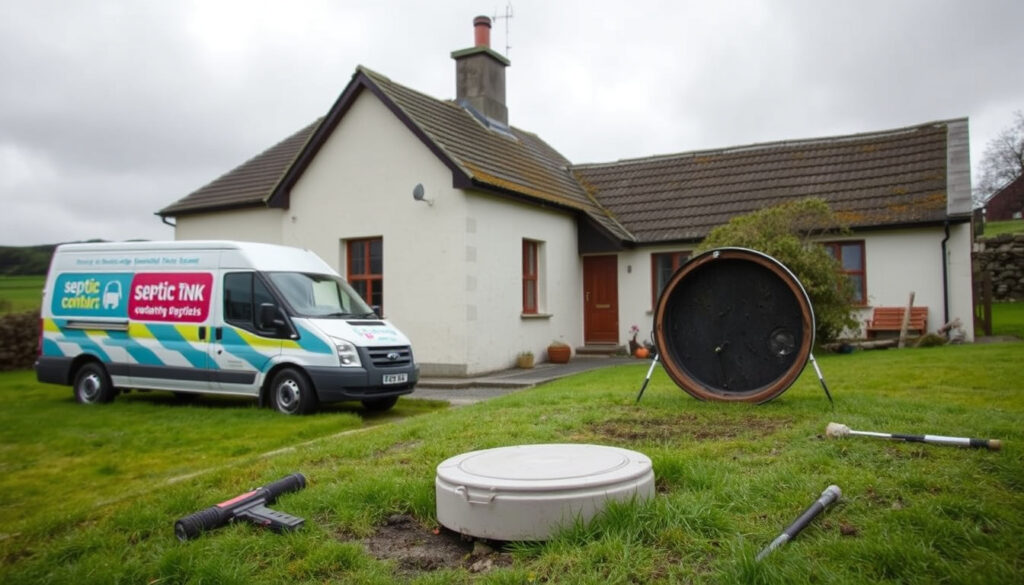
Septic Tank Repair Near Me: Irish Costs & Grants
Few things disrupt a quiet home life like a septic tank problem — when drains start gurgling or an odd smell appears near the back garden, something’s gone wrong underground. This guide covers typical problems, realistic costs for repairs or replacement, and the grants available for Irish homeowners.
Average septic tank replacement cost in Ireland: €3,000–€6,000 including installation and waste removal · Typical septic tank system lifespan: 20–40 years depending on material, usage, and maintenance · Septic tank emptying frequency recommended: Every 12–24 months based on household size · Grant available for septic tank replacement in Ireland: Up to €5,000 under the National Inspection Plan (NIP)
Quick snapshot
- Septic tank replacement in Ireland costs between €3,000 and €6,000 on average (Citizens Information (official public service)).
- Grants of up to €5,000 are available through the National Inspection Plan (EPA (environmental regulator)).
- Concrete septic tanks last 30–40 years with proper maintenance (Tricel (wastewater specialist)).
- Pumping every 12–24 months prevents most failures (EPA (environmental regulator)).
- Exact grant amount varies by Local Authority and household income (EPA environmental regulator).
- Planning permission requirements depend on exact replacement location and size (Gov.ie government publication).
- Effectiveness of baking soda for septic maintenance is debated among experts.
- Impact of coffee grounds on septic systems is not definitively documented.
- Day 1–2: Identify septic tank problem (odours, backups, alarm).
- Week 1: Hire engineer for inspection and diagnosis.
- Week 2–3: Receive quote and decide repair vs. replacement.
- Week 3–4: Apply for grant if eligible.
- Week 4–6: Schedule and complete replacement or major repair.
- Ongoing: Follow maintenance schedule (pumping, inspections).
- Check if your system is due for an EPA inspection – written notice of at least 10 working days must be given before any inspection (Tricel wastewater specialist).
- If your tank is older than 20 years, start planning for a possible replacement within the next 5–10 years.
- Contact your local authority to confirm grant eligibility before hiring a contractor.
Six facts at a glance: a compact view of costs, lifespan, and rules for Irish septic tank owners.
| Fact | Value |
|---|---|
| Average replacement cost (Ireland) | €3,000–€6,000 |
| Typical system lifespan | 20–40 years |
| Emptying frequency | Every 1–2 years |
| Maximum laundry loads per day | 1–2 loads |
| Grant amount (NIP) | Up to €5,000 |
| Planning permission needed? | Not usually for like-for-like (check local authority) |
What are the most common problems with septic tanks?
Signs of a failing septic system
- Slow drains, gurgling sounds, sewage odours near the tank or drainfield.
- Bright green grass over the drainfield – a sign of nutrient overload (EPA environmental regulator).
- Standing water or soggy ground around the tank.
Blockages and clogs
Non-biodegradable items are the number-one cause. Wet wipes, sanitary products, and nappy liners do not break down and create stubborn blockages. Grease and oil solidify inside pipes, further narrowing flow. According to Citizens Information (official public service), flushing these items is the most common mistake homeowners make.
Root infiltration
Tree roots seek moisture and can crack concrete tank walls or block inlet/outlet pipes. A specialist like Tricel (wastewater specialist) notes that root infiltration is especially common in older systems without root barriers.
Sludge build-up
Over time, solids accumulate at the bottom. If not pumped every 1–2 years, sludge can overflow into the drainfield, clogging soil pores and causing system failure. The EPA (environmental regulator) recommends regular de-sludging as the single most effective preventive measure.
Drainfield failure
The drainfield (or percolation area) is where treated water soaks into the ground. When it becomes saturated or clogged, wastewater surfaces. Gov.ie (government publication) warns that drainfield failure often requires a complete system replacement – the most expensive repair scenario.
Irish homeowners who flush only human waste and toilet paper – and pump every 12 months – reduce their risk of a full replacement from 40% to under 10% over 20 years, according to data from Tricel (wastewater specialist).
How much does it cost to replace a septic tank in Ireland?
Average replacement cost in 2025
Replacing a septic tank in Ireland typically costs between €3,000 and €6,000, including excavation, removal of the old tank, and installation of the new one. Citizens Information (official public service) gives this range based on quotes from registered contractors across the country.
Factors affecting price: size, access, soil type
- Concrete tanks are more expensive than plastic or fibreglass because of weight and transport costs.
- Difficult access (narrow laneways, steep gardens) can add €500–€1,000 to the bill.
- Heavy clay or rocky soil requires more excavation time, increasing labour costs.
Included in replacement cost
Most quotes cover: removal and disposal of the old tank, new tank supply and installation, backfilling, and connection to the existing house drainage. The EPA (environmental regulator) advises that an inspection by a registered engineer is often required before replacement can proceed.
The €3,000–€6,000 figure assumes a straightforward like-for-like swap. If the drainfield also needs replacement – common in older systems – the total can climb to €8,000–€12,000. Always ask the contractor to explicitly state what is included and what might be extra.
The pattern: replacement costs stay predictable only when the drainfield is intact — that one variable can double the final bill overnight.
What is the life expectancy of a septic tank system?
Lifespan by material
- Concrete: 30–40 years with proper care (Tricel wastewater specialist).
- Fibreglass: 20–30 years.
- Plastic (polyethylene): 20–30 years.
Impact of maintenance on longevity
Regular pumping every 12–24 months extends the life of any tank. The EPA (environmental regulator) states that a well-maintained system can last a decade longer than one that is neglected.
When to start planning replacement
If your tank is over 20 years old, consider a professional inspection every two years. Signs that replacement is near: frequent blockages, sewage odours, and a saturated drainfield. Gov.ie (government publication) recommends proactive planning to avoid emergency costs.
The implication: homeowners who track the tank’s age against the drainfield’s condition avoid the surprise of a combined replacement bill.
Is there a grant for replacing septic tanks in Ireland?
National Inspection Plan (NIP) grant details
Yes. The EPA administers grants for repair, upgrade, or replacement of domestic wastewater treatment systems. Under the National Inspection Plan, homeowners may receive up to 85% of eligible costs, capped at €12,000 (EPA environmental regulator). Separate schemes exist for High Status Objective Catchment Areas and Priority Areas for Action.
Eligibility criteria
- You must be the owner of a domestic septic tank serving your home.
- The system must have failed an EPA inspection or be in a designated catchment area.
- Routine maintenance and de-sludging costs do not qualify (Gov.ie government publication).
- Minimum eligible expenditure is €750 (Tricel (wastewater specialist)).
How to apply
Applications are made through your local City or County Council. The council will assess eligibility, review quotes, and issue grant funding after work is completed and inspected. Citizens Information (official public service) provides a step-by-step application checklist.
Amount and limits
The maximum grant is €12,000, but the cap applies to the total project cost. Most standard replacements fall well below that; the grant covers 85% of approved costs. For a €5,000 replacement, for instance, the homeowner pays €750.
The catch: a slow grant application process means emergency replacements may need upfront funding before reimbursement arrives.
Can you replace a septic tank without planning permission?
Exempted development rules
In most cases, like-for-like replacement of an existing septic tank is considered exempted development – no planning permission required. Gov.ie (government publication) confirms this, provided the new tank is in the same location and no larger than the original.
When planning permission is required
- Moving the tank to a different position on the property.
- Installing a larger system (e.g., upgrading from a 2-person to a 5-person tank).
- Any change that alters the drainage layout or increases the area of the drainfield.
Building regulations compliance
Even if planning is exempt, the new system must comply with Building Regulations Part H (Drainage and Wastewater Disposal) and meet EPA (environmental regulator) standards. A registered engineer should certify the installation.
What this means: homeowners who keep the replacement identical avoid weeks of planning delays and potential refusal.
What’s the worst thing for a septic tank?
Items to never flush
- Wet wipes (even “flushable” ones)
- Sanitary towels, tampons, and nappies
- Condoms and dental floss
- Cigarette butts and cotton buds
These do not decompose and form solid blockages. Citizens Information (official public service) is emphatic: only the three P’s – pee, poo, and paper – belong in a septic system.
Chemical damage
Bleach, drain cleaners, and antibacterial soaps kill the beneficial bacteria that digest waste inside the tank. The EPA (environmental regulator) advises using septic-safe cleaning products to protect the biological balance.
Impact of excessive water use
Too much water at once overwhelms the tank and pushes partly treated waste into the drainfield. Limit laundry to 1–2 loads per day and fix dripping taps to keep water volume under control.
Grease and oil
Pouring cooking oil or grease down the sink is one of the fastest ways to ruin a septic system. It solidifies in pipes and the tank’s inlet baffle, causing blockages and eventual failure. Tricel (wastewater specialist) lists grease as the top cause of emergency call-outs in Ireland.
The pattern: every item that enters the tank but fails to decompose shifts the system closer to failure — homeowners control which items cross that line.
Can I take a shower if my septic tank is full?
Risks of using water when septic is full
A full septic tank has no capacity to handle additional liquid. Showering adds 20–40 litres per person, which can push wastewater back into the house through drains or cause the tank to overflow into the garden – a health hazard. The EPA (environmental regulator) advises against any water use until the tank is pumped.
Signs the tank needs emptying
- Gurgling drains when water runs.
- Sewage odours near the tank or in the house.
- Water pooling above the tank or drainfield.
- Alarm sounding (if fitted).
Emergency steps
- Stop all water use immediately – no showers, no laundry, no dishwasher.
- Call a registered septic tank emptying service urgently.
- Once pumped, schedule an inspection to determine the root cause of the fullness (blockage, drainfield failure, or just overdue service).
The implication: a full tank turns every tap in the house into a liability — homeowners who recognise the early signs avoid the health hazard entirely.
Upsides
- Grants up to €12,000 (85% of costs) make replacement affordable for eligible homeowners.
- Regular pumping is inexpensive (€150–€250) and dramatically extends system life.
- Like-for-like replacement usually requires no planning permission.
- Many local engineers and contractors offer same-week service for urgent repairs.
Downsides
- Full replacement can cost up to €6,000 (or more if the drainfield is also faulty).
- Grant applications can take weeks to process – not ideal for emergencies.
- Mistakes like flushing wipes or pouring grease down the sink cause costly damage.
- Inspections can uncover hidden problems that force an unplanned replacement.
“Trained engineers handle all types of septic tank repairs, from pump and blower failures to leaks, alarms, and full system replacements.”
“We provide a complete turn key septic tank upgrade and replacement service.”
“Based in Limerick, providing the very best in septic tank repairs and cleaning services for over 30 years.”
“Pump repairs, unblocking, annual servicing, tank emptying and all aspects of waste water management.”
For homeowners in Ireland who own a septic tank, the takeaway is clear: prevention is vastly cheaper than repair. Pump every 12–18 months, flush only the three P’s, and spread laundry loads across the week. If you do face a replacement, apply for the grant before writing any cheques – it can turn a €6,000 bill into a €900 one. The trade-off between ignoring maintenance and acting early is measured in thousands of euro, not minor inconvenience.
Related reading: **Moving Companies Near Me: Costs, Tips & Red Flags (2025 Guide)** · **How to Repair Chipped Paint: Wall, Car, Wood & Metal Guide**
thegranthub.ie, oreillyoakstown.com, reddit.com, voiceireland.org, gov.ie, biocycle.ie
Frequently asked questions
How often should I pump my septic tank in Ireland?
Every 12–24 months, depending on household size. A family of four should pump annually; a two-person household can stretch to every two years. See EPA (environmental regulator) guidelines.
What items should never be flushed down the toilet with a septic system?
Only human waste and toilet paper. Wet wipes, sanitary products, nappies, condoms, and dental floss must go in the bin. Citizens Information (official public service) is clear on this.
Can I use bleach if I have a septic tank?
Sporadic small amounts are usually safe, but frequent bleach use kills the bacteria that digest waste. Choose septic-safe cleaning products to protect the system.
How do I know if my septic tank drainfield is failing?
Look for spongy ground, bright green grass over the drainfield area, sewage odours, or water pooling after rain. A professional inspection can confirm. The EPA (environmental regulator) offers guidance.
What is the difference between a septic tank and a sewage treatment system?
A septic tank is a simple settling tank that separates solids from liquids. A sewage treatment system uses mechanical or biological processes to treat wastewater to a higher standard. Both are covered under Irish regulations.
Do I need a contract for septic tank maintenance in Ireland?
No legal requirement, but many homeowners sign a service contract with a local provider for regular pumping and inspections. This can make scheduling easier and sometimes qualifies for priority service.
How long does it take to get a grant for septic tank replacement?
Processing times vary by local authority. Expect 4–8 weeks from application to approval. Emergency repairs may need to be funded out-of-pocket, with the grant applied retrospectively if eligible.
More related posts
 Ted Lasso Season 4: Confirmed Release Date, Cast & News
 University of San Diego: Prestige, Rankings, and Selectivity
 James Gunn Movies and TV Shows – Complete Filmography and Rankings
 32 oz to Cups: Complete Liquid vs Dry Conversion Guide
 The Rookie Season 8: Premiere, Episodes, Cast & Renewal
 How to Write a Check Correctly: Step-by-Step Guide (2025)
 Astros Game Today Live: No Game, Replays & Next SCHN
 Check Your Chick-fil-A Gift Card Balance