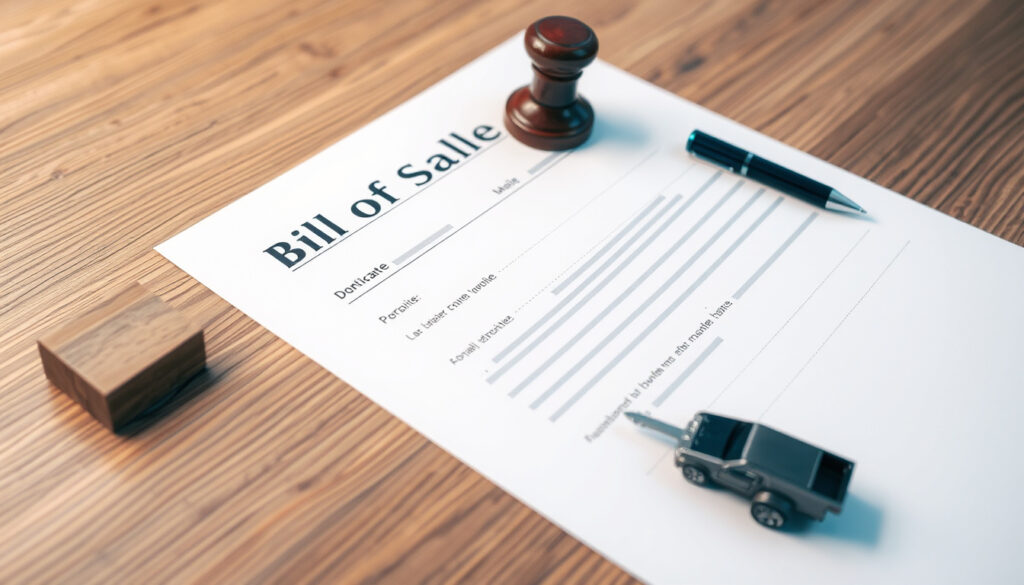
Bill of Sale Template: Write a Legally Valid Form in 5 Steps
Anyone who has sold a car, boat, or tractor to a stranger knows the moment when a handshake feels like the only thing between you and a fair deal. A bill of sale is that handshake, made into a permanent record — but only if the right details are on the page.
U.S. states requiring notarization for vehicle bill of sale: 14 ·
Average consumer cost of a lawyer-drafted bill of sale: $200–$500 ·
Year LawDepot launched its free customizable template: 2001 ·
States with specific bill of sale forms for vehicles: 38
Quick snapshot
- Handwritten bills of sale are legally valid in all 50 states (CarWhere).
- 14 states require a bill of sale to be notarized for vehicle transfers (CarWhere).
- A bill of sale proves the transaction happened; it does not transfer title (Indiana Bureau of Motor Vehicles).
- Whether courts enforce bills of sale lacking odometer disclosure varies by jurisdiction (CarWhere).
- No public source aggregates disputes involving homemade versus template bills. (CarWhere)
- 2001: LawDepot launched its first online bill of sale template.
- 2010: Uniform Commercial Code revisions standardized requirements across states.
- 2025: 38 states now have standardized vehicle bill of sale forms.
- Expect more states to adopt electronic notarization for private sales.
- Buyers will increasingly demand templates with odometer disclosure built in.
- Free state-provided forms will continue to replace generic DIY templates.
What is a bill of sale and who needs one?
A bill of sale is a written record that transfers ownership of an item from one person to another. It is not the same as a title — which is a separate document that proves who currently owns the vehicle. The bill of sale captures the moment of transfer: what was sold, for how much, and under what conditions.
Anyone selling a vehicle, boat, motorcycle, trailer, or other high-value personal property needs one. Private sellers — not dealerships — are the primary users, since dealers typically have their own paperwork. A bill of sale protects both parties if a dispute later arises about the condition of the item, the agreed-upon price, or whether the sale actually happened.
Who specifically should use a bill of sale?
- Private vehicle sellers in any state — a bill of sale is the single documented proof of the transaction.
- Buyers paying in cash — without a bill of sale, a cash transaction leaves no paper trail for tax or ownership purposes.
- Sellers of boats, ATVs, or RVs — many states treat these as vehicles requiring a bill of sale even when the item is not titled.
- Anyone selling an item worth over $500 — at this threshold, oral contracts become harder to enforce in many states.
How do I make a homemade bill of sale?
A homemade bill of sale is a piece of paper you write, type, or print from a free template. On one level, it’s as simple as that. On another, the details determine whether it protects you. The good news: making one is easy, and the required fields are few.
- Identify the parties — write the full legal names of buyer and seller, along with addresses. For vehicles, include the seller’s driver’s license number.
- Describe the item — for a car, that means year, make, model, body style, color, VIN, and odometer reading at the time of sale.
- State the price — write the amount in both numbers and words, and specify whether the sale price includes taxes and fees.
- Add the date and signatures — the date of the sale, the buyer’s signature, and the seller’s signature.
- Make copies — the buyer gets the original; the seller keeps a photocopy. Some states require the buyer to present the bill of sale at registration.
What information should every bill of sale include?
At a minimum, a bill of sale must include the buyer’s and seller’s names, the item description with VIN or serial number, the price, and the date of sale. Many states also require the odometer reading for vehicles under ten years old. A handwritten bill of sale is legally valid in all 50 states — notarization is the exception, not the rule.
How to write a bill of sale on a piece of paper
Writing a bill of sale by hand is simple — but the details matter. Omit one field and the document loses its power in a dispute. The safest approach is to use a LawDepot template, which was launched in 2001 and has been refined through thousands of transactions, or a Bill of Sale Tool guide that shows which fields your state requires.
A handwritten bill of sale is legally binding in all 50 states — but only if it includes every field above. A single missing VIN or a date written in the wrong format can make the document worthless in court, which is why most people choose a template for a few dollars rather than risk a DIY version.
For vehicles, the VIN and odometer reading are the two fields most commonly skipped. A generic template may not include a dedicated odometer disclosure field — yet states like Texas and Florida require it for vehicles under ten years old. When you write a handwritten bill of sale, add the odometer reading in the middle of the document so neither party can claim it was added after the fact.
Skipping the odometer disclosure is a federal offense under 49 U.S.C. § 32705, and states have their own penalties. A bill of sale that looks complete but lacks this field is a liability, not a protection.
The implication: a homemade bill of sale demands precision that most casual sellers underestimate. The fields themselves are simple, but the legal weight comes from completeness, not format.
Will a handwritten bill of sale work in Texas or Florida?
Yes — in every state. No state requires a bill of sale to be typed, printed, or notarized to be valid. What differs is whether the state requires a specific form for certain transactions. That’s why a homemade bill of sale works in Texas but might need to be attached to a Florida DMV form to register a vehicle there.
| State | Handwritten Bill of Sale Valid? | Notarization Required? |
|---|---|---|
| Texas | Yes | No (not required for private vehicle sales) |
| Florida | Yes | No (but must use specific HSMV 82050 form for vehicles) |
| Indiana | Yes | No (unless the vehicle is not required to be titled) |
| New York | Yes | No (but odometer disclosure is mandatory) |
According to the Indiana Bureau of Motor Vehicles, Texas does not require a bill of sale to be notarized for private vehicle sales — you can write one on a napkin and it’s still valid. Florida similarly doesn’t require notarization for most private vehicle sales, but the state mandates that a specific form be used for registration. The Florida Highway Safety and Motor Vehicles department provides this form as a free PDF.
The pattern: a handwritten document’s legal power comes from its content, not its format. A napkin with the right details is as enforceable as a lawyer’s template — the opposite of the “official form only” myth.
Does Florida require a specific bill of sale form?
Florida does require a specific form for vehicle bill of sale: Form HSMV 82050. This form has sections for the buyer and seller to complete, and the department directs that the seller must sign it in the presence of a notary or two witnesses if the sale includes a lien. This is one of the few states where the form itself is regulated, though the bill of sale itself does not need notarization.
Can I use a blank Texas bill of sale form?
A blank Texas bill of sale form — one you print from a template website — is the same as writing one by hand. Texas does not require a specific form, only a written document with the necessary fields. The DMV.org tool lets you generate a bill of sale for your state, and their guide explains that Texas accepts any complete bill of sale, including handwritten ones.
The bill of sale’s legal power comes from its content, not its format. A handwritten document with the right details is as enforceable as a lawyer’s template — the opposite of the “official form only” myth.
The catch: a handwritten bill of sale is perfectly legal, but state-specific forms reduce error risk by forcing a checklist of required fields. For Texas sellers, a napkin works legally — but a template works smarter.
Do I need a specific form, or can I use a bill of sale template?
A generic bill of sale template works in most states, but not in all. Some states require a specific form — and using the wrong one can delay registration or cost you the sale. The key is knowing whether your state has an official form or simply a set of required fields.
The table below shows the difference. States like Florida publish an official form; others, like Texas, accept any written document with the right information. Thirty-eight states have standardized forms, but that doesn’t mean you must use them — it means the state has a template it prefers.
| State Approach | Example States | Using a Generic Template |
|---|---|---|
| Official state form required | Florida, Louisiana, Maryland | Works only if the state’s fields are included; safest to use the official PDF |
| Accept any written document | Texas, Indiana, Ohio | A template is fine — just include all required fields |
| State-specific notarization rules | 14 states including Arkansas, Connecticut | A generic template may not alert you to notarization requirements |
Florida’s official bill of sale form (HSMV 82050) is worth knowing about if you sell vehicles in that state. It includes sections for the buyer and seller to fill out, and the Florida Highway Safety and Motor Vehicles department publishes it as a free PDF. Similarly, CarWhere notes that a bill of sale itself needs notarization in just 14 states — but this is a per-transaction requirement, not a per-document one.
For private sellers, a LawDepot bill of sale template is a strong starting point because it’s customizable and was built with legal counsel review. But a state-specific form is always the safer choice when one is available — it has the state’s required fields already printed in the right order.
Free printable bill of sale template vs. state forms
Free printable bill of sale templates are everywhere online. Some are good; others are outdated or omit state-specific requirements. The risk is low when the transaction is straightforward — a car sold for cash, a boat sold “as-is” — but it rises when the item has a loan against it, or when the state requires odometer disclosure.
- Free printable templates — okay for most states, especially if they come from a reputable source like e-Laws or LawDepot.
- State-provided forms — the safest option for vehicles because states like Florida and Texas tailor their forms to registration requirements.
- Lawyer-drafted templates — the gold standard, but they cost $200–$500 when you use a service like LawDepot or LegalTemplates.
Does a bill of sale need to be notarized in Texas?
Usually, no. Only 14 states require notarization for a vehicle bill of sale. The other 36 states accept an un-notarized document — as long as it includes the required elements. However, notarization adds a layer of authenticity that makes it harder for either party to claim the signature was forged or the document was altered after signing.
Indiana Bureau of Motor Vehicles specifically states that “Texas does not require a bill of sale to be notarized” for private vehicle sales. In states like Louisiana and Maryland, the requirement is the opposite — a bill of sale is not valid without notarization. Notarization is required in these states regardless of what the template or form says.
When is notarization legally required for a bill of sale?
Notarization becomes a legal requirement when a state mandates it for a specific type of transaction — typically vehicle transfers or high-value personal property. For example, Arkansas requires notarized bills of sale for vehicles purchased from private parties, and Connecticut requires them for vehicles being transferred between family members where a gift tax applies.
| Situation | Notarization Required? |
|---|---|
| Vehicle sold in a state with notarization laws (e.g., Louisiana, Maryland, Connecticut) | Yes |
| Vehicle sold “as-is” in a state without notarization laws | No |
| High-value item sale (e.g., boat, aircraft, classic car) | Recommended, not required, in most states |
Notarization is a trap for DIY sellers — it’s not required in most states, but using a template that includes a notary block makes it look like it is, which confuses buyers into thinking the bill of sale is invalid without one.
What this means for Texas sellers: ignore any template that demands a notary stamp. Your handwritten bill of sale is enforceable the moment both parties sign it. The notary block is optional decoration, not legal necessity.
Do I need a bill of sale to register a car in my state?
Often, yes — but the exact requirement varies by state and by what you’re registering. A car with a title, for instance, needs a bill of sale only to document the price for tax purposes in some states. A boat with no title may need a bill of sale as the primary proof of ownership.
| Vehicle Type | Bill of Sale Required for Registration? | Notes |
|---|---|---|
| Car, truck, or motorcycle (titled) | Not always | Title transfer may suffice; bill of sale is for tax or residue protection |
| Vehicle under 10 years old | Yes, odometer disclosure | Required by federal law |
| Boat, jet ski, or ATV | Often required | Most states require a bill of sale for registration when no title exists |
| Older or homemade trailer | Sometimes | Depends on state; some accept a bill of sale alone for ownership |
The Indiana Bureau of Motor Vehicles is a good example of a state that accepts a bill of sale as proof of ownership only in specific situations — vehicles not required to be titled, certain older trailers, and off-road vehicles. For most cars, the title is the document that matters; the bill of sale is supportive evidence.
Which states do not require a bill of sale for registration?
In states where the title transfers ownership, a bill of sale is generally not required for registration — the title assignment serves that purpose. The bill of sale becomes a supporting document, not a primary one. But when a vehicle is old, homemade, or lacks a title, the bill of sale steps into the primary role.
A bill of sale is essential documentation, but it is not ownership evidence by itself — unless no title exists. That’s why the DMV asks for it in specific situations, and why private sellers should always provide one.
The implication: a bill of sale’s role shifts depending on the asset. For titled vehicles, it’s a receipt. For untitled property, it’s the ownership document itself. Know which category your sale falls into before you write a single word.
What are common mistakes on a bill of sale?
The most common mistakes are also the most avoidable — and the most damaging. A bill of sale riddled with errors can cost a seller the sale, the price, or both. In some states, it can even turn a straightforward transfer into a dispute over whether the sale happened.
- Missing VIN or serial number — without it, the bill of sale describes an invisible item.
- Odometer disclosure omitted — a federal requirement for vehicles under 10 model years old; failure can trigger $10,000 in penalties.
- Signing in the wrong place — some states require both buyer and seller to sign the same line, others require separate lines.
- Date confusion — the sale date and the signature date must match, or the document becomes ambiguous.
- Not stating the condition — “as-is” must be written explicitly, or the seller may be held liable for undisclosed defects.
A bill of sale is designed to prevent disputes, but an incomplete bill of sale creates new ones — and courts are more likely to side with the buyer when the seller left out critical details.
Mistakes that invalidate a bill of sale
- Missing VIN or item serial number — the single most common error, and the one that makes a vehicle bill of sale useless at the DMV.
- Skipping the odometer disclosure — legally required for vehicles under 10 model years old; failure results in fines and ownership disputes.
- Buyer and seller dating signatures incorrectly — if the seller signs on June 3 and the buyer signs on June 5, the document has an awkward gap that suggests the deal changed.
How to correct errors on a bill of sale after signing
If you discover an error — say, the wrong VIN or a misspelled name — the safest fix is to write a new bill of sale. Do not white-out or cross out errors on the original; that makes the document look forged. Instead, write a new bill of sale, have both parties sign it, and date it with the correction date.
The pattern: omission errors are the biggest risk, not format errors. A handwritten bill of sale with every field filled correctly beats a lawyer-drafted template with blank spaces.
What does a bill of sale need to include to be legally valid?
The core requirements are consistent across all 50 states, even when the exact forms differ. A bill of sale must identify the parties, describe the item, state the price, and be signed by both sides. Each of these elements serves a distinct legal purpose.
- Full legal names and addresses of buyer and seller — identifying who is transferring what to whom.
- Item description — year, make, model, VIN (vehicle identification number), or serial number for boats.
- Sale date — the exact day ownership transfers; this matters for tax and registration purposes.
- Sale price — the amount agreed upon, written in both numbers and words to prevent alteration.
- Signatures — the seller’s signature indicates they are transferring ownership; the buyer’s signature confirms they accept the item “as-is” unless stated otherwise.
How legally binding is a bill of sale?
A bill of sale is a legally binding contract because it satisfies a basic legal principle: it shows consideration (the price) and mutual assent (both parties agreed to the terms). The document doesn’t need to be notarized, typed, or witnessed to be enforceable — it only needs to demonstrate that a sale took place.
What makes a bill of sale enforceable in court?
Enforceability comes down to completeness. A bill of sale is a contract, and courts enforce contracts when the terms are clear. If the bill of sale is complete — full names, VIN, price, date, signatures — courts will enforce it. If it’s missing key details, the court may rule the contract is too vague to enforce.
Can a bill of sale be contested after signing?
Yes, a bill of sale can be contested — usually on grounds of fraud, duress, or mistake. The most common challenge is a seller claiming the buyer altered the document after signing. That’s why it’s a good idea to fill in every field and initial next to any changes.
The implication: a bill of sale’s legal power comes from its completeness, not its formality. A complete handwritten note is enforceable; an incomplete lawyer-drafted form is not.
Can I write my own bill of sale, or should I use a lawyer?
Writing your own bill of sale is perfectly legal — a handwritten bill of sale is valid in all 50 states. But legality and protection are different things. A lawyer-drafted bill of sale or a well-made template reduces the risk of omission errors that make a hand-written form invalid in court.
For most private sellers, a free template from LawDepot is a strong beachhead between DIY and a lawyer. It costs nothing, is legally reviewed, and lets you customize fields for your state. When the item is particularly valuable — a classic car, a boat, or a commercial vehicle — spending $200–$500 on a lawyer-drafted version is a reasonable safeguard.
Upsides
- Handwritten bills of sale are legally valid in all 50 states.
- No notarization required in 36 states for private vehicle sales.
- Free templates are available from reputable legal sites.
Downsides
- Missing a single required field can void the document in court.
- Some states (14) require notarization you might not know about.
- A lawyer-drafted bill of sale costs $200–$500, which may be overkill for a $3,000 car.
The pattern is clear: DIY bills of sale are fine when the sale is clean — a few thousand dollars, a single item, a straightforward “as-is” handshake. They fail when the item is new enough to trigger odometer rules, the buyer wants financing, or the sale price is high enough to invite a dispute.
What this means for sellers: a free template is the smart default. Only escalate to a lawyer when the asset value exceeds what you’re willing to lose in a dispute.
What is the difference between a bill of sale and a title?
A bill of sale is proof of the transaction; a title is proof of ownership. The bill of sale records the handshake — the title proves who owns the car. In most states, the title is the document that matters for the DMV; the bill of sale is evidence that you bought the car from the person who signed the title.
How do they work together?
When you sell a car privately, the correct order is: the seller signs the title assignment, the buyer hands over cash, and both parties sign a bill of sale. The buyer then takes the signed title plus the bill of sale to the DMV to register the vehicle in their name. The bill of sale serves as a receipt for the transaction — it proves the buyer paid for the car and the seller received the money.
A bill of sale is not a substitute for a title — but in 14 states, it’s the next best thing when the title is missing. States like Indiana allow a bill of sale to substitute for the title only in specific situations: vehicles not required to be titled, older trailers, and off-road vehicles.
Can a bill of sale be used as a warranty?
A bill of sale is not a warranty — unless it includes one. In most cases, a bill of sale describes the item and records the price; it does not guarantee the item works. That’s why the phrase “as-is” is so important: it tells the court the buyer accepted the vehicle in its current condition.
What if the bill says “as-is” but the seller made verbal promises?
Verbal promises are generally unenforceable if the bill of sale is the final written agreement. Courts call this the “merger clause” — the bill of sale represents the entire deal. If the seller later claims the buyer was promised a new engine for free, a bill of sale with an “as-is” clause terminates that argument.
A bill of sale is legal evidence of the terms of sale — but it doesn’t create a warranty unless it says so. Buyers who want protection should purchase a used-car warranty separately; a bill of sale is not a warranty document.
The implication: “as-is” is the seller’s best friend and the buyer’s warning. Write it clearly, and both parties know where they stand.
Related reading: **Hillsborough County Property Appraiser: Search, Tax, Exemptions** · **Miami-Dade Property Search: Official Records & Tax Guide**
carregistrationfee.com, billofsaletool.com, billandsale.com, lawdistrict.com, document.com, irundocs.com
Frequently asked questions
Does a bill of sale transfer ownership like a title?
A bill of sale records the transaction; a title proves ownership. The bill of sale shows that the sale happened, while the title tells the state who legally owns the item. They serve different legal functions.
Can I sell a car without a bill of sale?
You can sell a car without a bill of sale, but it’s not recommended. Without a bill of sale, you have no proof of the sale if the buyer later claims the car was never delivered or the price was different.
Do I need a bill of sale for a gift transfer?
For a gift transfer, a bill of sale is not required, but it’s a useful way to document that the vehicle was given as a gift and no money changed hands. Some states require a notarized bill of sale for gift transfers where tax liability is waived.
How do I get a duplicate bill of sale?
You can’t — the original bill of sale is a private document. If you lose it, you’ll need to ask the buyer or seller for a new one, or write a new bill of sale and have both parties sign it again.
Can a bill of sale include warranty terms?
A bill of sale is not a warranty document, but you can include warranty terms within it. It records the sale, the price, and the condition (“as-is” or “with warranty”). If you want a separate warranty, you’ll need a written warranty from the seller.
More related posts
 Ghost of Yotei: Release date, controversy and Easter egg
 28 Days Later Series Guide: Movies, Watch Order & 28 Years Later
 28 Years Later Alpha Zombie Hung: Chi Lewis-Parry
 Giants vs Saints 2025: Final Score & Player Stats
 D’Andre Swift Stats 2024: Rushing Yards & Fantasy Value
 Galaxy A41 to Buy? 2024 Price, Specs & Common Problems
 What Is a Mocktail? Definition, Top Examples & Recipes
 Quest Diagnostics Near Me: Locations & Appointments