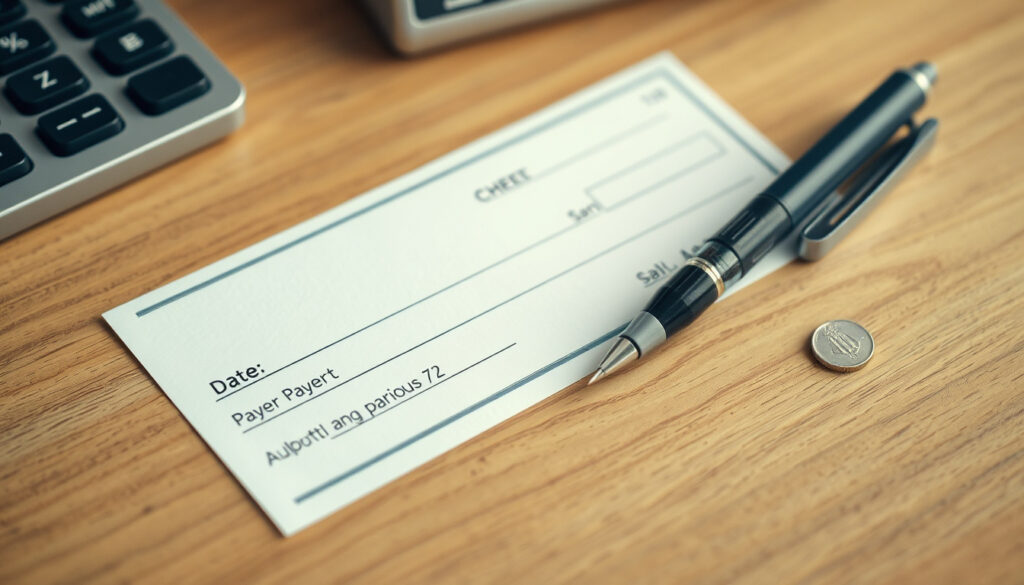
How to Write a Check Correctly: Step-by-Step Guide (2025)
Writing a check might feel like a relic, but with 11.2 billion checks still paid annually in the U.S. as of 2021 — worth $17.5 trillion — it’s a skill that still matters. This guide walks you through each field, explains how to handle cents and thousands, and covers the new security standards that make modern checks harder to forge.
US consumers who wrote checks in 2022: 42% · Annual checks paid (2021): 11.2 billion · Total value of checks paid (2021): $17.5 trillion · Average check amount (2021): $1,562
Quick snapshot
- Writing a check requires six steps: date, payee, numeric amount, written amount, memo, signature (PNC Insights)
- Cents are expressed as a fraction over 100, e.g., 50/100 (PNC Insights)
- Modern checks include security features like watermarks and microprinting (J.P. Morgan PDF)
- The padlock icon means at least three security features are present (CPSA Padlock Icon Guidelines)
- Exact deadline for full adoption of new check format varies by country; confirm with your bank (SecurityBank / PCHC advisory post)
- Whether all U.S. banks will adopt the new MM-DD-YYYY date box format remains unconfirmed (SecurityBank / PCHC advisory post)
- Check 21 Act (2004) enabled electronic processing, reshaping check design (J.P. Morgan PDF)
- New CPSA padlock icon guidelines updated January 2025 (CPSA Padlock Icon Guidelines)
Eight key facts, one pattern: check writing is straightforward in structure but nuanced in execution — especially when cents or round amounts are involved.
| Label | Value |
|---|---|
| Check format standard | ANSI X9.100 |
| Typical check dimensions | 6 inches x 2.75 inches |
| Check validity period | 6 months (most banks) |
| Maximum amount without special approval | Typically $10,000 |
The pattern in these specs: checks follow a strict physical and regulatory standard, designed for machine processing and fraud prevention.
What is the correct way to write a check?
Most U.S. banks — including Huntington Bank and Chase — recommend a six-step sequence. Each field exists for a reason, and skipping one can gum up the works.
Date the check
- Write the current date (or a future date if you’re post-dating) in the top-right corner: month, day, and year.
- Huntington Bank emphasizes that dating the check ensures the bank knows when it was written.
Write the payee’s name
- Use the full legal name of the person or business you’re paying — no nicknames or abbreviations.
- Huntington Bank’s checking-basics guide notes that the payee line identifies who the check is for (Huntington Bank).
Write the amount in numbers
- Place the numeric amount in the small box on the right, with dollars and cents separated by a decimal point — e.g., $1500.00.
- U.S. Bank instructs writers to place the payment amount in the small box on the right in dollars and cents numerically.
Spell out the amount in words
- On the line below the payee, write the dollar amount in words followed by “and” and a fraction over 100 for cents — e.g., “One thousand five hundred and 00/100.”
- Fidelity Investments says the written amount is the critical line for preventing ambiguity if it disagrees with the numeric amount.
Add a memo line
- Use the memo line (bottom left) for a note: account number, invoice reference, or “birthday gift.” Optional.
- This helps both you and the payee track the payment.
Sign the check
- Use your legal signature on the bottom-right line. The check is not valid without it.
- Chase’s banking education guide presents adding the signature as the final step (Chase).
How do I write $1500 on a check?
The principle is the same whether it’s $15 or $15,000 — but handling thousands and cents together trips up even experienced writers.
Writing fifteen hundred dollars in numbers
- Write $1,500.00 in the dollar box. Use a comma for clarity and two zeros after the decimal.
- Fidelity Investments advises writing cents in the numeric box with two digits after a decimal point.
Writing fifteen hundred dollars in words
- Write “One thousand five hundred and 00/100” on the amount line. Do not write “Fifteen hundred” — banks expect the formal reading.
- Wells Fargo Stories says the written amount should match the numeric amount exactly, with cents as a fraction.
Handling cents with thousands
- For $1,500.50, write “One thousand five hundred and 50/100.” Ensure the decimal point is clear to avoid misinterpretation.
- PNC Insights notes that writing cents as a fraction over 100 is a common bank convention (PNC Insights).
If the numeric and written amounts don’t match, the bank legally honors the written amount. That makes the words — not the numbers — your best defense against disputes.
What is the new check format?
When you pull out a checkbook today, you’re holding a document designed to be harder to forge than the checks your parents used. The shift began with the Check 21 Act in 2004, which allowed banks to process checks electronically, and continues with updated security standards.
New check design standards introduced by APACS and Check 21
- The Check 21 Act (J.P. Morgan PDF) enabled banks to process checks electronically, speeding up clearing times.
- New standards from organizations like the Check Payment Systems Association (CPSA) define security and layout requirements.
Key changes: enhanced security features and standardized layout
- Watermarks, microprinting, and tamper-resistant toner areas are now common. Intuit Market lists microprinting, watermark, holograms, invisible fluorescent fibers, and fraud-sensitive ink as secure check features.
- A recently circulated advisory describes a new date format using MM-DD-YYYY date boxes, reported by SecurityBank / PCHC advisory post.
- The CPSA Padlock Icon (CPSA Padlock Icon Guidelines, updated January 2025) indicates a check contains a minimum of three security features.
Deadline for implementation
- Exact deadlines vary by country and institution. The SecurityBank advisory suggests financial institutions are moving toward the new date-box format, but not all banks have mandated it.
If your bank issues checks with the padlock icon, you’re already benefiting from anti-fraud features. But the new date-box format may require a different way of writing the date — check with your bank before ordering new checks.
Is there a wrong way to write a check?
Absolutely. And the banks have seen them all — from missing signatures to ambiguous amounts that let fraudsters insert an extra digit.
Common mistakes when writing a check
- Writing an incorrect amount or misspelling the payee’s name.
- Forgetting to sign the check — it’s void without a signature.
- Postdating a check may cause delays; some banks process postdated checks anyway.
- Using blank or incomplete checks is a security risk; anyone can fill in the missing fields.
What happens if you make an error
- If you catch the mistake before handing over the check, write “VOID” across it and start over.
- If you don’t catch it, the bank may reject the check, or worse, process it with incorrect information.
How to void a check
- Write “VOID” in large letters across the front. Do not use it for payment. Voided checks are often used for setting up direct deposit or automatic payments.
- Deluxe notes that high-security checks can include alteration barriers that reveal washing through speckling or stains — but only if the check is used, not voided.
How to write check amount in words with cents
This is where the math meets the English. Getting the format right prevents fraud and keeps your check from bouncing over a simple formatting mistake.
Writing whole dollar amounts
- For $250.00, write “Two hundred fifty and 00/100.” Do not use hyphens or “and” between hundred and fifty.
- Chase states that the cents value can be written as a fraction such as 50/100, giving writers flexibility in the legal amount line.
Including cents (e.g., $250.00 written as “Two hundred fifty and 00/100”)
- Use “and” to separate dollars from cents. Then write a fraction over 100 for cents — 00/100, 50/100, 99/100.
- WaFd Bank recommends including cents even when the amount is round, describing cents as a safeguard against fraudsters altering the amount.
Handling zero cents
- Write “and 00/100” — never leave the fraction blank. A blank line invites someone to add their own cents.
- Ensure the written amount matches the numeric amount exactly: $250.00 = “Two hundred fifty and 00/100.”
You are legally bound by the written line, not the numeric box. That makes the words — not the numbers — your best defense against disputes. Write carefully.
Related reading: November Social Security Payments 2025
Frequently asked questions
What should I do if I make a mistake while writing a check?
Write “VOID” across the check, tear it up, and start over. Never use correction fluid or scribble over the error — banks treat altered checks as suspicious.
Can I write a check with no cents?
Yes. Write the numeric amount as $100.00 and the written amount as “One hundred and 00/100.” Including the zeros is optional but recommended.
How long is a personal check valid?
Six months is the standard for most U.S. banks. After that, the bank may refuse to honor it.
Do I have to use a blue or black pen?
Yes. Blue and black inks are standard because they show up clearly on scanned images and are harder to erase. Avoid pencil or erasable pen.
What is a post-dated check and is it legal?
A check written with a future date is called a post-dated check. It is legal, but banks can process it before that date unless you notify them.
How do I write a check to “Cash”?
Write “Cash” on the payee line. This means anyone holding the check can cash it — so only do this if you are physically at the bank.
What should I do if a check is lost or stolen?
Contact your bank immediately to issue a stop payment. Provide the check number, amount, and payee details. There may be a fee, but it protects your account.
Checks remain a legitimate payment tool even in 2025. For the U.S. consumer who writes a check only a handful of times a year, the choice is clear: follow the six steps, match your numeric and written amounts, and use a pen that can’t be erased — or risk seeing your payment delayed at best, altered at worst.
More related posts
 Bill of Sale Template: Write a Legally Valid Form in 5 Steps
 Universal Studios Florida Tickets – Prices, Deals and Savings
 Tom Glynn-Carney Biography: Height, Age, and House of the Dragon
 San Antonio River Walk Guide: Length, Safety, Things to Do
 Redmi Note 9 4G to Buy: Specs, Price & Verdict for 2025–2026
 Galaxy S23 Plus to Buy 2025: Irish Price, Trade-In & Review
 Cast of This Fool – Full Actors and Characters
 Gluten Free Banana Bread: Moist, Easy & Delicious Recipe