How Many Planets Are There? Solar System Planet Count Explained
It’s one of those questions that sounds simple until you stop to think about it: how many planets are there? Growing up, anyone who memorized the solar system learned nine names — ending with Pluto. But astronomy, like any science, evolves. Today, the International Astronomical Union (the global authority for astronomical naming) recognizes eight planets, and Pluto has been reclassified as a dwarf planet since 2006. Here’s a look at the official count, the reasoning behind the change, and why the answer depends on context.
Number of planets in the Solar System: 8 (NASA) ·
Number of officially recognized dwarf planets: 5 (NASA) ·
Year Pluto was reclassified: 2006 (NASA) ·
Largest planet: Jupiter ·
Smallest planet: Mercury
Quick snapshot
- The solar system has eight planets: Mercury, Venus, Earth, Mars, Jupiter, Saturn, Uranus, Neptune (NASA Science).
- Pluto is a dwarf planet (NASA Science).
- An IAU planet must orbit the Sun, be spherical, and clear its orbit (Sky & Telescope).
- Exactly how many dwarf planets exist — at least five, but many more candidates (NASA Science).
- Total number of planets in the galaxy — estimated in billions (Britannica).
- Astrological and religious definitions of “planet” vary. (NASA Science)
- Whether the “12 planets” model counts as a scientific category or just a teaching tool. (NASA Science)
- 1930 – Pluto discovered, becomes ninth planet (NASA Science).
- 2005 – Eris found, larger than Pluto (Britannica).
- 2006 – IAU redefines “planet”; Pluto reclassified (NASA Science).
The table below summarizes the key numbers and planetary extremes in the solar system.
| Label | Value | Source |
|---|---|---|
| Number of Planets | 8 | NASA Science |
| Number of Dwarf Planets | 5 | NASA Science |
| Year of Pluto’s Demotion | 2006 | NASA Science |
| Largest Planet | Jupiter | Sky & Telescope |
| Smallest Planet | Mercury | Sky & Telescope |
| Farthest Planet | Neptune | NASA Science |
How many planets are there in our solar system?
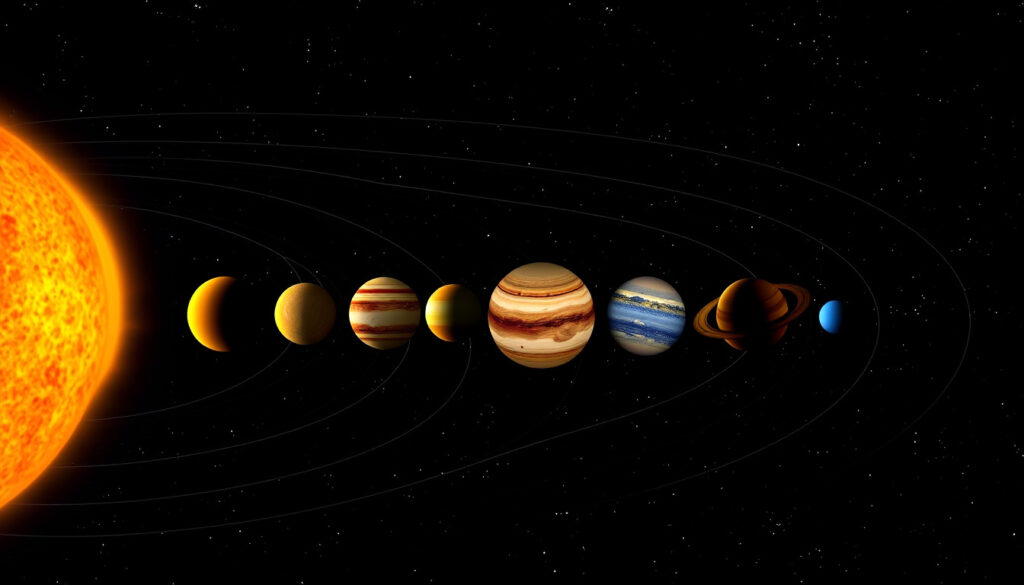
The straightforward answer: eight. NASA (the U.S. space agency responsible for planetary exploration) lists Mercury, Venus, Earth, Mars, Jupiter, Saturn, Uranus, and Neptune as the official planets. These eight worlds are split into two groups: the four inner, rocky terrestrial planets (Mercury through Mars) and the four outer giants — gas giants Jupiter and Saturn plus ice giants Uranus and Neptune (Sky & Telescope).
The eight official planets
- Mercury – smallest planet, closest to the Sun
- Venus – similar size to Earth, often called Earth’s sister planet
- Earth – our home, the only known planet with life
- Mars – the red planet, target for future exploration
- Jupiter – largest planet, famous for its Great Red Spot
- Saturn – known for its spectacular ring system
- Uranus – an ice giant that rotates on its side
- Neptune – the farthest planet, with the strongest winds
NASA confirms these eight are all spherical and have cleared their orbits — the two key requirements of the IAU definition.
The five dwarf planets
Alongside the eight planets, the IAU officially recognizes five dwarf planets (NASA Science): Ceres, Pluto, Haumea, Makemake, and Eris. These objects are also round and orbit the Sun, but they share their orbital neighborhoods with other debris. Pluto is the most famous: discovered in 1930, it was considered the ninth planet for 76 years until the IAU’s 2006 resolution demoted it.
The eight-planet count is scientifically clean but hides a richer reality. Dwarf planets like Pluto and Eris are just as fascinating as the major planets — they simply orbit in crowded zones. For schoolchildren, sticking to eight is accurate; for astronomy enthusiasts, the five dwarf planets add depth to the story.
Do we have 8 or 9 planets?
Before 2006, textbooks listed nine planets. The change from nine to eight wasn’t a discovery — it was a redefinition. Britannica (the long-established encyclopedia) notes that Pluto was listed as a planet from its discovery in 1930 until the IAU’s 2006 vote.
The historical nine-planet model
For decades, the nine-planet model was taught worldwide. Pluto, though small and eccentric, was considered the outermost planet. The discovery of the Kuiper Belt in the 1990s — a region of icy bodies beyond Neptune — revealed that Pluto was not alone (NASA Science). With the 2005 discovery of Eris, a Kuiper Belt object larger than Pluto, astronomers recognized a problem: if Pluto was a planet, then Eris and likely dozens of others would have to be planets too.
The 2006 IAU reclassification
In August 2006, the IAU voted on a formal definition of “planet.” The UCLA SETI group (part of the University of California’s search for extraterrestrial intelligence) explains that the vote created three classes: planets, dwarf planets, and small solar-system bodies. Pluto was reclassified as a dwarf planet because it failed the third criterion — clearing its orbital neighborhood (Sky & Telescope). The official planet count dropped to eight.
The decision wasn’t about demoting Pluto — it was about logical consistency. If we kept Pluto as a planet, we’d owe planet status to Eris and potentially dozens of other Kuiper Belt objects. The IAU chose a clear rule: a true planet must “clear the neighborhood” around its orbit. That gave us eight.
What this means: the nine-planet model gave way to a more consistent definition that applies equally to all objects.
Why is Pluto not a planet?
Pluto’s demotion boils down to three simple criteria. The International Astronomical Union (the professional body that sets astronomical definitions) requires a planet to: orbit the Sun, have enough gravity to pull itself into a round shape, and have cleared its orbit of other debris. Pluto passes the first two but fails the third.
The three criteria for planethood
- Criterion 1: Must orbit the Sun (not another planet or star).
- Criterion 2: Must have sufficient mass for self-gravity to make it nearly round.
- Criterion 3: Must have “cleared the neighborhood” around its orbit — meaning it’s gravitationally dominant.
Sky & Telescope (a leading astronomy magazine) notes that Pluto shares its orbit with many Kuiper Belt objects, some of which are nearly as large.
Pluto’s failure to clear its orbit
Pluto orbits in the Kuiper Belt, a ring of icy bodies beyond Neptune. It has not gravitationally dominated its region; instead it is one of many. In fact, Pluto’s moon Charon is so large that some astronomers consider the pair a double dwarf system. Because Pluto hasn’t cleared its orbit, it cannot be considered a planet under the IAU definition.
The clearance criterion is not a minor technicality — it reflects a fundamental difference. Planets are the “big fish” that have swept up all nearby material; dwarf planets are smaller bodies that coexist with a crowd. This distinction helps astronomers understand how the solar system formed and evolved.
The catch: Pluto’s demotion clarifies how the solar system sorted into gravitationally dominant planets and shared-orbit dwarf planets.
When did 9 planets become 8?
The shift happened on a specific date: August 24, 2006. That day, at the IAU General Assembly in Prague, members voted Resolution B5 — the definition that reclassified Pluto (NASA Science).
August 24, 2006: The IAU vote
The resolution passed with support from a majority of the 424 astronomers present. It defined a planet in a way that excluded Pluto, which was instead placed into the new category of dwarf planet (Britannica). The decision was not unanimous — some astronomers argued that the new definition was too restrictive and that Pluto should remain a planet.
Aftermath and public reaction
The public reaction was immediate and emotional. Pluto had been a beloved part of the solar system for decades, and many people felt a sense of loss. The word “demotion” appeared in headlines worldwide. Yet within the scientific community, the definition brought order. The IAU (the same organization that defines constellations and standardizes names) has maintained the eight-planet framework ever since, while also allowing for future additions if new objects meet the criteria.
What are the 12 planets in order from the Sun?
You may have heard of a “12 planets” model — it typically includes the eight major planets plus four dwarf planets: Ceres, Pluto, Haumea, and Makemake, and sometimes Eris. However, the IAU (the official body for planetary classification) has never adopted a 12-planet system. This idea is informal, often used to highlight the growing number of notable dwarf planets.
The origin of the ’12 planets’ idea
After Pluto’s reclassification, some educators and journalists began promoting a list that included both the eight classical planets and the largest dwarf planets. The goal was to keep Pluto in the planetary conversation. But the IAU’s three-category system — planets, dwarf planets, and small bodies — does not recognize dwarf planets as a subset of planets. So “12 planets” is a pedagogical tool, not a scientific definition (UCLA SETI).
Current official list of planets and dwarf planets
If you order all recognized planets and dwarf planets by distance from the Sun, you get: Mercury, Venus, Earth, Mars, Ceres, Jupiter, Saturn, Uranus, Neptune, Pluto, Haumea, Makemake, and Eris. That’s 13 objects — eight planets and five dwarf planets. But only the first eight are officially planets. For a deeper look at how celestial bodies are classified, see our guide on Parts of a Flower – Anatomy, Functions and Identification, which offers a parallel example of how scientific classification works in nature.
The pattern: mixing categories may help engage learners but does not change the IAU’s clear three-class framework.
Timeline of the planet count
The number of recognized planets has changed exactly once in the modern era. Here’s the sequence of events:
- 1930: Pluto discovered by Clyde Tombaugh at Lowell Observatory; becomes the ninth planet (NASA Science).
- 1992: First Kuiper Belt object discovered (1992 QB1), hinting at a large population beyond Neptune (Britannica).
- 2005: Eris discovered — its size surpasses Pluto, forcing the planet definition debate (Britannica).
- August 24, 2006: IAU votes on Resolution B5, reclassifying Pluto as a dwarf planet (NASA Science).
- 2006–present: Eight planets officially recognized; dwarf planet category active. A 2024 proposal suggests a new definition that could include exoplanets (Sci.News — a science news outlet covering astronomy research).
What this means: scientific definitions can shift as knowledge grows, making the planet count a moving target over decades.
Confirmed facts
- There are eight planets in the Solar System: Mercury, Venus, Earth, Mars, Jupiter, Saturn, Uranus, Neptune (NASA Science).
- Pluto is a dwarf planet (NASA Science).
- The IAU planet definition requires orbit, roundness, and cleared orbit (Sky & Telescope).
- The term “planet” comes from the ancient Greek word for “wanderer” (NASA Science).
What remains unclear
- Exactly how many dwarf planets exist — at least five, but more candidates are being evaluated (NASA Science).
- Total number of planets in the Milky Way galaxy — estimated in the billions (Britannica).
- Whether the IAU will adopt a new definition (2024 proposal) that includes exoplanets (Sci.News — a science news outlet covering astronomy research).
Expert voices on the planet count
“Our solar system has eight planets: Mercury, Venus, Earth, Mars, Jupiter, Saturn, Uranus, and Neptune.”
NASA Science
“The IAU 2006 classification created three distinct classes of objects in the solar system: planets, dwarf planets, and small solar-system bodies.”
UCLA SETI
The story of how many planets there are is less about a magical number and more about how science classifies the universe. For students and anyone curious about space, the most accurate answer today is eight planets — plus a growing catalog of dwarf planets that remind us that definitions are human-made tools. The IAU’s eight-planet framework gives astronomers and educators a consistent standard, one that may adapt as new discoveries emerge. Curious about Mercury’s current position?
The official answer to how many planets exist is provided by the official answer.
Frequently asked questions
What is Earth’s sister planet?
Venus is often called Earth’s sister planet because it is similar in size, mass, and composition. It orbits closer to the Sun and has a thick, toxic atmosphere (NASA Science).
What is the Moon’s full name?
The Moon’s official name is simply “the Moon” (with a capital M). It does not have a separate scientific name like the moons of other planets. Our Moon is sometimes called Luna in Latin-derived contexts, but that is not its official IAU name.
Which planet has a day lasting 42 years?
No planet has a day of exactly 42 Earth years, but Venus comes close: a Venusian day (one rotation) lasts about 243 Earth days — longer than its year (225 Earth days). Jupiter has the shortest day at just under 10 hours (Sky & Telescope).
How many moons does Jupiter have?
Jupiter has 95 confirmed moons as of 2024, including the four large Galilean moons: Io, Europa, Ganymede, and Callisto (NASA Science).
How many planets are there in the galaxy?
Astronomers estimate there are billions of planets in the Milky Way galaxy. The Kepler mission found that, on average, every star has at least one planet. Exact numbers are unknown (Britannica).
How many planets have been discovered beyond our solar system?
As of 2025, over 5,700 exoplanets have been confirmed, with thousands more candidates. Most were discovered by the transit method using telescopes like Kepler and TESS (NASA Science).
More related posts
 Google Translate French to English – Step-by-Step Guide
 Orange County Clerk of Court – Records, Phone, Locations Guide
 Teacher Appreciation Week 2025: Dates & Teacher-Tested Gift Ideas
 Find Catholic Churches Near Me: Ireland Mass & Costs
 New Balance Golf Shoes: Spiked, Waterproof and More
 Sinners (2025) Trailer: Plot, Cast and Release Date
 Athletic vs Barcelona: History, Rivalry, Key Matches 2025
 Signs You’re Losing Too Much Blood During Period: When to Worry