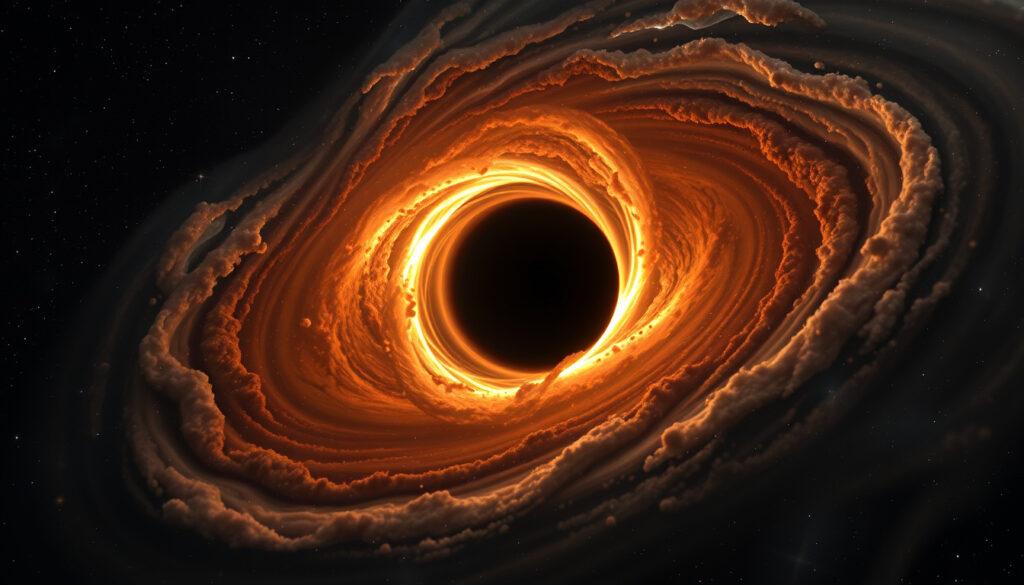
What Is a Black Hole? Simple Explanation, Formation & Dangers
Few objects in space spark as much curiosity as black holes — invisible points where gravity becomes absolute. But the reality is even stranger than fiction: a black hole is not an empty void but an intensely dense region where the laws of physics break down. This guide uses NASA data and peer-reviewed research to explain what black holes are, how they form, and what happens near them.
Largest known black hole: TON 618, ~66 billion solar masses ·
First black hole discovered: Cygnus X-1 (1972) ·
Nearest black hole: Gaia BH1, 1,560 light-years away ·
Escape velocity at event horizon: Speed of light (299,792 km/s)
Quick snapshot
- Black holes exist and have been observed indirectly and directly (Wikipedia)
- Gravitational waves from black hole mergers were first detected in 2015 (NASA Science)
- The Milky Way’s supermassive black hole is Sagittarius A* (NASA Science)
- What exactly happens at the singularity remains unknown (Britannica)
- Whether Hawking radiation causes complete evaporation is unconfirmed (EBSCO Research Starters)
- The information paradox is still unresolved (Space.com)
- Gravitational-wave observatories (LIGO, Virgo) will detect more black hole mergers (NASA Science)
- Direct imaging of black holes will improve with the next-generation Event Horizon Telescope (NASA Science)
- Research into primordial black holes as dark matter candidates continues (NASA Science)
The table below maps the key features from the event horizon to formation, showing one pattern: the physics gets stranger the closer you get to the singularity.
| Label | Value |
|---|---|
| Event Horizon | Point of no return; boundary where escape velocity equals speed of light (EBSCO Research Starters) |
| Singularity | Point of infinite density at the center of a black hole (Britannica) |
| Gravitational Waves | Ripples in spacetime from black hole mergers, first detected in 2015 (NASA Science) |
| Hawking Radiation | Quantum effect causing black holes to slowly evaporate, first predicted by Stephen Hawking (EBSCO Research Starters) |
| Black Hole Types | Stellar-mass, supermassive, intermediate-mass, and hypothetical primordial (NASA Science) |
| Formation | Massive stars (above ~8–10 solar masses) collapse into black holes after exhausting nuclear fuel (Space.com) |
| Detection Method | Observed via X-ray emissions from accreting material, gravitational waves, and direct imaging (NASA Science) |
| Supermassive Example | Sagittarius A* at the Milky Way’s center, about 4 million solar masses (NASA Science) |
What is a black hole in simple terms?
A black hole is a region of spacetime where gravity is so powerful that nothing — not even light — can escape once it crosses the event horizon. The event horizon is not a physical barrier but a mathematically defined surface that marks the point of no return (EBSCO Research Starters).
What is exactly in a black hole?
At the center of a black hole lies the singularity — a point of infinite density where the known laws of physics break down (Britannica). The singularity is hidden from view by the event horizon, making it impossible to observe directly.
What is a black hole made of?
Black holes are not made of ordinary matter. They are pure spacetime curvature — the result of matter compressed into an infinitely small point. According to NASA Science, the mass can range from a few times the Sun’s to billions of solar masses, but the internal composition remains a theoretical puzzle.
The singularity is often described as a point of infinite density, but “infinity” here is a sign that general relativity has broken down. Physicists suspect quantum gravity will provide a more complete description, but no experiment has tested it yet.
The implication: the core of a black hole is not a thing we can describe — it is a place where physics as we know it ends.
How is a black hole formed?
Black holes form through two main channels: the collapse of massive stars and the merger of smaller black holes over cosmic time.
- Stellar collapse: A star with a birth mass above about 8 to 10 times the Sun’s mass ends its life in a supernova explosion, leaving behind a core that collapses into a black hole (Space.com).
- Supermassive growth: The largest black holes, found at galaxy centers, grow through mergers with other black holes and by accreting gas and stars (NASA Science).
- Primordial origin: Hypothetical black holes that may have formed in the first second after the Big Bang, with masses ranging from less than a paperclip to far more than the Sun (NASA Science).
What kills a black hole?
Black holes are not immortal. Through a quantum process called Hawking radiation, they slowly lose mass and energy and eventually evaporate completely (EBSCO Research Starters). For a stellar-mass black hole, this process would take longer than the current age of the universe, so none have evaporated yet.
Hawking radiation is theoretically sound but has never been observed. If it does cause complete evaporation, the black hole would vanish in a flash of gamma rays. For now, the mechanism remains a prediction, not a proven fact.
What this means: black holes are eternal on human timescales but finite on cosmic ones — they will eventually vanish, but not for far longer than the universe has existed.
What happens if we go to a black hole?
The experience depends on the black hole’s size and how close you get. For a stellar-mass black hole, tidal forces become extreme well before you reach the event horizon.
- Spaghettification: The difference in gravity between your head and feet becomes so large that your body would be stretched into a thin strand of plasma. This process is called “spaghettification” (Space.com).
- Time dilation: Near the event horizon, time slows down dramatically relative to a distant observer. One minute for you near the horizon could equal years or even centuries for someone far away (EBSCO Research Starters).
How long is 1 minute on a black hole?
If you could hover just outside the event horizon for one minute (by your clock), an observer far away would see an enormous amount of time pass. For a black hole with the mass of the Sun, one minute near the horizon equals roughly 300 million years for the distant observer (Space.com).
If I spent one minute one meter from the event horizon of a black hole, what would happen?
At that distance, tidal forces would already be fatal for any stellar-mass black hole. The gravitational gradient across your body would be millions of times stronger than Earth’s gravity, pulling you apart before you could register the pain. For a supermassive black hole (like the one at the Milky Way’s center), the event horizon is so far from the singularity that you might cross it without immediate spaghettification — but you’d still be trapped forever (Britannica).
The catch: the outcome flips entirely depending on black hole size — small ones shred you, large ones trap you whole.
Is a black hole dangerous?
Black holes are not cosmic vacuum cleaners. They pose no danger to Earth — the nearest known black hole, Gaia BH1, is 1,560 light-years away and will never affect our planet (NASA Science). The danger is only real if you venture close enough to be caught by its gravity.
Can life exist in a black hole?
Inside the event horizon, survival is impossible because all matter is pulled toward the singularity. Some speculative models suggest that life could exist near the outer edge of the accretion disk, where the environment is less extreme, but the intense radiation would make it unlikely (Space.com). No evidence of life anywhere near a black hole has ever been found.
Even if a black hole isn’t actively sucking in matter, its event horizon is still a one-way door. Anything that crosses it — spacecraft, signals, light — is lost forever. The no-return rule is absolute.
What this means: black holes pose zero threat from a distance, but they are the most final traps in the universe up close.
Do we live inside a black hole?
This is a speculative idea that has appeared in theoretical physics and cosmology. Some models suggest that our universe could be the interior of a black hole that formed in a parent universe (Britannica). But there is no observational evidence to support it, and most physicists regard it as a thought experiment rather than a serious hypothesis.
What is black hole time travel?
General relativity allows for closed timelike curves — paths through spacetime that loop back on themselves — near rotating black holes. In theory, you could travel into the past by following such a curve (EBSCO Research Starters). However, quantum effects likely prevent this, and no time-travel experiment has ever been conducted.
What is black hole ai?
There is no established concept called “black hole AI” in mainstream physics or artificial intelligence research. The term occasionally appears in science fiction or speculative articles that imagine self-replicating probes or advanced AI systems studying black holes from a safe distance. It has no basis in current scientific literature (NASA Science).
The pattern: most popular black hole questions ask whether we can escape or exploit them — the scientific answer is almost always no.
“A black hole is so dense that gravity just beneath its surface, the event horizon, is strong enough that nothing – not even light – can escape.”
— NASA Science (Black Hole Basics)
“A black hole is a region of spacetime from which nothing, not even light, can escape once it crosses the event horizon.”
For a deeper dive into the science, NASAs explanation of black holes offers a clear and authoritative overview.
Frequently asked questions
What is the closest black hole to Earth?
The closest known black hole is Gaia BH1, about 1,560 light-years away in the constellation Ophiuchus (NASA Science).
Can a black hole die?
Yes, black holes can slowly evaporate through Hawking radiation, a process that takes far longer than the current age of the universe (EBSCO Research Starters).
Do black holes move?
Black holes move through space like any other massive object. They orbit galaxy centers and can be ejected by gravitational interactions (Space.com).
What color is a black hole?
Black holes themselves are black because light cannot escape. However, the surrounding accretion disk can glow brightly in X-rays and radio waves (NASA Science).
How big can a black hole get?
The largest known black hole, TON 618, has a mass of about 66 billion solar masses. Theory suggests black holes could grow to 100 billion solar masses or more, but growth is limited by the availability of matter to accrete (Space.com).
Is there a black hole in our solar system?
No. The only black holes in our galaxy are at stellar-mass scales and located far from the solar system. The nearest, Gaia BH1, is over a thousand light-years away (NASA Science).
What happens when a black hole evaporates?
As a black hole loses mass via Hawking radiation, it shrinks and eventually disappears in a flash of gamma rays. For a black hole with the mass of our Sun, this would take about 1067 years (EBSCO Research Starters).
More related posts
 Mission Lane Credit Card Review: A 2025 Guide
 Dallas Museum of Art: Visitor Guide & Highlights
 Hilton Friends and Family – Discount Guide 2024
 Highest Yield Savings Account 2025: Ireland vs US
 Check Your Chick-fil-A Gift Card Balance
 Best Defense for Fantasy Football 2025: Rankings & Strategy
 Duquesne Light Bill Rise: 2025-2026 Rate Hikes Explained
 Is Mercury in Retrograde Right Now – Status, Dates and Effects