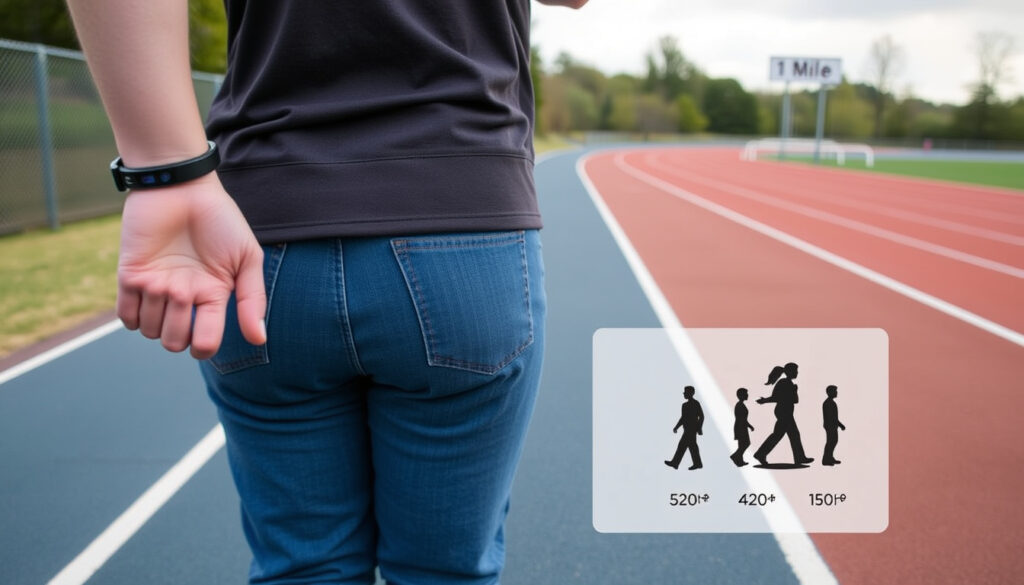
How Many Steps Is a Mile? Average Steps by Height, Speed
Anyone who’s clipped on a fitness tracker has asked: how many steps is a mile? The simple answer—about 2,000 steps for a typical adult walker—hides variation due to height, pace, and walking vs running.
Average steps per mile (walking): 2,000 ·
Average steps per mile (running): 1,500 ·
Miles in 10,000 steps: 5 miles ·
Time to walk 1 mile (average pace): 15–20 minutes
Quick snapshot
- Average 2,000 steps per mile walking (University of Iowa Student Health).
- 1,500 steps per mile running (GPSTraining).
- Varies by height, stride length, and speed (CH Parks).
- 1 mile takes 15–20 minutes at moderate pace (Motera).
- 10,000 steps = about 5 miles or 1.5 hours (University of Iowa Student Health).
- A 30-minute walk covers roughly 2 miles (GPSTraining).
- Walking 3 miles/day burns 300–400 calories (Weight Loss Calculator Hub).
- 2 miles/day enough for general health (University of Iowa Student Health).
- Consistency matters more than intensity for weight loss (Motera).
- Faster walks boost calorie burn per minute (Motera).
- Longer walks improve endurance and step totals (GPSTraining).
- 6-6-6 challenge combines pace and timing (CH Parks).
Five key measurements, one pattern: your height, pace, and whether you’re walking or running create a 500-step swing in a single mile. Here’s how the averages stack up.
| Measurement | Value |
|---|---|
| Steps in 1 mile (average, walking) | 2,000 |
| Steps in 1 mile (running) | 1,500 |
| Miles in 10,000 steps | 5 |
| Time to walk 1 mile | 15–20 minutes |
| Steps in 30-minute walk | 3,000–4,000 |
Walking speed changes both steps per mile and time. Here’s a breakdown of common paces.
| Speed (mph) | Steps per mile | Time per mile |
|---|---|---|
| 2.5 (slow) | 2,400–2,600 | 24 min |
| 3.0 (moderate) | 2,200–2,400 | 20 min |
| 3.5 (brisk) | 2,000–2,200 | 17 min |
| 4.0 (fast) | 1,900–2,100 | 15 min |
How far is 10,000 steps in miles?
If you’ve hit 10,000 steps on your tracker, you’ve covered about 5 miles—assuming you’re an average-height adult with a moderate walking pace. The University of Iowa Student Health FAQ notes that 10,000 steps is close to 5 miles, depending on stride length. But that 5-mile figure shifts when you change who’s walking.
Steps per mile for different heights
- 5’0″ person: roughly 2,400–2,500 steps per mile (stride length about 24 inches, per GPSTraining).
- 5’5″ person: roughly 2,200–2,300 steps per mile (stride length about 25.5 inches).
- 6’0″ person: roughly 1,800–2,000 steps per mile (stride length about 28 inches).
The pattern is straightforward: taller people cover more ground with each stride, so they take fewer steps per mile. A person who’s 5’0″ may walk 500 more steps than someone who’s 6’0″ over the same distance.
Steps per mile for men vs women
Because height averages differ between men and women, so do typical step counts. A calculator from Weight Loss Calculator Hub estimates that an average-height adult of 170 cm (about 5’7″) takes around 2,250 to 2,300 steps per mile. Women, who on average are shorter than men, tend to fall at the higher end of that range—closer to 2,300 steps per mile—while taller men often sit near 1,900–2,000.
How many miles is 10,000 steps for a woman?
For a woman of average height (about 5’4″), 10,000 steps equals roughly 4.5 to 5 miles. The shorter the person, the more steps it takes to cover a mile—meaning 10,000 steps for a 5’0″ woman might be closer to 4 miles, while a 5’8″ woman would hit closer to 5.5 miles. The same distance in steps, a different actual distance covered.
How long does it take to walk a mile?
At a moderate pace of 3 to 4 miles per hour, a mile takes 15 to 20 minutes. That range matters because time is often more relevant than step count for planning a walk. If you have 30 minutes to walk, you’re covering about 1.5 to 2 miles—and racking up roughly 3,000 to 4,000 steps, depending on your stride.
Average walking speed and time per mile
- Slow walking (2.5 mph): ~2,400–2,600 steps per mile, about 24 minutes.
- Moderate walking (3.0 mph): ~2,200–2,400 steps per mile, about 20 minutes.
- Brisk walking (3.5 mph): ~2,000–2,200 steps per mile, about 17 minutes.
- Fast walking (4.0 mph): ~1,900–2,100 steps per mile, about 15 minutes.
These estimates come from the Motera walking pace calculator. Notice that faster walking actually reduces your steps per mile because your stride lengthens as you pick up speed.
Time for a 30-minute walk: how many steps?
A 30-minute walk at a moderate pace (3 mph) covers about 1.5 miles, which translates to roughly 3,000 to 3,600 steps. At a brisk pace (3.5 mph), you’d cover about 1.75 miles and log around 3,500 to 3,850 steps. Either way, half an hour of walking gets you well on your way to a 10,000-step daily goal.
Is a 10 minute walk a mile?
Only if you’re walking at a very fast pace of about 6 mph—which most people would consider jogging. At a typical walking pace of 3 to 4 mph, a 10-minute walk covers somewhere between 0.5 and 0.7 miles. You’d need to cover about 1,000 to 1,400 steps in that time.
The catch: time-based walkers need to adjust their expectations. A 10-minute walk isn’t a mile unless you’re moving at a speed most people can’t sustain comfortably.
Faster walking burns more calories per minute—but shorter total time means fewer steps overall. For someone focused on step count, a longer moderate walk beats a shorter fast one. For calorie burn, intensity wins.
The choice depends on your goals: step count or calorie burn.
How many steps a day is healthy?
The 10,000 steps target is everywhere, but it’s less a medical prescription and more a marketing number. The real health data shows benefits at much lower numbers.
The 10,000 steps goal: origin and evidence
10,000 steps came from a Japanese pedometer campaign in the 1960s, not from cardiology research. However, studies have since found genuine health benefits at and below that number. A University of Iowa Student Health FAQ confirms that 10,000 steps is close to 5 miles but emphasizes it’s a guideline, not a rule.
Is 2 miles a day enough walking?
Yes—and the evidence is strong. Walking 2 miles a day, which is roughly 4,000 to 5,000 steps, provides measurable health benefits including reduced cardiovascular risk, better blood sugar control, and improved mental health. Research has shown that even 6,000 to 8,000 steps per day significantly reduce mortality risk compared to a sedentary baseline.
Minimum steps for health benefits
- Less than 5,000 steps/day: sedentary baseline.
- 5,000–7,499 steps/day: low active—reduced mortality risk versus sedentary.
- 7,500–9,999 steps/day: somewhat active—significant risk reduction.
- 10,000+ steps/day: active—additional marginal benefits.
What this means: hitting 10,000 steps is great, but don’t let perfect be the enemy of good. Walking 2 miles a day—about 4,000 to 5,000 steps—already puts you ahead of the sedentary baseline and delivers real health returns.
Will I lose weight if I walk more than 10,000 steps a day?
Walking more steps increases calorie burn—that much is straightforward. But weight loss depends on the calorie deficit, and step count alone doesn’t guarantee one.
Calories burned walking 1 mile vs 3 miles
A person weighing about 155 pounds burns roughly 100 calories per mile walked at a moderate pace. That means:
- 1 mile: ~100 calories.
- 2 miles: ~200 calories.
- 3 miles: ~300 calories.
- 5 miles (10,000 steps): ~500 calories.
These are estimates, and your actual burn depends on weight, pace, and terrain. Walking 3 miles a day for a week burns about 2,100 calories—enough to lose about 0.6 pounds per week if diet stays constant.
Will I lose belly fat if I walk 2 miles a day?
Spot reduction—losing fat from one specific area—is not physiologically possible. Your body decides where to burn fat based on genetics and hormonal profile. Walking 2 miles a day will reduce overall body fat, including belly fat, but it won’t target the stomach exclusively. The broader benefit: consistent walking lowers cortisol levels, which can reduce the storage of visceral belly fat.
Is walking 3 miles a day enough to lose weight?
For many people, yes. Walking 3 miles (about 6,000 steps, or 45–60 minutes) burns roughly 300–400 calories daily. Combined with maintaining your current diet, that deficit adds up to about 0.3 to 0.4 pounds of fat loss per week. Over a month, that’s 1.2 to 1.6 pounds—and it’s sustainable.
Why this matters: walking isn’t the fastest method for weight loss, but it’s the most sustainable for most people. A 3-mile daily walk that you actually do beats a more aggressive routine you abandon after two weeks.
Is it better to walk faster or longer?
This is the central question for anyone trying to optimize walking for fitness. The answer depends on your goal: step count, calorie burn, or endurance.
Walking speed vs. duration for fitness
Faster walking burns more calories per minute. At 4 mph, you burn about 1.4 times the calories per minute compared to 3 mph. But longer walking accumulates more total steps and more total calories. A 60-minute moderate walk at 3 mph covers 3 miles and burns about 300 calories. A 30-minute fast walk at 4 mph covers 2 miles and burns about 250 calories. Moderate walk wins on total calorie burn and step count.
The catch: if you only have 30 minutes, fast walking gives you more intensity in less time. If you have an hour, moderate walking yields higher totals.
What is the 6 6 6 rule in walking?
The 6-6-6 rule is a walking challenge that involves walking for 6 minutes at 6 km/h (about 3.7 mph) at either 6 a.m. or 6 p.m. The idea is to combine brisk pace with consistent timing. At 6 km/h, you’d cover about 0.6 miles in 6 minutes, which translates to roughly 1,200 steps. The challenge promotes speed consistency and habit formation.
Should you try the 6-6-6 walking challenge?
It depends on what you’re after. The 6-6-6 challenge is useful for building a habit because it’s time-bound and specific. But 6 minutes at that pace burns only about 50 calories—a tiny fraction of a daily energy deficit. As a warm-up or mindfulness break, it has value. As a primary fitness strategy, it’s insufficient on its own.
Upsides
- Faster walking burns more calories per minute.
- Shorter walks fit tight schedules.
- 6-6-6 challenge builds a consistent habit.
Downsides
- Faster walking may reduce total step count.
- Shorter walks limit endurance gains.
- 6-6-6 challenge burns minimal calories alone.
For step-focused walkers, longer moderate walks win. For time-crunched calorie burners, shorter faster walks win. The 6-6-6 challenge is best as a habit starter, not a total fitness solution.
So consider your time and priorities when choosing your walking routine.
Walking: confirmed facts and open questions
Confirmed facts
- 2,000 steps per mile is a reliable average for walking (University of Iowa Student Health).
- 10,000 steps ≈ 5 miles for most adults (University of Iowa Student Health).
- Walking 30 minutes daily reduces mortality risk (Motera).
What’s unclear
- Exact steps per mile for individuals below 5’2″ or above 6’0″.
- Whether walking faster or longer is better for long-term fat loss.
- Effectiveness of the 6-6-6 challenge compared to other routines.
“The average person’s stride length is approximately 2.5 feet long, and it takes a little over 2,000 steps to walk one mile.”
— University of Iowa Student Health, Taking Strides FAQ
“10,000 steps is close to about 5 miles, depending on your stride length.”
— University of Iowa Student Health
“A typical adult walking mile is often estimated at about 2,000 to 2,500 steps.”
Walking 1 mile a day is better than nothing—it burns about 100 calories and adds 2,000 steps to your daily total. But for noticeable weight loss, combining a deficit diet with at least 2 to 3 miles per day will produce more consistent results. The key is not the exact number of steps in a mile—it’s doing the walk, day after day.
mypacer.com, everyrank.app, stepscal.com, lowellrunning.com, sport-calculator.com, thecalculatorsite.com, calcipedia.org
For a detailed breakdown of how height and pace affect your steps per mile by height and speed, this guide offers a comprehensive look at the averages.
Frequently asked questions
How many steps is a mile for a child?
A child’s shorter stride means more steps per mile. A 4-foot-tall child might take 2,500 to 3,000 steps per mile, while a 5-foot child would be closer to 2,200. Using the stride formula (stride length as a percentage of height) can give a rough estimate for any child.
Does walking uphill change step count per mile?
Walking uphill doesn’t change your step count much—your stride length shortens slightly, so you might take a few more steps. The bigger difference is effort: walking uphill at the same pace burns significantly more calories because you’re working against gravity.
Can I use a fitness tracker to measure steps per mile?
Yes. Most fitness trackers and smartphone apps let you calibrate your step length by entering your height or by walking a known distance. GPS watches measure actual distance traveled and can calculate your exact steps per mile based on your stride.
How many steps are in a 5-mile walk?
At the average of 2,000 steps per mile, a 5-mile walk comes to about 10,000 steps. A shorter person might need 11,000 to 12,500 steps, while a taller person might need 9,000 to 10,000.
Is it better to walk on a treadmill or outdoors for step count?
Step count by distance is very similar on a treadmill versus outdoors. The main difference is that treadmills have a consistent surface that can reduce your natural stride length slightly, potentially adding a few extra steps per mile. Outdoors, wind and terrain can increase calorie burn slightly.
How many steps per minute is considered brisk walking?
Brisk walking is generally defined as 100 to 120 steps per minute. That pace corresponds to about 3 to 3.5 mph—enough to notice your breathing increase but still hold a conversation.
What is the difference in steps per mile between walking and running?
Running reduces steps per mile because your stride lengthens significantly when you’re airborne between steps. Average for walking is 2,000 steps per mile; average for running is about 1,500 steps per mile—a 25 percent reduction. A runner’s stride may be 3 to 4 feet compared to a walker’s 2.5 feet.
For another measurement conversion guide, see How Many Tablespoons in a Cup?. For more on time-based calculations, check What Is a Leap Year? Complete Definition, Rules, and Key Facts.
More related posts
 Can Dogs Eat Beans? Safe Types, Risks & Preparation Tips
 Dave Ramsey Baby Steps: A 7-Step Plan to Beat Debt
 When Did COVID Start? A Timeline of the Pandemic’s Beginning and End
 Who Should I Start? Expert Fantasy Football Start/Sit Advice
 What Does Poison Ivy Look Like? Guide
 Cast of Marvel Zombies: Voice Actors, Characters & Episode Guide
 Rainbow Six Siege Tracker: Best Stats Tools Compared
 Icon of the Seas Capacity: Passenger Count, Crew, Size & More