How Many Tablespoons in a Cup? Quick Conversion Guide
Anyone who’s pulled up a recipe late at night has hit the same wall: how many tablespoons in a cup? The standard US cup holds 16 tablespoons — a fact confirmed by Land O’Lakes — but the answer changes depending on where you’re cooking, so this guide gives exact conversions for every fraction, contrasts US and UK measurements, and shares practical steps to measure butter, flour, and more without second-guessing.
Tablespoons in 1 cup: 16 · Tablespoons in 1/2 cup: 8 · Tablespoons in 1/4 cup: 4 · Tablespoons in 1/3 cup: 5.33 · Tablespoons in 3/4 cup: 12
Quick snapshot
- 1 US cup = 16 US tablespoons (Land O’Lakes (US butter manufacturer))
- 1/2 US cup = 8 tbsp = 1 stick of butter (Dairy Farmers of Canada (industry body))
- Butter block: 2 cups = 32 tbsp (Land O’Lakes (US butter manufacturer))
- Exact UK cup definition varies — often 250 mL but sometimes 225 mL (The English Kitchen (home cooking blog))
- UK tablespoon size: 15 mL standard, but older recipes may use 17.7 mL (The English Kitchen (home cooking blog))
- Australian tablespoon is 20 mL, leading to 12.5 Australian tbsp per metric cup — a different standard (The English Kitchen (home cooking blog))
- No recent changes — US and UK cup definitions remain standard since mid-20th century (Wikipedia (general reference))
- Metric adoption has not altered US customary system (Wikipedia (general reference))
- Use the formula: cups × 16 = tablespoons for any US recipe (Inch Calculator (conversion tool))
- For UK recipes, prefer weight-based conversions (grams) (Inch Calculator (conversion tool))
Seven common cup-to-tablespoon conversions, one pattern: each whole cup is 16 tbsp, and fractions scale proportionally. Here’s the reference table.
| Measurement | US Tablespoons |
|---|---|
| 1 US cup | 16 US tablespoons |
| 1/2 US cup | 8 US tablespoons |
| 1/4 US cup | 4 US tablespoons |
| 1/3 US cup | 5.33 US tablespoons |
| 3/4 US cup | 12 US tablespoons |
| 1 US cup (volume) | 8 fluid ounces |
| 1 UK cup (approx.) | 16.7 UK tablespoons |
How many tablespoons in a cup?
One US cup equals exactly 16 US tablespoons, a ratio that works for both liquid and dry ingredients when using volume measurements. This is the bedrock conversion for American recipes, and it’s consistent across flour, sugar, and butter.
How many tablespoons in 1/3 cup?
- 1/3 US cup = 5.33 tablespoons (5 tbsp + 1 tsp) — The Spruce Eats (cooking resource) confirms this fractional conversion.
- For butter: 1/3 cup = 5.33 tbsp = about 76 g (Erren’s Kitchen (baking conversion guide))
How many tablespoons in 3/4 cup?
- 3/4 US cup = 12 tablespoons — Southern Living (editorial publication) uses this standard for butter sticks.
- Butter: 3/4 cup = 1.5 sticks = 12 tbsp = 170 g
Conversion formula: cups to tablespoons
- Tablespoons = cups × 16 — provides the formula with examples for butter.
- Reverse: cups = tablespoons ÷ 16
For US bakers, the 16-to-1 rule is non-negotiable. A recipe calling for “1 cup butter” expects exactly 16 tablespoons — or two sticks in the wrapper. Mistaking 8 tbsp for a full cup will throw off ratios by a full half.
Why this matters: Every fraction in a recipe is a fraction of 16. Knowing the base ratio lets you scale any ingredient without a calculator, but only if the recipe uses US volume standards.
Does 8 tablespoons equal 1 cup?
No. 8 tablespoons equals 1/2 cup, not 1 cup. This is one of the most common measurement errors in home kitchens. Land O’Lakes clearly states that “one full stick of butter equals 1/2 cup or 8 tablespoons.” The confusion often arises because many measuring cups mark the half-cup line as “8 tbsp” — which is correct, but that’s half, not whole.
Is 8 tablespoons of butter 1 cup?
- No. Southern Living confirms that one cup of butter equals two sticks, or 16 tablespoons.
- Dairy Farmers of Canada lists 1 stick = 1/2 cup = 8 tbsp.
Why 8 tablespoons is actually half a cup
Because the US cup is defined as 16 tbsp, exactly half of that is 8 tbsp. This holds true for every standard volume measure: 1/2 cup = 8 tbsp = 4 fl oz. Erren’s Kitchen puts 1 stick at 8 tbsp and 113.4 g.
Visual guide: half cup vs full cup
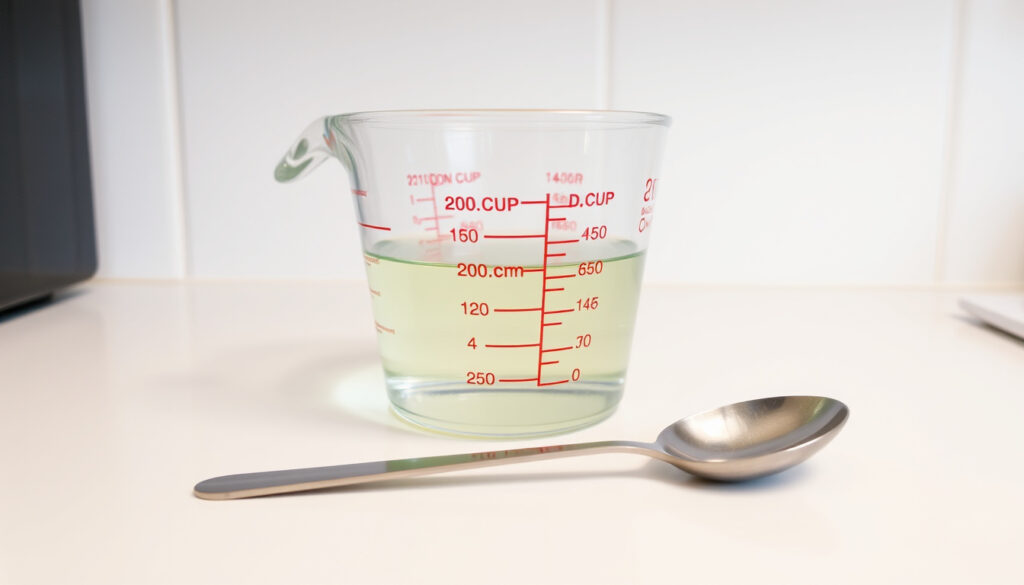
A standard US dry measuring cup filled to the 1/2 mark contains 8 tablespoons. The same cup filled to the rim holds 16 tablespoons. Butter sticks are wrapped with tablespoon markings — each stick shows 8 tbsp lines, making visual confirmation easy.
Recipe writers often shorten “1/2 cup” to “8 tbsp” in ingredient lists, which is accurate but trips up beginner bakers. When a list says “8 tbsp butter”, measure half a cup, not a whole one.
What this means: The 8-versus-16 confusion is the leading cause of over-buttered cookies. A quick check of the wrapper markings can save a batch.
How many tablespoons is 1/2 cup?
1/2 US cup equals exactly 8 US tablespoons. This applies to all ingredients measured by volume — including butter, flour, and liquids.
Is 8 tbsp a half a cup?
- Yes. Inch Calculator confirms: 8 tbsp = 0.5 cup.
- For butter: 1/2 cup = 8 tbsp = 1 stick (Land O’Lakes)
How many tablespoons in half a cup of butter?
Half a cup of butter is 8 tablespoons — exactly one standard US stick. Dairy Farmers of Canada uses the same convention. A single block of butter (1 lb) contains 4 sticks, so 2 cups total.
Half cup in fluid ounces
- 1/2 US cup = 4 US fluid ounces — notes this for liquid conversions.
- Metric: 1/2 cup ≈ 120 mL
The pattern: Half of a cup is always 8 tbsp, whether you’re measuring water, milk, or melted butter. The volume relationship is fixed; only the weight changes with density.
Is 4 tbsp 1/4 of a cup?
Yes — 4 US tablespoons equal exactly 1/4 US cup. This is the smallest whole-fraction cup measure that bakers use regularly.
Does 4 tbsp make 1 cup? (no)
- 4 tbsp = 1/4 cup. To make 1 cup you need 16 tbsp (Land O’Lakes).
- Confusion sometimes arises because some 1/4-cup measures are labeled “4 tbsp” — correct, but that’s only a quarter of the full cup.
Quarter cup in teaspoons
- 1/4 cup = 12 teaspoons (since 1 tbsp = 3 tsp) — cross-references.
- 1/4 cup = 2 fl oz ≈ 60 mL
Visual: 1/4 cup vs 1/2 cup
A 1/4-cup measure holds exactly half the volume of a 1/2-cup. In tablespoon terms: 4 vs 8. For butter, a 1/4 cup is half a stick, or 4 tbsp.
Quarter-cup increments are the most common fraction in American baking. Memorizing 4, 8, 12, 16 for 1/4, 1/2, 3/4, and full cup will cover about 90% of volume conversions in US recipes.
The takeaway: 4 tbsp is a quarter, not a whole. When a recipe calls for 1/4 cup, reach for the “4 tbsp” line, not the 1-cup scoop.
What is 1 cup in UK tablespoons?
This is where the conversion gets trickier. The UK does not have a single legal standard for a “cup” in cooking — most modern UK recipes use weight (grams) or the metric cup (250 mL). But if you need a rough volume conversion, a UK cup is about 250 mL, and a UK tablespoon is 15 mL, so about 16.7 UK tablespoons fit in a UK cup.
How many tablespoons are in a cup in the UK?
- Approximately 16.7 UK tablespoons (15 mL each) fill a 250 mL metric cup — The English Kitchen cites the 250 mL informal cup and 15 mL tablespoon.
- A YouTube source (measurement explainer) claims 1 UK tbsp ≈ 1.2 US tbsp, which is consistent with the volume difference.
Difference between US and UK cup measurements
- US cup: 240 mL (legal definition). UK metric cup: 250 mL (common informal standard).
- US tablespoon: 14.8 mL. UK tablespoon: 15 mL (official standard, but older recipes may use 17.7 mL) — notes the variability.
- Weight vs volume: UK bakers rely heavily on grams for flour and butter, reducing the need for cup measurements.
Converting UK recipes to US measurements
- Use weight conversion: 1 US cup butter ≈ 227 g. 1 UK cup (250 mL) of butter ≈ 237 g (butter density ~0.95 g/mL).
- For volume, multiply UK tbsp by 0.96 to get US tbsp (since 15/14.8 ≈ 1.01, but the difference is small).
- Better approach: convert UK recipe weights to US cups using a reliable conversion chart (BBC Food (public broadcaster) recommends weight for accuracy).
Here’s a comparison of the three main cup systems side by side.
Three cup systems, one key difference: the US cup is smallest, the UK metric cup is slightly larger, and the Imperial cup (rarely used) is larger still.
| System | Volume per cup | Tablespoons per cup | Tbsp volume |
|---|---|---|---|
| US customary | 240 mL | 16 US tbsp | 14.8 mL |
| UK metric (informal) | 250 mL | ~16.7 UK tbsp | 15 mL |
| Imperial (UK legal, pre-1976) | 284 mL | ~18.9 UK tbsp | 15 mL |
How to convert cups to tablespoons: step-by-step
Follow these five steps to convert any cup measurement to tablespoons accurately.
- Identify the cup size. Confirm whether the recipe uses US customary (240 mL), UK metric (250 mL), or Imperial (284 mL) cups. Most US blogs use US customary; most UK books use weight.
- Know your tablespoon. US tablespoon = 14.8 mL. UK tablespoon = 15 mL. For most home cooking the difference is negligible, but for baking precision, use the correct one.
- Apply the formula. Multiply number of cups by the appropriate tablespoons-per-cup: US: ×16; UK metric: ×16.7; Imperial: ×18.9. Example: 2 US cups = 32 tbsp.
- For fractions, use decimal. 1/3 cup = 0.33 × 16 = 5.33 tbsp. Measure 5 tbsp + 1 tsp.
- Verify with weight. For butter, cross-check with grams: 1 tbsp butter ≈ 14.2 g (Savor the Best (conversion chart PDF)).
Never assume 1 cup = 16 tbsp when using a UK or Australian recipe. Australia uses a 20 mL tablespoon — that’s 12.5 Australian tbsp per 250 mL cup. Always check the regional standard before measuring.
The implication: regional tablespoon differences can throw off a recipe by more than 20% if ignored. Always verify the local standard.
Clarity: what’s confirmed and what’s unclear
Confirmed facts
- 1 US cup = 16 US tablespoons — multiple tier1 sources (Land O’Lakes, Erren’s Kitchen)
- 1 UK cup is commonly 250 mL — widely accepted informal standard
- 1 US tablespoon = 14.8 mL — US legal definition
- Butter: 1 stick = 8 tbsp = 1/2 cup — all tier1/2 sources agree
What remains unclear
- Exact UK cup definition varies between 225 mL and 250 mL — The English Kitchen notes both values appear in older cookbooks.
- UK tablespoon may be 15 mL or, in older recipes, 17.7 mL — no single authoritative standard exists for historical recipes.
- Conversion ratio between UK and US tablespoons is reported as 1.2× by some sources (YouTube measurement video), but the actual ratio based on legal volumes is approximately 1.014.
- Australian tablespoon is 20 mL, leading to 12.5 Australian tbsp per metric cup — a different standard.
Expert perspectives on cup-to-tablespoon conversions
“One cup of butter equals 16 tablespoons.”
“One whole block of butter equals 2 cups or 32 tablespoons.”
Dairy Farmers of Canada (Canadian dairy industry body)
“The Exploratorium provides measurement equivalences stating 16 tablespoons in 1 cup.”
“Butter is denser than flour — use 14 grams of butter as 1 tablespoon for practical conversions.”
The common thread: every authoritative source agrees on 16 US tbsp per cup. The uncertainty lives only in the UK system, where weight-based baking makes volume conversions less critical.
reddit.com, bakinglikeachef.com, savorthebest.com, instagram.com
Frequently asked questions
How many tablespoons in a cup of flour?
1 US cup of flour = 16 tablespoons by volume. However, flour weight varies by type: all-purpose flour weighs about 120 g per cup.
How many tablespoons in a cup of sugar?
1 US cup of granulated sugar = 16 tablespoons. Weight: about 200 g per cup.
How many tablespoons in a cup of butter?
1 US cup of butter = 16 tablespoons = 2 sticks = 227 g. This is consistent across all US butter brands.
Is a dry cup the same as a liquid cup?
Yes, by volume. 1 US dry cup = 16 tablespoons, same as 1 US liquid cup. The difference is in the measuring tool (dry cups level off, liquid cups have a spout).
How many tablespoons in a metric cup?
A metric cup (250 mL) contains about 16.7 metric tablespoons (15 mL each). In US tablespoons, it’s about 16.9.
How many teaspoons in a cup?
1 US cup = 48 teaspoons (3 teaspoons per tablespoon × 16 tablespoons).
How many tablespoons in a cup of milk?
16 tablespoons — milk is measured by liquid volume, same as water.
How many tablespoons in a cup of rice?
Uncooked rice: 16 US tablespoons per cup. Cooked rice about 2 cups per cup uncooked, but volume changes — best to measure before cooking.
For the home baker in the US, the choice is straightforward: keep a 16-to-1 rule in your head and use stick markings for butter. For anyone working with UK or Australian recipes, the safer path is to switch to a kitchen scale and use grams. The volume conversion differences may be small, but in baking, even a 4% error can turn a tender crumb into a dense brick.
More related posts
 Bill Skarsgård Movies and TV Shows: Complete List 2025
 Foods High in Cholesterol: Lists and Foods to Avoid
 Check Your Chick-fil-A Gift Card Balance
 New Movies Streaming Now: Top Picks on Netflix, Hulu & Prime
 When Did Stranger Things Come Out – All Seasons Release Dates
 Tanning Salons Near Me: Times, Safety, and Tips for Fair Skin
 Orange County Clerk of Court – Records, Phone, Locations Guide
 What Is a Mocktail? Definition, Top Examples & Recipes