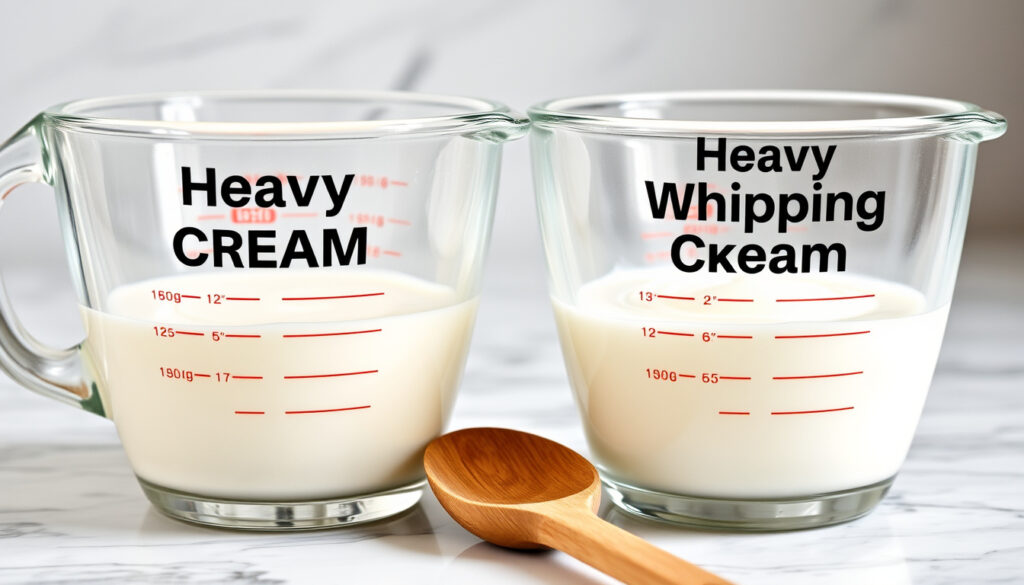
Is Heavy Cream the Same as Heavy Whipping Cream? Facts
There’s a reason the dairy aisle can feel overwhelming: heavy cream, heavy whipping cream, whipping cream — each carton looks almost identical, yet a single percentage point of milk fat separates a stable sauce from a thin one and a safe week from a risky month. Here are the fat standards, the cooking tests, and the safety rules that actually matter.
Milk fat minimum for heavy cream: At least 36% · Milk fat range for whipping cream: 30-35% · Opened heavy cream shelf life: About 7 days refrigerated at 40°F or below · Commercial cream treatment: Pasteurized or ultra-pasteurized
Quick snapshot
- Heavy cream and heavy whipping cream have the same milk fat minimum in common U.S. labeling, while whipping cream has 30-35% milk fat. (USDA Agricultural Marketing Service (official U.S. standards))
- The exact spoilage point depends on temperature, handling, and pasteurization method. Brand labeling of heavy cream vs heavy whipping cream varies. (Better Living (home and kitchen safety advice); Food Network (test-kitchen editorial team))
- Opened heavy cream is usually best within about 7 days of refrigeration at 40°F or below. Unopened cream should be used by the date on the carton. (USDA FoodKeeper guide; USDA standards)
- Check the fat percentage rather than relying only on the name. Treat opened cream with a sensory check before use. (Food Network; USDA FoodKeeper guide)
One set of numbers, one defining threshold: the 36% milk fat line separates U.S. heavy cream from everything else in the dairy case.
| Attribute | Value |
|---|---|
| Heavy cream milk fat | At least 36% |
| Whipping cream milk fat | 30-35% |
| Commercial processing | Pasteurized or ultra-pasteurized |
| Opened refrigerator life | About 7 days at 40°F or below |
| Spoiled cream | Discard; do not cook with it |
| Light whipping cream milk fat | 30% to less than 36% |
| Double cream (UK) milk fat | At least 48% |
| Single cream (UK) milk fat | At least 18% |
Is heavy cream the same as heavy whipping cream?
The only meaningful difference between a carton labeled “heavy cream” and one labeled “heavy whipping cream” is the name on the front. Under U.S. standards of identity, heavy cream must contain at least 36% milk fat (USDA Agricultural Marketing Service (official U.S. standards)). Heavy whipping cream, as a labeled product, generally meets the same 36% standard, making it functionally identical in the kitchen (Food Network (test-kitchen editorial team)).
Two names, one product. The table below shows how closely the two products overlap in the dairy case.
| Feature | Heavy cream | Heavy whipping cream |
|---|---|---|
| Minimum milk fat | 36% | 36% (common practice) |
| Legal standard | Yes (USDA) | No standalone standard |
| Best for whipping | Excellent | Excellent |
What the label means
Heavy cream: ≥36% milk fat · Whipping cream: 30-35% milk fat · Heavy whipping cream: ~36% milk fat
The implication is clear: in U.S. grocery stores, the terms are largely marketing synonyms for the same high-fat dairy product. Whipping cream without the “heavy” label, however, has a legally distinct fat range (30-35%) that can affect performance.
Is heavy cream the same as heavy whipping cream for cake?
- Yes. Both whip well. Heavy cream gives firmer, more stable peaks due to its higher fat content. Whipping cream produces softer, lighter peaks that may collapse faster under the weight of frosting or filling (Food Network).
Is heavy cream the same as heavy whipping cream for pasta?
- Yes. Both can be used in pasta sauces. Heavy cream makes a richer, thicker sauce and is less likely to curdle when simmered. Whipping cream works but produces a noticeably thinner result (Food Network).
Heavy cream gives firmer peaks and a richer sauce. Whipping cream gives a lighter texture and thinner body. Choose based on the outcome, not the label.
Is heavy cream the same as fresh cream?
- No. “Fresh cream” is not a legally defined term in the United States. It can refer to any cream that hasn’t been ultra-pasteurized, or simply be a marketing phrase for a product’s flavor profile. Unlike “heavy cream,” it carries no guaranteed fat percentage.
The implication: U.S. shoppers can treat the two “heavy” names as identical in almost any recipe, paying attention only to the fat percentage on the carton.
This means the label difference is mostly cosmetic; the fat percentage determines culinary performance.
Can I use whipping cream for pasta?
Yes, whipping cream can replace heavy cream in pasta dishes. Because whipping cream contains 30-35% milk fat compared to heavy cream’s 36% floor, the sauce will be slightly thinner and less resistant to curdling over heat (Food Network (test-kitchen editorial team)).
Can you use heavy cream in coffee?
- Yes. Both heavy cream and whipping cream can be added to coffee. Higher fat content gives a richer, creamier texture that blends smoothly without curdling in hot liquid.
Does lower-fat whipping cream make a thinner pasta sauce?
- Yes. Whipping cream (30-35% fat) produces a thinner sauce than heavy cream. For a glossy, clingy sauce that coats noodles firmly, heavy cream holds better and resists breaking under heat (Food Network).
The catch: if the sauce needs to coat noodles firmly, heavy cream holds better and resists breaking under heat.
Is whipping cream pasteurized?
Almost all commercially sold heavy cream and whipping cream in the United States is pasteurized or ultra-pasteurized. This process kills pathogens that can cause illness, which is why it is the standard treatment for all dairy products sold across state lines (USDA Agricultural Marketing Service (official U.S. standards)).
Why does pasteurization matter for cream safety?
- Pasteurization kills harmful bacteria. It does not make the cream sterile. Once opened, cream is vulnerable to new contamination from air and handling (USDA FoodKeeper guide (food safety recommendations)).
Why this matters: pasteurization gives the unopened carton a long shelf life, but opened cream relies entirely on refrigeration and sensory checks to stay safe.
How long will heavy cream stay good in the fridge?
Opened: ~7 days at 40°F · Unopened: By carton date
The widely cited guideline from the USDA FoodKeeper program is that opened heavy cream is best used within about seven days when kept at a consistent 40°F or below (USDA FoodKeeper guide (food safety recommendations)). Unopened heavy cream stays fresh until the printed date on the carton, which typically assumes continuous refrigeration.
Sensory checks — smell, look, and taste — are the most reliable tool for determining if heavy cream is still safe after the seven-day mark.
The pattern: pasteurization type and fridge temperature shift the safe window, but seven days remains the safest average recommendation from food safety authorities.
Can I use heavy cream past 7 days after opening?
- It depends on temperature and handling. If it smells sour, looks curdled, or tastes off, discard it. The seven-day rule is an average, not a precise expiration (USDA FoodKeeper guide).
How should opened heavy cream be stored?
- In the coldest part of the refrigerator, below 40°F. Keep the carton tightly sealed to avoid absorbing other food odors and to slow bacterial growth (Better Living (home and kitchen safety advice)).
Can old heavy whipping cream make you sick?
Spoiled heavy cream can contain bacteria that cause foodborne illness. The risk increases the longer the product is stored past its date or kept at unsafe temperatures (USDA FoodKeeper guide (food safety recommendations)).
Can I use heavy whipping cream that is 2 months expired?
- No. A two-month-expired carton is well past typical safe storage. Discard it immediately if there is any off smell, texture, or appearance.
I accidentally ate expired whipped cream. What should I do?
- Monitor for symptoms like stomach upset or nausea. Seek medical care if severe reactions occur. Most cases of mild dairy spoilage resolve on their own, but persistent symptoms warrant professional attention.
The trade-off: discarding a $4 carton of cream is far cheaper and safer than a doctor visit for a preventable case of food poisoning.
What to do with spoiled whipping cream?
Spoiled whipping cream should be discarded. Do not attempt to cook with it or salvage it by boiling, as heat does not reverse spoilage already caused by bacterial waste products (USDA FoodKeeper guide (food safety recommendations)).
What can I do with expired heavy cream?
- If it passes the sensory test (smells clean, looks smooth, tastes fresh), it can be used in cooking or baking. Otherwise, discard. Freezing is an option for extending life, but thawed cream is best used in cooked dishes rather than for whipping (Pantry Metric (food storage research)).
What are the signs that heavy cream has spoiled?
- Visible mold, curdled texture, a strong sour smell, or a discolored appearance. A carton that looks fine but smells neutral can be trusted, but any off quality means the product is a food safety risk.
The bottom line: when in doubt, throw it out. The cost of a replacement carton is not worth the risk of illness.
What is known and what remains unclear about heavy cream
Confirmed facts
- Heavy cream contains at least 36% milk fat and commercial cream is pasteurized. (USDA)
- Opened cream is best within 7 days. (USDA FoodKeeper)
What’s unclear
- Exact spoilage and pasteurization type vary by temperature, handling, and brand. (Better Living)
- Brand labeling and the term fresh cream are not standardized. (Food Network)
Understanding these confirmed and uncertain points helps you make informed decisions about cream selection and storage.
Expert perspectives on heavy cream safety and handling
The label difference between heavy cream and heavy whipping cream is almost entirely a marketing choice. The fat content is what determines how it behaves in the pan.
— Test-Kitchen Editorial Team, Food Network
Under U.S. standards of identity, heavy cream must contain no less than 36% milk fat. This is the legal floor that gives it its rich texture and stable whip.
— USDA Agricultural Marketing Service (official U.S. standards)
Spoilage is not a calendar event. Temperature, handling, and pasteurization method are what actually determine how long an opened carton will stay safe.
— Home Safety Editor, Better Living
These expert opinions reinforce that fat content and handling matter more than label names.
How to tell if heavy cream is still good: A 5-step check
- Check the carton date. Unopened cream is generally safe until the printed date. (USDA FoodKeeper)
- Give it a sniff. A sour, off odor is the first sign of spoilage.
- Look for curdling. Lumpy or separated liquid that does not reincorporate when shaken means the cream has turned.
- Do a tiny taste test. If the smell is neutral, taste a small amount. A sour or bitter taste means discard.
- When in doubt, throw it out. The risk of foodborne illness is not worth saving a few dollars. (USDA FoodKeeper)
Following these steps minimizes the risk of using spoiled cream.
Summary
For the home cook in the United States, the choice between heavy cream and heavy whipping cream is a distraction. The real decision is whether the cream is cold, fresh, and properly stored — because a $5 carton of spoiled milk fat is still a food safety risk.
freshfoodkeeper.com, ams.usda.gov, stillgood.food, onbetterliving.com, onbetterliving.com, dairyconsultant.co.uk, foodnetwork.com, pantrymetric.com
Frequently asked questions
Can I freeze heavy cream?
Yes, for 3-4 months for peak quality. Thawed cream works best in cooked dishes because separation can impair whipping performance. (USDA FoodKeeper guide)
Does heavy cream need to be refrigerated?
Yes, at or below 40°F. Aseptic shelf-stable cream may be stored unrefrigerated before opening, but must be refrigerated afterward. (Better Living)
Can I use half-and-half instead of heavy cream?
Half-and-half has around 10–12% milk fat, so it will not whip the same way and sauces will be noticeably thinner. It works as a substitute in soups and coffee, but not for stable whipped cream.
What is the difference between heavy cream and double cream?
Double cream, common in the UK, has a legal minimum fat content of 48% — far richer than the 36% floor of U.S. heavy cream. (Dairy Consultant UK)
Does heavy cream separate when it sits in the fridge?
Yes, fat naturally rises to the top. Shake the carton well before opening to reincorporate it.
Can I make whipped cream from heavy cream?
Yes. Heavy cream with at least 36% milk fat whips readily and produces a stable, scoopable whipped cream. (Food Network)
These FAQs address common uncertainties about cream storage and substitution.
Related reading
More related posts
 Spectrum Internet Speed Test: Results, Fixes, and Expectations
 Sweet Treats Near Me: Best Local Desserts & Delivery in Ireland
 3/8 Inch to mm – Exact 9.525 mm Value, Formula & Chart
 Drive In Movie Theater Near Me: Ireland’s Top Venues
 Julie and the Phantoms Cast: Who Sings and Season 2 News
 Who Should I Start? Expert Fantasy Football Start/Sit Advice
 Is a Sinus Infection Contagious? Viral vs. Bacterial
 The Conjuring: Last Rites (2025) – Fact-Checked Dossier