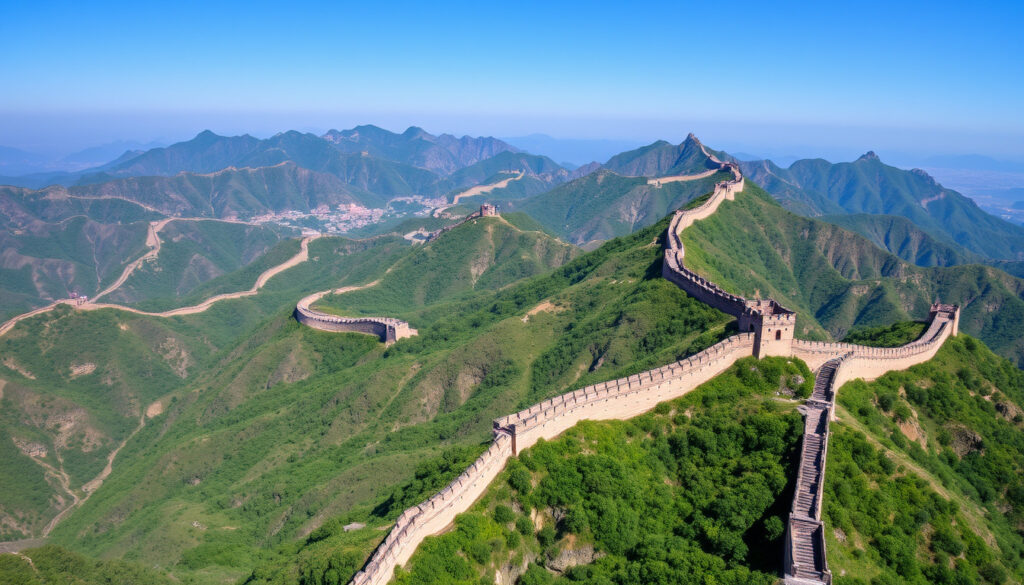
Great Wall of China: Length, History, Facts & Visiting Guide
The Great Wall of China stretches over 21,000 kilometers across mountains, deserts, and plains—a distance that defies most visitors’ expectations. The wall took more than two millennia to build and involved multiple dynasties, yet it remains one of humanity’s most ambitious construction projects. Here’s everything verified about the wall, from its earliest origins to what you can actually see visiting today.
Total Length: 21,196 km · Construction Period: 7th century BC to 17th century AD · UNESCO Status: World Heritage Site since 1987 · New 7 Wonders: Voted in 2007 · Primary Purpose: Military defense
Quick snapshot
- 21,196 km total length across all sections (Britannica)
- UNESCO World Heritage designation in 1987 (Britannica)
- Ming Dynasty built best-preserved 8,850 km section (Britannica)
- Exact number of workers who died during construction
- Precise total cost in modern equivalent terms
- Complete archaeological inventory of all wall sections
- First walls: 7th century BC
- Major dynasties: Qin, Han, Ming
- UNESCO listing: 1987
- Ongoing conservation efforts
- New sections still being discovered and mapped
- Visitor numbers recovering post-pandemic
This comprehensive table breaks down the structural specifications that make the Great Wall one of engineering history’s most remarkable achievements.
| Attribute | Value |
|---|---|
| Total Length | 21,196.18 km |
| Height Average | 6–7 m |
| Width at Top | 4–5 m |
| UNESCO Inscription | 1987 |
| Dynasties Involved | Qin to Ming |
| Ming Section Length | 8,850 km |
How long is China’s Great Wall and why was it built?
The Great Wall of China spans 21,196 kilometers (13,171 miles) when you count every section ever constructed—walls, trenches, and natural barriers combined. According to Wikipedia, China’s National Cultural Heritage Administration mapped 10,051 distinct wall sections in 2012 alone, confirming this total length through systematic survey.
Exact length measurements
The Ming Dynasty portion—the most visually striking and well-preserved section most tourists visit—measures 8,850 kilometers by itself (Britannica). This Ming wall breaks down into 6,259 km of actual walls, 359 km of trenches, and 2,232 km of natural barriers like cliffs and rivers. The wall stretches from Liaodong in the east to Lop Lake in the west, tracing China’s northern frontier.
Traditional estimates put the length at around 6,700 km, but these measured only the main continuous wall without branches and overlaps. The 2012 survey revealed the true scale when including everything ancient builders constructed.
Historical purpose and builders
The wall served three core military functions: border control, trade regulation, and defense against northern nomads like the Xiongnu, Mongols, and Manchus. The UNESCO official description notes that construction continued up to the Ming dynasty, when it became “the world’s largest military structure.”
Qin Shi Huang ordered the first unified Great Wall in 213 BC, mobilizing approximately 300,000 workers—soldiers, peasants, and prisoners—to connect existing fortifications left by previous states (China Xian Tour). This first phase was rough and hurried, built more for psychological deterrence than lasting durability.
Most tourists visit the Badaling section near Beijing—a 3.7 km stretch that represents less than 0.02% of the total structure.
What are 5 facts about the Great Wall of China?
The Great Wall ranks as the largest man-made structure ever built on Earth. Beyond its sheer scale, five facts define its historical and cultural significance.
Key dimensions
- The total route across all dynasties measures 21,196 km—longer than the distance from London to New York roughly four times over
- The wall averages 6–7 meters in height and 4–5 meters wide at the top, wide enough for five horses to ride abreast
- The Ming section alone spans 8,850 km, representing the best-preserved and most visited portions
Construction materials
Early walls used rammed earth, gravel, and sand. The Ming Dynasty (1368–1644) introduced brick and stone construction, creating the iconic white-walled sections visible today (Britannica). Workers kiln-fired bricks locally, reducing transport costs. Some mountain sections required scaffolding systems that still impress engineers today.
UNESCO recognition
UNESCO inscribed the Great Wall as a World Heritage Site in 1987, recognizing its exceptional universal value. The designation specifically covers “the Great Wall, sections of the fortifications of the frontier states and the Ming Great Wall”—acknowledging that the wall is not one linear structure but a complex defensive network spanning millennia.
Before 1987, many wall sections deteriorated from neglect and local brick-robbing for construction materials. Post-designation, preservation efforts intensified significantly.
How long will it take to walk the Great Wall of China?
Walking the entire Great Wall in a single lifetime is physically impossible for any individual—the route crosses deserts, mountain ranges, and remote terrain with no continuous path for hikers.
Popular sections durations
- Badaling: The most accessible section, 2–3 hours for the main tourist stretch (3.7 km one-way)
- Mutianyu: Fully restored section, 3–4 hours for the scenic 5.4 km loop
- Jinshanling: Popular for hikers, 4–6 hours for the 10.5 km wild wall section
- Simatai: Partially restored, 2–3 hours for the dramatic 5.4 km night section
Full wall feasibility
Documented hikers have completed specific multi-day sections. Traversing the entire Ming wall from Shanhai Pass (eastern terminus, built 1381) to Jiayu Pass (western terminus, built 1372) requires approximately 6–8 months of dedicated hiking with support teams. Most visitors focus on one or two sections as day trips from Beijing.
Which is older, Jesus or the Great Wall of China?
The Great Wall predates Jesus by approximately 700 years. The earliest walls date to the 7th century BC during the Spring and Autumn Period, centuries before Roman occupation of Judea and well before the historical figure of Jesus was born.
Timeline origins
The earliest confirmed wall segment was built by the State of Chu around 2600 years ago along the Henan-Hubei border (China Xian Tour). During the Spring and Autumn Period (770–476 BC), independent Chinese states built their own defensive walls, initially as protection against each other rather than northern invaders.
Qin Shi Huang unified China in 221 BC and ordered the connection of these disparate walls into a single defensive system—a project that started in 213 BC, approximately 234 years before Jesus’s estimated birth year.
Key construction dynasties
- Qin Dynasty (221–206 BC): First unification of existing walls
- Han Dynasty (206 BC–220 AD): Extended western portions to protect the Silk Road, adding 3,080 km
- Ming Dynasty (1368–1644): Built the iconic brick-and-stone sections over 200 years
- Jin Dynasty (1115–1234): Added 4,010 km of border fortifications
How long did it take to build the Great Wall of China?
Total construction time exceeded 2,000 years—making it history’s longest-running infrastructure project. Multiple dynasties contributed separate phases, with major construction concentrated in specific periods.
Dynastic phases
- 7th century BC to 221 BC: Early state walls built by competing kingdoms
- 221–206 BC: Qin unification and first connected wall
- 206 BC–220 AD: Han Dynasty extensions, particularly western additions
- 550–618 CE: Northern Dynasties and Sui Dynasty repairs
- 1115–1234 CE: Jin Dynasty fortifications with moats and beacon towers
- 1368–1644 CE: Ming Dynasty’s monumental 200-year reconstruction
- 1644–1912 CE: Qing Dynasty largely abandoned the wall
Total span
The longest continuous construction period was the Ming Dynasty’s 276-year effort. The first unified wall under Qin took roughly 10 years but required massive labor mobilization. The Han dynasty spent generations extending western sections. Most individual passes were built in 1–5 years: Jiayu Pass in 1372, Yanmen Pass in 1374, and Shanhai Pass in 1381.
UNESCO officially recognizes that construction continued “from the 3rd century B.C. to the 17th century A.D.,” spanning approximately 2,000 years of intermittent but continuous effort.
Where is the Great Wall of China located?
The Great Wall traces China’s northern border from the Bohai Sea coast near Dandong eastward to Lop Nur (ancient Lop Lake) in the western Xinjiang desert, roughly following the 400mm annual rainfall line that divides agricultural China from the Mongolian steppe.
Major passes
- Shanhai Pass: Eastern terminus, built in 1381, where the wall meets the sea
- Badaling: Most visited section, 70 km northwest of Beijing
- Jiayu Pass: Western terminus in Gansu Province, built in 1372
- Yanmen Pass: Strategic Shanxi Province pass, built in 1374
- Juyong Pass: Key Beijing-region fortification
Geographic extent
The wall traverses nine provinces and municipalities: Liaoning, Hebei, Tianjin (coastal section), Beijing, Shanxi, Inner Mongolia, Shaanxi, Ningxia, and Gansu. It crosses terrain ranging from beaches and plains to high mountains exceeding 2,500 meters elevation.
Can you see the Great Wall from space?
No—the Great Wall is not visible to the naked eye from space, despite a persistent myth claiming otherwise. Astronaut William Shepherd reportedly dispelled this claim during a 1990 space shuttle mission after explicitly looking for it.
The wall’s width (4–5 meters at the top) is simply too narrow relative to Earth’s surface area to distinguish from orbital altitude. Even from low Earth orbit (160–2,000 km), the wall requires specific conditions—low sun angle casting shadows—to appear visible in satellite imagery.
NASA’s astronaut Jeff Hoffman confirmed in 2003 that he could not see the Great Wall from the International Space Station. The wall lacks sufficient contrast with surrounding terrain, and its narrow profile disappears against natural geological features.
What materials were used to build the Great Wall?
Construction materials evolved significantly across dynasties, reflecting technological development and available resources. For those interested in impressive geological formations, the White Cliffs of Dover are a famous example.
- Early walls (Qin, Han): Rammed earth ( ), using locally sourced soil compressed in layers
- Ming Dynasty: Kiln-fired bricks, limestone mortar, granite blocks for foundations
- Beacon towers: Stone or brick, strategically placed for line-of-sight signaling
- Transported materials: Local sourcing where possible; strategic transport for key fortifications
Ming builders quarried stone locally, burned bricks on-site to reduce transport costs, and used wooden scaffolding to move materials up steep mountain faces.
What are the best sections of the Great Wall to visit?
Visitor preference depends on interests: restoration level, accessibility, crowd avoidance, and photography opportunities.
- Badaling: Most accessible, steepest, and most crowded; recommended for first-time visitors prioritizing convenience
- Mutianyu: Fully restored with modern amenities; includes a toboggan ride down; less crowded than Badaling
- Jinshanling: Partially restored “wild wall” section beloved by photographers and serious hikers
- Simatai: Dramatic elevation changes, night opening (special permit required), challenging terrain
- Huangyaguan: Historic section with the famous “Sky Street” incline; good compromise between restoration and authenticity
Avoid Chinese national holidays (Golden Weeks in May and October) if possible. Badaling during National Day can mean 4+ hour queues and wall sections so crowded you cannot walk freely. Mutianyu or Jinshanling offer much better experiences during peak periods.
Are there hotels on the Great Wall?
Direct accommodation directly on the wall itself is prohibited by UNESCO conservation guidelines and Chinese heritage law. However, numerous hotels operate in communities surrounding the wall, ranging from luxury resorts to budget guesthouses.
- Mutianyu area: Several boutique hotels and farm-stay options within walking distance of the section entrance
- Gubeikou region: Rustic countryside inns offering immersive rural experiences
- Jinshanling: Basic guesthouses catering primarily to hiking groups
- Beijing fringe: International chain hotels 30–60 minutes from major wall sections
How was the Great Wall of China constructed?
Ming Dynasty builders developed sophisticated techniques adapted to challenging terrain. Workers quarried stone locally, burned bricks on-site to reduce transport costs, and used wooden scaffolding to move materials up steep mountain faces.
The labor system involved military garrisons supplemented by forced labor and contracted workers. Construction standards varied by section importance—near Beijing, walls received premium materials and skilled craftsmen; remote western sections used more basic techniques with available labor.
Key engineering features included watchtowers every 500 meters (for sight-line signaling), crenellated parapets for defender cover, horseshoe bends for defensive geometry, and drainage systems integrated into foundations to prevent erosion.
Confirmed facts
- 21,196 km total length across all sections
- Ming Dynasty section: 8,850 km
- First walls: 7th century BC
- Qin unification: 221 BC
- UNESCO World Heritage Site since 1987
- New 7 Wonders of the World (2007)
- Jiayu Pass built 1372, Shanhai Pass built 1381
- 10,051 wall sections mapped in 2012 survey
What’s unclear
- Exact number of workers who died during construction
- Total cost estimates in modern currency
- Complete archaeological inventory remains ongoing
- Precise total labor-force numbers per dynasty
Quotes
“Construction continued up to the Ming dynasty (1368–1644), when the Great Wall became the world’s largest military structure.”
“In c. 220 B.C., under Qin Shi Huang, sections of earlier fortifications were joined together to form a united defence system against invasions from the north.”
“The wall constructed during the Ming dynasty, the most well-preserved section, is about 8,850 kilometers (5,499 miles) long.”
— Britannica Encyclopedia
For visitors planning a trip, the choice is clear: prioritize sections based on your fitness level and crowd tolerance. If you want the Instagram shot, go to Mutianyu or Jinshanling—not Badaling on National Day. If you want to understand why emperors obsessed over this structure for two millennia, spend time at Shanhai Pass or Jiayu Pass where the wall meets vast open landscape and you can finally grasp the logistical impossibility of defending thousands of kilometers of frontier.
Where is the Great Wall of China located?
The Great Wall traces China’s northern border from the Bohai Sea coast near Dandong eastward across nine provinces to Lop Nur in western Xinjiang, following the traditional boundary between agricultural China and the Mongolian steppe.
Why is the Great Wall so special?
The Great Wall is the largest man-made structure ever built, spanning 21,196 km across all sections. It represents over 2,000 years of continuous construction effort by multiple dynasties and remains the world’s largest military fortification, designated a UNESCO World Heritage Site in 1987.
Can you see the Great Wall of China from space?
No. Despite the popular myth, the Great Wall is not visible to the naked eye from space. Astronauts have confirmed this repeatedly—the wall is too narrow (4–5 meters wide) to distinguish from orbital altitude without specialized equipment.
What materials were used to build the Great Wall?
Early walls used rammed earth. The Ming Dynasty introduced kiln-fired bricks, limestone mortar, and granite blocks. Watchtowers and key fortifications often used local stone. Materials were typically sourced as close to construction sites as possible to reduce transport costs.
What are the best places to visit the Great Wall?
Mutianyu and Jinshanling offer the best balance of restoration quality, accessibility, and crowd management for most visitors. Badaling is most accessible but most crowded. For photography and hiking, Jinshanling is preferred. Simatai offers dramatic night views with special permits.
Are there hotels on the Great Wall?
No hotels exist directly on the wall—UNESCO guidelines and Chinese heritage law prohibit overnight accommodation on the structure itself. However, numerous hotels operate in nearby communities: boutique options near Mutianyu, rustic inns at Gubeikou, and international chains within an hour of Beijing’s wall sections.
How was the Great Wall of China constructed?
Ming builders used locally quarried stone, on-site brick kilns, and wooden scaffolding to move materials up steep terrain. Workers layered compressed rammed earth for early sections; brick-and-stone construction became standard during the Ming Dynasty. Key engineering features included watchtowers every 500 meters, crenellated parapets, and integrated drainage systems.
Related reading: Piaget’s Theory of Cognitive Development: 4 Stages Explained · Parts of a Flower – Anatomy, Functions and Identification
chinahighlights.com, globaladventurechallenges.com, worldhistory.org, youtube.com
The Great Wall’s staggering 21,196 km span emerges from length, history and myths spanning over two millennia of dynastic defense efforts.
More related posts
 Taco Bell Nacho Fries: Price, Ingredients & 2026 Return
 Who Is the New Pope – Still Francis in March 2025
 What Is a Leap Year? Complete Definition, Rules, and Key Facts
 How Many Tablespoons in a Cup? Quick Conversion Guide
 Check Your Chick-fil-A Gift Card Balance
 Mission Lane Credit Card Review: A 2025 Guide
 Seahawks vs Steelers Player Stats: 31-17 Recap (2025)
 Amazon Vine Sign In: Official Portal & Login Steps (2025)