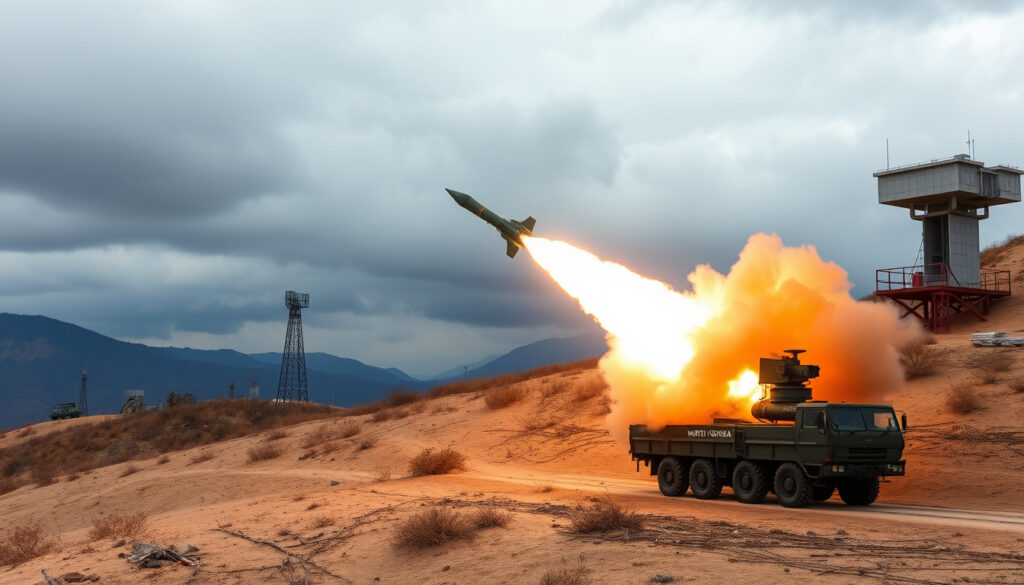
North Korea Rocket Launches: Tests, Nuclear Arsenal & Defense
Few topics grab attention quite like North Korean missile launches. In August 2026, North Korea fired 10 ballistic missiles in a single test, underscoring the rapid pace of its weapons program.
Latest major launch: 10 ballistic missiles on Aug 20, 2026 (Reuters) · Hwasong-15 flight time: 50 minutes (Wikipedia) · Estimated nuclear warheads: 80–120 (South Korean government estimate via Reuters)
Quick snapshot
- August 2026: 10 ballistic missiles fired (Reuters)
- Hwasong-15 altitude: 4,500 km (Wikipedia)
- Six nuclear tests since 2006 (Arms Control Association)
- Exact number of nuclear warheads — South Korea estimates 80–120, other analysts suggest 50–80 (Reuters, Federation of American Scientists)
- Success rate of US missile defense against a multi-ICBM salvo — tests show ~55% for single intercepts (Congressional Research Service)
- North Korea’s ability to miniaturize warheads for all missile types (Arms Control Association notes progress but uncertainties remain)
- Aug 2026: 10 ballistic missiles launched (Reuters)
- May 2026: AI-guided cruise missiles tested (Reuters)
- Jan 2026: Hypersonic missile test (Reuters) (Reuters)
- Likely more solid-fuel ICBM tests in 2026–2027
- Possible US deployment of additional THAAD batteries to South Korea
- Renewed diplomatic talks or sanctions escalation
A quick look at the core data shows how fast the program is evolving.
| Metric | Value | Source |
|---|---|---|
| Latest major test | 10 ballistic missiles on Aug 20, 2026 | Reuters |
| Estimated nuclear warheads | 80–120 (South Korean estimate) | Reuters |
| ICBM range (Hwasong-15) | Up to 13,000 km | Wikipedia |
| Total missile tests (2023) | Over 100 | BBC News |
North Korea’s 2026 test cadence — hypersonic, ballistic, cruise, artillery — shows a deliberate strategy to stress every layer of US and allied missile defense. The sheer volume means no single system can guarantee interception.
Did North Korea launch any missiles recently?
Yes. On August 20, 2026, North Korea launched 10 ballistic missiles that flew about 300 km toward the East Sea, according to Reuters citing South Korea’s Joint Chiefs of Staff. The test used the KN-25 multiple rocket launch system, a short-to-medium range weapon the country has been improving. South Korea and Japan immediately condemned the launches.
Earlier that year, in January 2026, North Korea conducted a hypersonic missile test that state media said hit a target 1,000 km away (Reuters). In April, Kim Jong Un oversaw tests of upgraded Hwasong-11 Ra tactical ballistic missiles with special mission warheads (Reuters).
Why is North Korea launching missiles?
Missile tests serve multiple purposes for Pyongyang. First, they are a military deterrent — proving that the country can strike South Korea, Japan, and potentially the US mainland. Second, each test yields data to improve accuracy, range, and survivability. North Korea routinely cites US-South Korea joint military exercises as provocation, framing its launches as necessary self-defense (Reuters).
Third, the tests give Kim Jong Un political leverage. Demonstrating new capabilities — like AI-guided cruise missiles or hypersonic gliders — forces the international community to negotiate on his terms. According to BBC News, the nuclear program has accelerated markedly under Kim’s leadership.
The more capable North Korea’s arsenal becomes, the harder it is for the US to remove it by diplomacy. The missiles themselves are negotiation chips — but they also make any future conflict infinitely more dangerous.
How many nukes has North Korea?
Estimates vary widely. A South Korean government assessment, reported by Reuters in August 2026, concluded North Korea may possess between 80 and 120 nuclear warheads. Older expert analyses, such as those from the Federation of American Scientists, placed the number at roughly 50 as of 2024. The country has conducted six nuclear tests since 2006, including a hydrogen bomb test in 2017 (Arms Control Association).
What this means: Even the lower estimate gives North Korea enough warheads to threaten multiple cities. The uncertainty itself is a strategic weapon — adversaries cannot know exactly what they’d face in a conflict.
How is North Korea so powerful?
North Korea’s military strength rests on three pillars. First, its nuclear weapons program provides a strategic deterrent that no other country in its position has. Second, it maintains the world’s fourth-largest standing army, with roughly 1.2 million active personnel (Wikipedia). Third, the authoritarian regime can prioritize military spending without public accountability, pouring resources into missile development and nuclear enrichment.
The Yongbyon nuclear facility, for example, produces plutonium and enriched uranium for warheads. According to BBC News, these facilities have been modernized in recent years. The trade-off is a starving economy — but for Kim, military might is the ultimate guarantee of survival.
What happens if North Korea attacks the USA?
If North Korea launched an ICBM toward the US mainland, a multi-layered defense system would try to stop it. The Ground-Based Midcourse Defense (GMD) system, based in Alaska and California, is designed to intercept ICBMs in space (U.S. Department of Defense). THAAD batteries stationed in South Korea and Guam handle medium-range threats. But no system is 100% effective, especially against a large salvo or decoys.
Four missile defense systems, compared below, show the strengths and gaps.
| System | Designed for | Key limitation |
|---|---|---|
| GMD (Ground-Based Midcourse Defense) | ICBM interception in space | Only 44 interceptors, limited salvo capability |
| THAAD (Terminal High-Altitude Area Defense) | Medium-range missile interception | Cannot engage ICBMs in boost phase |
| Aegis BMD (Ship-based) | Short to intermediate-range | Limited coverage over land |
| Iron Dome (Israel, short-range) | Rockets and mortars | Useless against ICBMs; overwhelmed by mass fire |
Can the US stop a nuke from hitting us?
The US missile defense network has never been tested against a live ICBM attack. The GMD system has a Congressional Research Service reported success rate of about 55% in controlled tests. Against a single North Korean ICBM, odds are moderate. But if North Korea launched multiple missiles simultaneously — with decoys — the defense could be saturated.
Why does the Iron Dome have vulnerabilities against North Korean missiles?
Iron Dome is designed for short-range rockets, not ICBMs. During the 2021 Gaza conflict, it intercepted roughly 90% of rockets that threatened populated areas, but Israeli officials acknowledge that a large barrage can overwhelm the system (BBC News). Iron Dome would be irrelevant against a North Korean ICBM.
How does US missile defense compare to other countries’ systems?
Most experts consider the US to have the most advanced and layered missile defense architecture, spanning ground-based, ship-based, and space-based sensors (Congressional Research Service). However, Russia and China also field capable systems (S-400, HQ-9), and Israel’s integrated Iron Dome/David’s Sling/Arrow system covers multiple threats. No single country can guarantee protection against a large salvo from a peer competitor.
Timeline of key events
North Korea’s missile program follows a clear trajectory of increasing range, accuracy, and diversity.
| Date | Event | Source |
|---|---|---|
| Aug 20, 2026 | North Korea launches 10 ballistic missiles, flights of ~300 km | Reuters |
| 2023 | Record number of missile tests, including solid-fuel ICBMs | Reuters |
| Nov 28, 2017 | Hwasong-15 ICBM test — altitude 4,500 km, flight time 50 minutes | Wikipedia |
What’s confirmed and what’s unclear
Confirmed facts
- 10 ballistic missiles launched on Aug 20, 2026 (Reuters)
- Hwasong-15 altitude and flight time (Wikipedia)
- Multiple test events in 2026 involving hypersonic, tactical ballistic, and cruise missiles (Reuters, BBC News)
What’s unclear
- Exact number of nuclear warheads — South Korea estimates 80–120, other analysts suggest 50–80 (Reuters, Federation of American Scientists)
- Success rate of US GMD against a multi-ICBM salvo with decoys (Congressional Research Service notes single-intercept success of ~55%)
- North Korea’s actual ability to miniaturize warheads for every missile type (Arms Control Association acknowledges progress but uncertainty)
Expert perspectives
“The missiles flew about 300 kilometers toward the eastern waters.”
— South Korean Joint Chiefs of Staff, via Reuters
Kim Jong Un said the tests demonstrated “the might and the invincibility of our republic’s nuclear deterrence.”
— North Korean state media, via Reuters
The accelerating test schedule — from hypersonic vehicles to AI-guided cruise missiles — is not just a military exercise. It forces every allied defense planner to reevaluate their assumptions. For the US and South Korea, the implication is stark: the window for a purely diplomatic resolution is narrowing, while the technical challenge of defense keeps growing. For the reader following this story, the key takeaway is that North Korea is no longer a regional threat — its missile range now covers most of the planet.
reuters.com, reuters.com, reuters.com, aljazeera.com, reuters.com, reuters.com, npr.org, congress.gov, upi.com, theguardian.com, economictimes.indiatimes.com
Frequently asked questions
Which country has the deadliest missile?
Russia fields the RS-28 Sarmat ICBM, a heavy liquid-fueled missile capable of carrying multiple warheads. The US has the Minuteman III and is developing the Sentinel. North Korea’s Hwasong-15 and Hwasong-17 are among the largest road-mobile ICBMs but have been tested fewer times.
Does Russia have better missiles than the US?
Russia has more diverse ICBM types, including heavy silo-based (Sarmat) and rail-mobile (Yars). The US relies on a single ICBM type (Minuteman III) plus submarine-based Trident II. Each has strengths: US missiles are more accurate; Russian missiles are designed to overwhelm defenses with numbers and decoys.
Which countries can hit the US with missiles?
Russia, China, and North Korea have ICBMs capable of reaching the US mainland. North Korea’s Hwasong-15 is estimated to have a range of 13,000 km, enough to strike anywhere in the US.
Why does the Iron Dome have vulnerabilities against North Korean missiles?
Iron Dome is designed for short-range rockets and mortars, not ballistic missiles. It can be overwhelmed by large salvos and is ineffective against ICBMs.
How does US missile defense compare to other countries’ systems?
The US operates the most layered system (GMD, THAAD, Aegis, Patriot), but no system is perfect. Israel’s multi-tier network (Iron Dome, David’s Sling, Arrow) is highly effective for its threat environment. Russia’s S-400 and S-500 systems focus on air defense with limited anti-missile capability.
Related reading
- US Intercepts Five Russian Warplanes Near Alaska: NORAD Scrambles F-16s and F-35s in Arctic Response — How the US air defense network reacts to Russian incursions near Alaska, relevant to understanding America’s northern detection capabilities.
- U.S. Embassy Qatar Warning: Ordered Departure & Level 3 — Context for US diplomatic security posture in the Middle East, which parallels its cautious approach in East Asia.
More related posts
 Are Grapes Bad for Dogs – Toxicity Risks Symptoms Emergency Guide
 The Curious Case of Benjamin Button: True Story & Viewing Guide
 Gold Chains for Men: Cost, Karat & Style Guide
 Isabella Ladera y Beéle Video Viral: Lawsuit Explained
 Ghost of Yotei: Release date, controversy and Easter egg
 Love Island New Season 2026: UK 13 & USA 8 Dates, Cast
 Manty Kazakh Near Me: Recipe, Origin, and Where to Eat
 Light Brown Hair Color: Best Shades & Dyes for Rosacea