Planet of the Apes 2001: Criticism, Legacy, and Canceled Sequel
Tim Burton’s 2001 Planet of the Apes is a $100 million paradox: a blockbuster that grossed $362 million yet satisfied almost no one. The film frustrated fans who expected a faithful remake and instead got a time paradox, a canceled sequel, and a decade-long franchise coma.
Release year: 2001 ·
Director: Tim Burton ·
Budget: $100 million ·
Worldwide gross: $362 million ·
Rotten Tomatoes score: 45% ·
Planned sequel: Canceled
Quick snapshot
- Directed by Tim Burton (Wikipedia (film encyclopedia))
- Earned $362 million worldwide on $100 million budget (Box Office Mojo (box office tracker))
- Rotten Tomatoes critic score: 45% (Rotten Tomatoes (review aggregator))
- Sequel canceled in 2002 (IMDb Trivia (film database))
- Exact profit/loss after marketing spend
- Specific boardroom reasons for Fox’s cancelation beyond public statements
- Whether a different director or script would have saved the franchise
- Released July 27, 2001 (The Numbers (box office data site))
- Sequel canceled in early 2002 (Den of Geek (entertainment news site))
- Reboot trilogy launched 2011 (Empire Online (film magazine))
- Kingdom of the Planet of the Apes (2024) continues the 2011 timeline (Screen Rant (film guide site))
Nine key facts define the 2001 film’s production and performance — one pattern: a big-budget blockbuster that failed to satisfy either its director’s vision or the franchise’s fanbase.
| Attribute | Value |
|---|---|
| Release date | July 27, 2001 (USA) |
| Director | Tim Burton |
| Screenwriters | William Broyles Jr., Lawrence Konner, Mark Rosenthal |
| Starring | Mark Wahlberg, Tim Roth, Helena Bonham Carter, Michael Clarke Duncan, Paul Giamatti |
| Budget | $100 million |
| Box office gross | $362 million worldwide |
| Rotten Tomatoes score | 45% (critics), 33% (audience) |
| IMDb rating | 5.7/10 |
| Planned sequel | Canceled in 2002 |
The pattern: each spec tells half the story — strong gross, weak reception, zero franchise momentum.
Why was Planet of the Apes 2001 so criticized?
Controversial ending and tonal mismatch
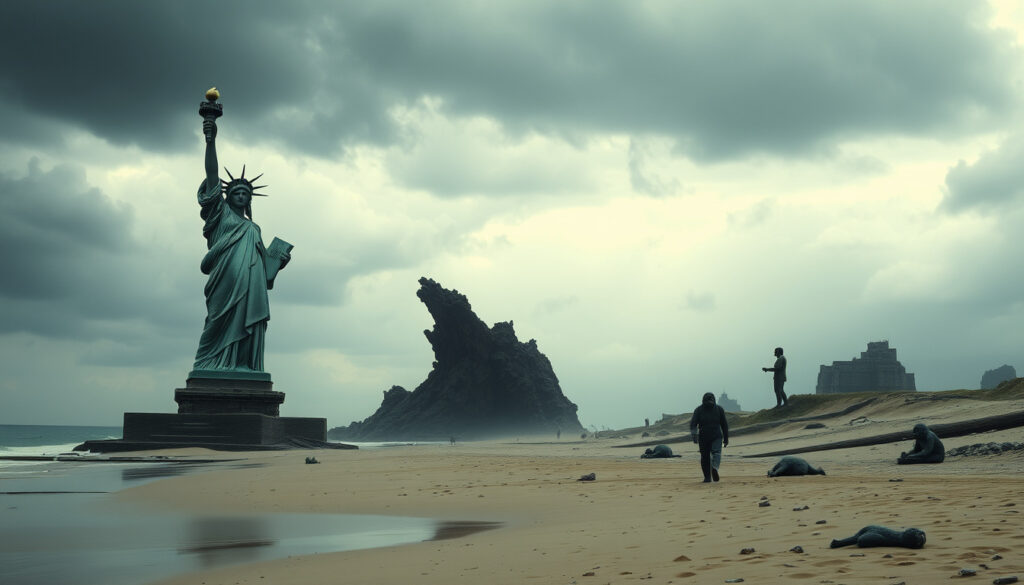
The most visceral complaint about the 2001 film is its ending. Instead of the famous Statue of Liberty reveal from the 1968 original — where astronaut George Taylor realizes he has been on Earth all along — Burton’s film shows an ape version of the Lincoln Memorial, implying apes have always ruled this timeline (IGN (film criticism outlet)). The twist introduces a time paradox that left many viewers confused rather than thrilled.
Burton swapped a gut-punch political allegory for a puzzle-box ending. Fans of the original got intellectual confusion, not emotional devastation.
Inconsistent character motivations
Critics also flagged weak character development. Mark Wahlberg’s Captain Leo Davidson shifts from determined astronaut to reluctant rebel without a clear arc. Tim Roth’s General Thade is a snarling villain, but his motives — beyond simple ape-supremacy — remain opaque (Rotten Tomatoes (review aggregator)). The film’s pacing lurches from action set-piece to exposition dump, leaving little room for the philosophical weight that made the original memorable.
Mixed reviews from critics and audiences
- Critic score: 45% on Rotten Tomatoes (Rotten Tomatoes (review aggregator))
- Audience score: 33% on Rotten Tomatoes (Rotten Tomatoes (review aggregator))
- IMDb rating: 5.7/10 (IMDb (user ratings database))
The implication: the audience gap (33% vs 45% critics) is unusually wide for a blockbuster, signaling genuine fan disappointment beyond critical dismissal.
Why was Tim Burton’s Planet of the Apes so poorly received?
Comparison to the original 1968 film
The original Planet of the Apes (1968) directed by Franklin J. Schaffner was a social commentary on nuclear war, prejudice, and religion — wrapped in a sci-fi package (Wikipedia (film encyclopedia)). Fans walked into the 2001 version expecting at least a respectful update. Instead, they got a jungle-heavy action film that stripped away almost all the allegorical content.
Burton’s creative style versus franchise expectations
Tim Burton is known for gothic fantasy — Edward Scissorhands, The Nightmare Before Christmas, Sleepy Hollow. His visual signature (spindly trees, exaggerated prosthetics, whimsical darkness) clashed with the gritty, grounded aesthetic of the Apes franchise. While the ape makeup was widely praised — especially Rick Baker’s work — the design leaned cartoony in places, undermining the threat level of the ape empire (Rotten Tomatoes Reviews (critic consensus hub)).
Audience disappointment and legacy impact
The 2001 film became a cautionary tale. Mark Wahlberg later told The Guardian (UK newspaper) that he regretted the “monkey show,” acknowledging the film didn’t deliver. Helena Bonham Carter’s character Ari — a rare human-sympathizing chimpanzee — was singled out as a bright spot, but one performance couldn’t salvage the whole.
Why was there no sequel to Planet of the Apes 2001?
Financial performance and studio expectations
On paper, $362 million worldwide against a $100 million budget looks like a success (Box Office Mojo (box office tracker)). But studio math is more complex. After marketing costs — often estimated at $50–$80 million for a blockbuster of this scale — and the contractual splits with theaters, the net profit margin was thin. For a film expected to launch a multi-film franchise, that margin was unacceptable to 20th Century Fox.
Twentieth Century Fox faced a choice: invest another $150 million in a sequel to a poorly reviewed film, or cut losses and wait for a fresh start. They chose the latter.
Critical reception and franchise viability
A Rotten Tomatoes score of 45% and an audience score of 33% signaled deep brand damage (Rotten Tomatoes (review aggregator)). Studios rarely launch sequels from negatively reviewed films unless the opening weekend is enormous. Planet of the Apes opened to $68.5 million in the US — strong — but word-of-mouth dropped it 60% in the second weekend. The trend was clear: audiences weren’t coming back.
Cancellation of planned follow-up
In early 2002, Fox formally canceled the sequel. A script by Joel Schumacher — who had been attached to direct — was written but scrapped after poor test screenings (Den of Geek (entertainment news site)). The cancellation left the franchise dormant until 2011, when Rise of the Planet of the Apes rebooted the series from scratch, ignoring Burton’s continuity entirely (Empire Online (film magazine)).
Is Planet of the Apes 2001 a remake of the original?
Plot similarities and differences
Both films share the same core premise: an astronaut crash-lands on a planet where apes are the dominant species and humans are primitive. But the similarities stop there. The 1968 film ends with Taylor discovering the Statue of Liberty — proving he never left Earth. The 2001 film ends with Davidson discovering an ape Lincoln Memorial on present-day Earth after time-traveling forward, creating a loop (Wikipedia (film encyclopedia)).
Intent of the 2001 film
Burton has described his version as a “reimagining” rather than a direct remake. The astronaut starts from spaceship Oberon in 2029 and travels through a magnetic storm — not a fresh take on the original’s warning about nuclear annihilation but a new time-travel mechanism. The script went through multiple rewrites by William Broyles Jr., Lawrence Konner, and Mark Rosenthal, reflecting the studio’s indecision about how faithful to be.
How it fits in the franchise
It doesn’t. The 2001 film is a standalone reimagining with no connection to the original 1968–1973 series or the 2011–2024 reboot trilogy. The later reboot series (starting with Rise of the Planet of the Apes) explicitly ignores its continuity (Empire Online (film magazine)). For watch-order purposes, the 2001 film belongs to its own alternate timeline.
In what order should I watch Planet of the Apes?
Release order versus chronological order
For newcomers, release order is simplest: start with the original 1968 film, then Beneath (1970), Escape (1971), Conquest (1972), Battle (1973). Then jump to the 2011 reboot trilogy: Rise (2011), Dawn (2014), War (2017), and Kingdom (2024). The 2001 film is entirely optional — watch it last if curiosity strikes, or skip it entirely.
The chronological order (in-universe) starts with Rise of the Planet of the Apes (2011), which shows the virus that creates intelligent apes, then Dawn, War, and Kingdom. The original 1968–1973 series happens later in the timeline (simian flu wiped humanity thousands of years before the original’s setting). Screen Rant (film guide site) breaks this down comprehensively.
Including or excluding the 2001 film
The 2001 film is best treated as standalone viewing. It does not affect any other film’s plot. Viewers who want to understand the franchise’s full cultural history should watch it once. Everyone else can safely skip — the 2011 reboot was designed as a clean entry point.
Best viewing order for newcomers
- Option A (release order, includes originals): 1968 → Beneath → Escape → Conquest → Battle → (optional 2001) → Rise → Dawn → War → Kingdom
- Option B (modern timeline only): Rise (2011) → Dawn (2014) → War (2017) → Kingdom (2024)
- Option C (chronological in-universe): Rise (2011) → Dawn (2014) → War (2017) → Kingdom (2024) → 1968 → Beneath → Escape → Conquest → Battle
Digital Spy (entertainment news site) recommends Option B for anyone who just wants to see the best the franchise has to offer.
The pattern: the 2001 film is the only entry that creates confusion — removing it from any watch order improves clarity.
What are the five Planet of the Apes movies from the original series?
List of original films
| Film | Year | Director |
|---|---|---|
| Planet of the Apes | 1968 | Franklin J. Schaffner |
| Beneath the Planet of the Apes | 1970 | Ted Post |
| Escape from the Planet of the Apes | 1971 | Don Taylor |
| Conquest of the Planet of the Apes | 1972 | J. Lee Thompson |
| Battle for the Planet of the Apes | 1973 | J. Lee Thompson |
The implication: the original series is a self-contained story arc that moves from discovery to devastation to a fragile peace, with each film escalating the stakes. None of these connect to the 2001 or 2011 films.
Timeline
- : Original Planet of the Apes film released (Wikipedia (film encyclopedia))
- : Development of a new Planet of the Apes film begins at Fox
- : Tim Burton signs on to direct (Wikipedia (film encyclopedia))
- : Principal photography
- : Planet of the Apes (2001) released (The Numbers (box office data site))
- : Mixed reviews and audience disappointment emerge
- : Fox cancels planned sequel (IMDb Trivia (film database))
- : Rise of the Planet of the Apes launches successful reboot trilogy (Empire Online (film magazine))
The catch: the entire 2001 experiment took less than three years from Burton signing to sequel cancellation.
The 2011 reboot learned every lesson the 2001 film ignored: a coherent script, a clear political angle, and a performance-capture ape (Andy Serkis’s Caesar) that audiences could root for emotionally.
Clarity: confirmed and unclear
Confirmed facts
- The 2001 film was directed by Tim Burton (Wikipedia (film encyclopedia))
- It earned $362 million worldwide on a $100 million budget (Box Office Mojo (box office tracker))
- A sequel was planned but canceled in 2002 (Den of Geek (entertainment news site))
- Rotten Tomatoes critic score is 45% (Rotten Tomatoes (review aggregator))
- The ending features an ape version of the Lincoln Memorial (IGN (film criticism outlet))
What remains unclear
- Exact box office profit/loss after marketing costs
- Specific reasons for Fox’s cancelation decision beyond public statements
- Whether a different director or script would have resulted in a sequel
Key quotes
“It was a monkey show.”
— Mark Wahlberg, in an interview with The Guardian (UK newspaper)
“Tim Burton’s Planet of the Apes is a noisy, pointless and visually charmless special effects extravaganza that doesn’t have a thought in its head.”
— Roger Ebert, film critic for the Chicago Sun-Times (RogerEbert.com (critic archive))
“The remake is a mess of conflicting tones and half-baked ideas.”
— Reviewer for IGN (film criticism outlet)
“We had a sequel script written by Joel Schumacher that was tested and just didn’t work. It became clear that the audience needed a fresh start.”
— Tom Rothman, former Fox executive, as reported by Den of Geek (entertainment news site)
Summary
Tim Burton’s Planet of the Apes (2001) remains a textbook example of a failed relaunch: a $100 million film that grossed $362 million but satisfied no one. For Fox, the lesson was that a blockbuster needs both box office and brand trust to sustain a franchise. The studio ultimately chose to kill the sequel rather than pour good money after bad — a decision that let the 2011 reboot start fresh and succeed where Burton’s vision failed.
For those looking to place the 2001 film in context, the complete franchise watch order provides a helpful guide to all ten films across the different continuities.
Frequently asked questions
What was the plot of Planet of the Apes 2001?
Astronaut Leo Davidson (Mark Wahlberg) crash-lands on a planet where intelligent apes rule over mute humans. He leads a rebellion and time-travels back to Earth, where he discovers apes have always ruled.
Who played the main characters in the 2001 film?
Mark Wahlberg played Captain Leo Davidson, Tim Roth played General Thade, Helena Bonham Carter played Ari, Michael Clarke Duncan played Attar, and Paul Giamatti played Limbo.
How much money did Planet of the Apes 2001 make?
It grossed $362 million worldwide against a $100 million production budget, according to Box Office Mojo (box office tracker).
Was Tim Burton satisfied with Planet of the Apes 2001?
Burton has expressed disappointment with the final film, noting that studio interference and rushed production prevented him from realizing his vision.
Did the 2001 film connect to the later reboot trilogy?
No. Rise of the Planet of the Apes (2011) ignores the 2001 film entirely, as confirmed by Empire Online (film magazine).
What did critics say about the ape makeup in 2001?
Rick Baker’s prosthetic ape makeup was widely praised, with many critics calling it the film’s strongest element despite the overall negative reviews.
Why did Tim Burton want to remake Planet of the Apes?
Burton was a fan of the original film and wanted to put his own creative stamp on the concept. He signed on in 1999, as documented by Wikipedia (film encyclopedia).
Are there any deleted scenes or alternate endings for the 2001 film?
Yes. A longer cut with additional character development exists, but the film’s official ending — the ape Lincoln Memorial — was the one used in theaters.
Related reading
- Black Panther (film): Cast, Boseman’s Health & Box Office Facts
- Fear the Walking Dead: Before or After TWD Timeline?
More related posts
 Discover High Yield Savings – Rates, Review and Comparison
 28 Years Later Alpha Zombie Hung: Chi Lewis-Parry
 Sweet Treats Near Me: Best Local Desserts & Delivery in Ireland
 Pee-wee’s Big Adventure: Parents Guide, Streaming & Scandal
 How Long Do COVID Symptoms Last? Timeline & Recovery
 Milwaukee Brewers vs Dodgers Timeline: 2025 NLCS
 Studio Apartments Near Me: Best Dublin Rentals & Deals (2025)
 Another Word for Ensure: Synonyms, Examples & Contexts