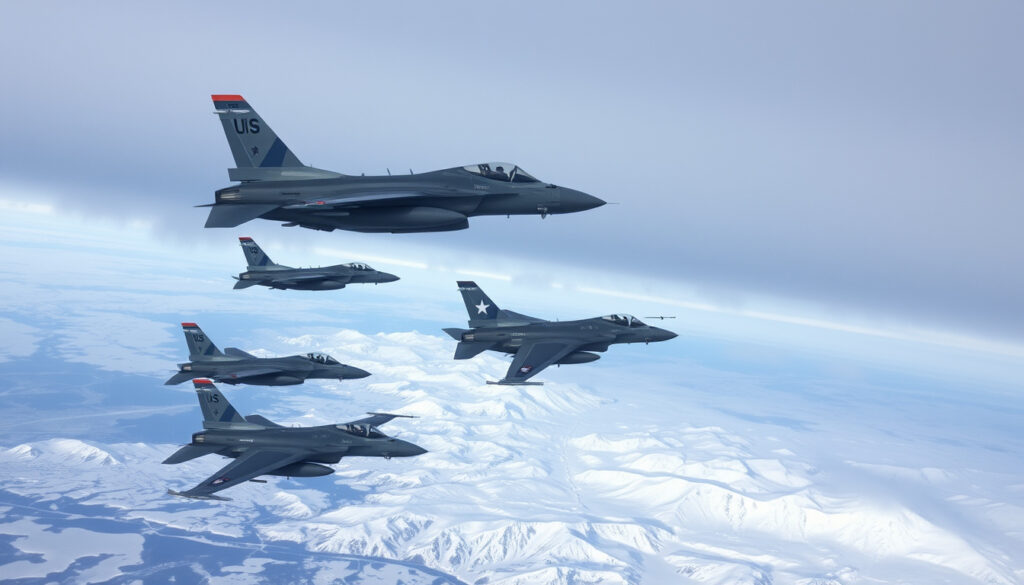
US Intercepts Five Russian Warplanes Near Alaska: NORAD Scrambles F-16s and F-35s in Arctic Response
For a few tense hours over the Bering Strait, the US military scrambled jets to intercept a squadron of Russian warplanes that had entered the Alaskan Air Defense Identification Zone. On February 19, 2026, NORAD launched a multi-aircraft response that included F-16s, F-35s, an AWACS, and tankers to track and escort the formation – a routine but notable demonstration of Arctic air policing.
Intercept Date: February 19, 2026 ·
Russian Aircraft Detected: 5 (bombers, fighters, spy plane) ·
US Aircraft Scrambled: 2 F-16s, 2 F-35s, 1 E-3, 4 KC-135s ·
Intercept Zone: Alaskan Air Defense Identification Zone (ADIZ) ·
Command: NORAD
Quick snapshot
- US operates F-22 and F-35 (stealth) (Stars and Stripes)
- Russia operates Su-57 and Su-35 (The Hill)
- No clear overall superiority; context-dependent (The Aviationist)
- Russia sold Alaska to the US in 1867 (NORAD)
- Sale price: $7.2 million (NORAD)
- Driven by economic strain and colonial competition (NORAD)
Five key facts from the intercept, one pattern: the military response reflects a carefully calibrated posture designed to deter without escalating.
| Fact | Value |
|---|---|
| Intercept Date | February 19, 2026 |
| Russian Aircraft | 5 (bombers, fighters, spy plane) |
| US Aircraft | 2 F-16s, 2 F-35s, 1 E-3, 4 KC-135s |
| Location | Alaskan Air Defense Identification Zone |
| Command | NORAD |
What happened when US intercepted five Russian warplanes?
Which US fighter jets were scrambled?
- Two F-16s and two F-35s were launched by NORAD to intercept the Russian formation (NORAD press release).
- An E-3 Sentry (AWACS) provided airborne radar coverage, while four KC-135 tankers supported the mission (Reuters).
- The F-35s, with their stealth and sensor fusion, likely acted as the primary trackers while F-16s provided visual identification (Stars and Stripes).
Where did the intercept occur?
The intercept took place in the Alaskan Air Defense Identification Zone (ADIZ), a buffer of international airspace where aircraft are expected to identify themselves for national security purposes (NORAD). The zone extends from Alaska’s coastline into the Bering Strait region. The Russian aircraft were operating near the Bering Strait when detected (Associated Press). Importantly, NORAD emphasized that the aircraft remained in international airspace and did not enter US or Canadian sovereign airspace (NORAD).
What was the Russian aircraft composition?
According to multiple sources, the Russian formation consisted of two Tupolev Tu-95 bombers, two Sukhoi Su-35 fighter jets, and one Beriev A-50 airborne early warning aircraft (The Hill). This is a classic long-range training package that Russia has used for decades to test NATO and US reaction times (The Aviationist).
For NORAD, this intercept was a textbook demonstration of layered response. The mix of stealth fighters, interceptors, and tankers ensured the Russian aircraft were continuously tracked from detection until departure — a capability that has been refined over years of Arctic patrols.
The implication: this intercept underscores that NORAD treats every incursion into the ADIZ as a readiness drill, even when the event is routine. The response speed and aircraft mix are designed to send a clear signal of defensive capability without crossing into provocation.
Bottom line: NORAD’s layered response to the Russian formation confirmed that the alliance treats ADIZ incursions as routine readiness drills, using a mix of stealth and conventional fighters to maintain deterrence without escalation.
How close is Russia to the U.S. in Alaska?
Which U.S. state is 2 miles from Russia?
The answer is Alaska. At the Bering Strait, the islands of Little Diomede (United States) and Big Diomede (Russia) are only about 2.4 miles apart at their closest point. During winter, the strait can freeze, creating an ice bridge between the two islands, but crossing on foot is extremely dangerous and illegal without proper authorization.
The Bering Strait’s narrow width means Russian aircraft can reach the ADIZ within minutes of takeoff from Chukotka, making the geographical gap a operational reality for NORAD.
The pattern: the physical proximity between the two nations makes the ADIZ a critical early-warning buffer. Russian aircraft can reach US-claimed airspace minutes after takeoff from bases in Chukotka.
Can you cross from Russia to Alaska by car?
Can you walk across the Bering Strait when it freezes?
Technically, yes, the Bering Strait freezes in winter, and people have crossed on foot between the Diomede Islands. However, it is illegal without permission from both border authorities, and the ice conditions are unpredictable. No road or bridge connects the two continents.
Can you legally cross the Bering Strait?
Legal crossing requires a visa and must be done through official ports of entry. Attempting to cross the strait without authorization is considered illegal entry into either country and can result in detention. The US Coast Guard and Russian border patrol both actively monitor the area.
The catch: while geography makes Alaska a literal stone’s throw from Russia, the legal and physical barriers keep the two worlds separated at that narrow gap.
Who has better fighter jets, the USA or Russia?
What is the most feared fighter jet in the world?
There is no definitive answer, but the US F-22 Raptor and Russian Su-57 Felon are often cited as the most feared. The F-22’s stealth and supercruise capability give it air superiority, while the Su-57 brings advanced sensors and maneuverability. The F-35, though less agile, offers integrated sensor fusion that makes it a formidable network node. In the February 2026 intercept, the presence of both F-35s and F-16s shows how the US blends high-end stealth with proven airframes for mission flexibility.
| Model | Country | Stealth | Primary Role |
|---|---|---|---|
| F-22 Raptor | USA | Yes | Air superiority |
| F-35 Lightning II | USA | Yes | Multi-role / sensor fusion |
| Su-57 Felon | Russia | Yes (limited) | Air superiority / strike |
| Su-35 Flanker-E | Russia | No | Air superiority / multi-role |
Arctic airspace is becoming a testing ground for next-gen fighter tactics. Both the US and Russia are increasingly deploying their newest aircraft — F-35 and Su-57 — to the region, meaning these intercepts will become more technologically complex over time.
The trade-off: the US relies on technological edge and global basing; Russia relies on mass and forward deployment. In a one-on-one engagement scenario, pilot training, logistics, and electronic warfare play decisive roles.
Why did Russia sell Alaska to the USA?
Do any Russians still live in Alaska?
Russia sold Alaska to the United States in 1867 for $7.2 million (roughly 2 cents per acre). The sale was driven by Russia’s economic strain after the Crimean War and the fear that Britain would seize the territory. Today, a small number of ethnic Russians live in Alaska, mainly descendants of Old Believers and post-Soviet immigrants, but they make up a tiny fraction of the state’s population.
Why this matters: the historical sale set up the current geopolitical reality — a US state bordering Russia, where the Bering Strait is both a natural boundary and a flashpoint for military posturing.
Confirmed facts
- US intercepted 5 Russian warplanes (2 Tu-95, 2 Su-35, 1 A-50) in Alaskan ADIZ on Feb. 19, 2026 (NORAD)
- NORAD launched 2 F-16s, 2 F-35s, 1 E-3, 4 KC-135s (NORAD)
- Aircraft remained in international airspace (NORAD)
What’s unclear
- Exact reason for Russian flight not officially stated
- Whether this is linked to broader Arctic exercises
- Precise flight path and duration of ADIZ incursion
- Incident reported by multiple Tier-2 outlets (AP, Reuters, The Hill, UPI, Stars and Stripes) but no single source confirms all details
Timeline signal
- February 19, 2026: NORAD detects and tracks Russian aircraft in Alaskan ADIZ; launches F-16s, F-35s, E-3, KC-135s to intercept (NORAD)
- February 20, 2026: AP, Reuters, and other outlets report the intercept (Associated Press; Reuters)
- Later: DVIDS releases video of the intercept (F-16s identifying Tu-95 and Su-35) (DVIDS)
“NORAD said this type of activity occurs regularly and is not seen as a threat.”
— NORAD spokesperson, as quoted by Associated Press
“The Russian formation was operating near the Bering Strait when NORAD detected it.”
— Associated Press report, AP News
The Feb. 2026 intercept is not an isolated event — it fits a long pattern of Russian long-range aviation probing the Alaskan ADIZ. For US commanders, each intercept is a chance to validate readiness. For the public, it’s a reminder that the Cold War’s geographic chessboard remains active in the Arctic.
Related reading: US fighter jets intercept Russian warplanes near Alaska · NORAD jets intercept Russian aircraft near Alaska
usnews.com, upi.com, fm.kuac.org, ctvnews.ca, nationaltoday.com
Frequently asked questions
What does NORAD stand for?
NORAD stands for North American Aerospace Defense Command, a combined US-Canada organization responsible for monitoring and defending the airspace over North America.
What is the Alaskan Air Defense Identification Zone?
It is a buffer of international airspace around Alaska where aircraft are required to identify themselves for security purposes. It is not sovereign airspace, but it allows NORAD to monitor incoming aircraft.
How often does NORAD intercept Russian aircraft?
Multiple times per year. Russian long-range aviation flights near Alaska occur regularly, and NORAD scrambles jets each time they enter the ADIZ.
Why do Russian military aircraft enter the ADIZ?
Russia typically conducts these flights as training exercises or to test reaction times of US defense systems. They are rarely considered direct threats.
What is the purpose of NORAD?
NORAD provides aerospace warning, air sovereignty, and defense for the US and Canada. It detects, tracks, and if necessary, intercepts aircraft that may pose a threat.
How does the US detect Russian aircraft over Alaska?
Through a network of ground-based radars, airborne early warning aircraft (E-3 AWACS), and satellite surveillance. Once detected, fighter jets are launched for visual identification.
For US defense planners in the Arctic, the February intercept is a clear signal: Russia continues to invest in long-range aviation capability, and the ADIZ will remain a daily flashpoint. For US taxpayers, the cost of maintaining rapid-response air patrols in Alaska is an investment in strategic deterrence. The alternative — allowing Russian aircraft to operate unchecked — would degrade the credibility of the ADIZ and embolden more aggressive probing.
More related posts
 The Incredible Hulk Cast: Norton, Tyler, Roth & More (2008)
 High Chloride Blood Test: Causes, Treatment, and When to Worry
 James Gunn Movies and TV Shows – Complete Filmography and Rankings
 Fox News Live Stream Free: Best Options Without Cable
 Case Western Reserve University: Prestige, Rankings & Facts
 Sweet Treats Near Me: Best Local Desserts & Delivery in Ireland
 What Does Magnesium Do? Benefits for Body, Sleep & More
 Pdf Editor Online Free – Best No Watermark Tools 2025